Author: kwetoday

Why Doesn’t Kim Pate Know What the Bedford Case Was About?

Yes, all over this!

sarah m's avatarautocannibal

For those who don’t know, Kim Pate is the executive director of the Canadian Association of Elizabeth Fry Societies, a national association that represents a group of local social service organizations, all named for the Quaker prison reformer Elizabeth Fry. Their mission is to reduce women’s incarceration in Canada.

Elizabeth Fry Societies help women access legal aid, run diversion programs that women can be sentenced to complete instead of going to prison, supervise probation and community service, offer assistance meeting basic food and shelter needs, offer counselling and therapy, help women get pardons and do other stuff related to the general idea of making life a little easier for criminalized women. If you can swallow the smug self-righteousness that social workers seem to be trained in, and if you ignore the fact that “reform” and “collaboration with the criminal justice system” are very much one and the same here…

View original post 1,462 more words

X is for XXX (Part 2! :-D): Bedford SCC Decision! :-D – Greater Granola Blog Project 2013

Love this video by @pivotlegal #BedfordSCC

Ms Syren's avatarsyrens

Okay, so by now I think everyone who reads this has probably already heard the news, but: WE WON!!! 😀 😀 😀
 
The Supreme Court of Canada unanimously struck down the three laws (Bawdy House, Communications, and Living Off The Avails) that the Bedford case challenged. The above link goes to the full text of the SCC Decision, but if you want the key points, you can check out Pivot Legal’s 705 Word Version.
 
You can read POWER’s press release here, while Maggie’s is available here.
 
 
Now it’s not all roses, of course. When is it ever?
Parliament, with it’s Conservative majority, has a year to come up with a different set of laws through-which to regulate sexwork in Canada (a number of friends in the business are expecting to be lobbying against a Nordic Model that criminalizes clients[1] in the near future…

View original post 176 more words

The #NordicModel and the CPC approach to #BedfordSCC

Awww isn’t this sweet, the cons want to help the hookers… no wait, they want to help women because hookers are a different class of people altogether in their eyes. But for real, this is how the Othering of sex workers that their bed buddy, Sun News, contributes to the violence and whorephobia that they experience. Is it really all that hard to refer to sex workers as sex workers and not prostitutes, prostituted women, or hookers? I get the right to self determination as some sex workers refer to themselves as hookers or prostitutes but only to reclaim the word and sometimes to refer to the history and legality of the word (Source). For real though, sex workers, is it all that hard?

Also, the cons attempts to address the SCC decision is a step in the wrong direction. If you weren’t angered after reading this article, entitled “Conservatives set to replace prostitution laws to help sex workers,” then you probably missed the gaps in their argument to criminalize the buyers or adopt the Nordic Model.

Let’s be honest, the cons aren’t helping sex workers by implementing the Nordic Model. In fact, much of the successes associated with this model have been refuted as myths. A talk that was given Mary Len-Skillbrei (Associate Professor at University of Olso) and Charlotta Holmstrom (Assistant professor at Malmo University) outlines the myths of the Nordic Model. Refuting this model as a myth is based on their research since the nineties and a large comparative study in 2007-2008 in which they “examined how Denmark, Finland, Iceland, Norway and Sweden approach prostitution through criminal justice and welfare policies, and reviewed the evidence for how these policies impact Nordic prostitution markets and the people who work in them” (Source).  They found that there were too many differences for there to be a “Shared Nordic Model” which suggests that referring to multiple countries to apply a model to one country is bound to be rife with difficulties. They also found that the success that is similarly praised by the Conservatives and the abolitionists (the antis) “is far more fraught than popular support would suggest” (Source). Even when the antis assume that this will help victims or prevent trafficking, this model actually “produce negative outcomes for people in prostitution” (Source). In fact, it has been cited that policies such as these produce an offshoot of bylaws, regulations, and other policies that negatively affect those involved in the trade. This article actually makes it very clear that when the antis say they only want to help and save women and young girls in the trade, the opposite happens. The authors state, that the other policies that arise because of this model “assume that the women who sell sex are to be punished and blamed for prostitution” (Source). As outlined by the authors, what is even more revealing of the model is how it treats migrant workers.

What is not commonly known when people cite the Nordic Model is the way it treats migrant women. Sweden even has an act that is entitled “Aliens Act” (oh how nice!) that prevents migrant women from selling sex. The authors state the problem with this concisely:

This reveals the limits of the rhetoric of female victimisation, with clients framed as perpetrators: if the seller is foreign, she is to blame, and can be punished with deportation. (Source)

Just exactly how is this model and its subsequent policies supposed to protect those that are “trafficked” if they are being deported? Helloooooo violence!

Then in Norway, the individuals *ahem* the victims that the model is meant to protect actually produce more negative and harmful effects on their lives. The whole basis of decriminalization is to highlight the contradictions with criminalization. The antis attempt to argue that the decriminalization will lead to more victimization and exploitation of those in trade, when in fact, the victimization and exploitation happens due to the Canada’s ambiguous nature of their quasi-criminal state of the trade. As such, the antis then support the criminalization of the buyers (which is essentially the Nordic Model in its simplest terms). However, what the antis fail to acknowledge is that the Nordic Model contributes to increased policing, neighbor and border controls which “stigmatize them and make them more vulnerable” (Source). This the same outcome of Canada’s ambiguous, quasi-criminal laws that police the trade which is supported by numerous reports/documents that are very recently published. For example, in this document entitled “10 reasons to fight decriminalization” outlines how criminalization “fosters violence” of not only women in the trade but also men and trans sex workers. What does that say about us as a society when we ignore a whole class of people and their lived experiences in the trade all in the sake of a moral crusade to police sex and sexual identities? Exactly. Exchanging one criminal law for another criminal law is exactly the same thing as what it was before: CRIMINALIZATION!

Finally, the authors of the article cited throughout this post actually highlight that the most often cited report by the antis describing its success only looks at women who are in contact with social workers and police. So this is not an accurate representation of the effects of the model and clearly suggests that the only way the effects are measured are due to contact with the police. Do you see the contradictions with that argument? No. Then let me spell it out for you: the only way one can receive help and the way in it is measured is the contact that one has with increased policing. Yeahno. Not ideal for migrant, racialized, or indigenized sex workers. In reality, the antis argument for the Nordic Model to protect victims and trafficking victims does the exact opposite.

So when Public Safety Minister Blaney says “the government will find another way to help women because prostitution turns people ‘into real modern slaves.’” What he really means is that the conservatives just wish to further subjugate women to people who are incapable of making the choices for themselves or having agency, similar to the abolitionists approach to the decriminalization/criminalization debate. Also, if all prostitution is slavery, then what does that mean? Conflating prostitution with slavery actually ignores the lived experiences of those who are in experience slavery and ignores the history of the slave trade. While yes some women were sexualized and raped during their lives as slaves, this does not mean that they were prostitutes, and saying that they were/are does an injustice to the key issues: the safety and security of individuals.

And no, Minister Blaney, this is not what many cases of prostitution is all about. What is harmful for women is subjugating them to beings that are incapable of making choices about their lives and their livelihood, and preventing them the safety and security affording to other citizens in Canada. Prostitution doesn’t turn women into human trafficking victims because prostitution isn’t trafficking. Even though prostitution isn’t actually defined in the Criminal Code, it has been defined by case law. This definition includes three main elements: the provision of sexual services, the essentially indiscriminate nature of the act, and the necessity for some form of payment (Source). Yup, the definition of prostitution does not include anything in relation to the definition of human trafficking. While the human trafficking definition refers to prostitution or sexual services, it fails to differentiate itself (human trafficking vs. prostitution) which is problematic in and of itself. These problems are demonstrated when one is actually charged with trafficking in Canada. As it goes, the fact is that human trafficking charges in Canada tend to be reduced to other charges because it doesn’t meet the threshold for trafficking elements. What does this exactly mean? Do we need more strict laws? No. What it means is that by conflating trafficking with prostitution just means that it does nothing for the safety and security of individuals that occupy either side of the argument. Also, by ignoring the voices of sex workers in the trade contributes to the problem that you, Mr. Blaney, are trying to prevent: removing their own identity. It says that sex workers don’t exist and don’t matter in this discussion. When, in reality, they matter because they are the real experts on the trade. Further using sensationalistic words and phrases, or the most extreme cases (like those who are addicted to drugs and also engage in sex work) is problematic, and also despicable.

Ugh. Despicable, Mr. Blaney.

So when the conservatives and the abolitionists argue that they are fighting for gender equality by criminalizing the trade or getting rid of prostitution, what they really mean is they are fighting for gender equality for a particular type of women, and that they are anti-human rights and anti-immigration.

#BedfordSCC My thoughts

Today was such an important day for the sex work community. If you didn’t know what happened today with respect to Canada’s anti-prostitution laws, then I feel really bad for you. You missed out on history making!

Earlier today (approximately 9:45am) the Supreme Court of Canada (SCC) delivered their decision relating to what the media and others refer to as the “Bedford Case” or more correctly, Attorney General of Canada v. Terri Jean Bedford, Amy Lebovitch, and Valerie Scott. You can read the entire decision or you can read this succinct piece by PIVOT. I recommend the PIVOT article if you only have a few moments but if you have some time, read or glance over the entire decision.

The specific sections in the Criminal Code of Canada that were challenged included Section 210, 212(1)(i), and 213(1)(c). Section 210 is commonly referred to as the bawdy-house law and it states that it is criminal for anyone to “own, operate, or even be in a bawdy house.” Section 212(1)(i) is sometime referred to as the living on the avails law and it states that it is criminal for someone to benefit from the sexual labour of another. Section 213(1)(c) is referred to as the communication law in layman terms and it stresses that communicating with anyone for the purposes of prostitution in a public place is criminal.

All three laws were struck down as unconstitutional. This is a big win for the sex work community because this isn’t the first time they fought against these laws. Many thought that the case would be decided the same way it had be in the 90s. While others thought that the SCC would reaffirm the Ontario Court of Appeal decision which stated that section 210 and 212 were unconstitutional but section 213 was attaining its legislative objective (albeit in a grossly disproportionate manner). This is a big win because it says that sex work and sex workers matter. It says that sex work and sex workers are persons in the community and their safety and security is just as important as non-sex workers. Because, surprise! Sex workers are people too! This decision also was unanimous meaning 9-0 (and there are 9 SCC Justices) agreed. Tres fuckin cool!

It was a whirlwind of feelings for me. Also, a lot of people have been sharing my blog post entitled “Exploration on Indigenous Lands and Exploitation of Indigenous Bodies.” Take some time to read that too! But I talk about it briefly below.

In this blog post, I talk about the history of the common bawdy house laws (and how our prostitution laws came to be). What is unfamiliar to people who know very little about sex work or Canada’s anti-prostitution laws is that the original laws were first enacted under the Indian Act. Does this mean that Indigenous women and girls were overly sexual beings? Not necessarily. I mean, we did have sex and we were sexual. However, the social construction of the prostitute can be traced back to colonialism. This is not to say that we should get rid of prostitution because this, for some people, this is their livelihood. But hellooooo, we should get rid of colonialism!

To expand on this a bit…certain relations were encouraged for economic, political, and social reasons, namely relations between settlers and Indigenous women (Mawani, 2001). However, as more white people, including white women, arrived in Canada, relations with Indigenous women were no longer seen as desirable. In fact, Indigenous women were seen as a threat to whiteness (or more correctly, a threat to Canada). Then with the Confederation of Canada, the Indian Act was enacted. Following the enactment of the Indian Act, there were several sections relating to prostitution that were included (Boyer, 2009). One of these sections include the bawdy house section. The original bawdy-house law only targeted Indigenous homes or wigwams, and by the very definition of wigwams, it assumed wigwams were disorderly (Boyer, 2009). These sections only targeted Indigenous people as a group. Further, by the very definition of prostitute in this legislation, it assumed all Indigenous women were prostitutes (Mawani, 2001). Then, by 1892, the Criminal Code of Canada was enacted, and all sections pertaining to prostitution were removed from the Indian Act and placed in the Criminal Code of Canada (CCC)(Boyer, 2009). By moving the prostitution sections from the Indian Act to the CCC, it facilitated the transition of prostitution as socially unacceptable to both criminally and socially wrong. The transition of prostitution to being criminal wrong also reduced the status of those who engaged in the trade even further.

When we begin to look into the history of these laws and how they came to be, we can begin to understand how they truly affect the social and the bodies within the social. We live in a colonial state, and the goal of the colonial state is to get rid of the Indian Problem. Indigenous bodies were only useful insofar they did not interfere with the colonial agenda: to dominate and control Indigenous lands. Once these bodies began to interfere with the colonial agenda, not only do Indigenous lands have to be dominated and controlled, but now the bodies must be dominated and controlled. What is the way to dominate and control Indigenous bodies? Just take a look at the stats for missing and murdered Indigenous women or the increasing numbers of Indigenous peoples in prison. And let me be clear here, constructing Indigenous people as a threat to Canada has not changed. Just take a look at the aggressive policing tactics when it comes to economic exploitation of their lands. Elsipogtog anyone?

So what do I think of Bedford? I am ecstatic! It is a fight against the colonial state and they lost. Some people are crying out against this decision because they assume it will lead to more exploitation, like human trafficking. Human trafficking isn’t sex work and sex work isn’t human trafficking. Also, some argue that prostitution is inherently violent because all prostitution is rape. No. All prostitution  is not rape because all rapes are not prostitution. Besides, that trivializes actual real rapes. Yes, victimization happens but that doesn’t mean that there isn’t help for those who need it. There are tons of organizations dedicated to helping victims–let their work continue but let’s not place others in more risk to experience violence because others believe that sex work is inherently violent (because it’s not) or degrading (also…because it’s not). Much of the exploitation or violence that occurs is because of the social construction of the prostitute as a social problem, a social evil. So, let’s a have a discussion about whorephobia while we are it! We need to make sure that we don’t take steps backwards by silencing those that will be affected most by these laws if and when the government steps in to write new laws that will affect the trade, the sex workers and the sex work community. Nothing without the sex work community!

References (not included in post links)

Mawani, R. (2001). “The ‘Savage Indian’ and the ‘Foreign Plague’: Mapping Racial Categories and Legal Geographies of Race in British Columbia, 1871-1925.” (PhD thesis). Retrieved from http://www.collectionscanada.ca/obj/s4/f2/dsk3/ftp04/NQ58938.pdf.

Boyer, Y. (2009). “First Nations Women’s Contributions to Culture and Community through Canadian Law.” In G. G. Valaskakis, M. Dion Stout & E. Guimond (Eds.), Restoring the Balance: First Nations Women, Community, and Culture (69-96). Winnipeg, MB: University of Manitoba Press.

#Indigenous #Sovereignty and Contradictions in Section 35(1)

CONTRADICTIONS OF Constitution Act, 1867-1982: Section 35(1)

Introduction

Located under Part I, Canadian Charter of Rights and Freedom, in Canada’s Constitution Act (1867-1982), the following phrase can be read, “Canada is founded upon principles that recognize the supremacy of God and the rule of law.” Within this section and the subsequent section, Part II, Rights of Aboriginal People in Canada, one can locate the sections pertaining to this specific population group. At first glance, it can be argued that Aboriginal peoples in Canada receive special or distinct rights from those granted to other Canadians. However, given their unique history with Canada, Aboriginal Peoples have a vested interest in preserving their rights to the land.  Section 35, under the heading, Rights of Aboriginal People in Canada, does just this. Yet, a question presents itself: how does using a colonial tool created by the colonizer benefit the colonized? One example of a colonial tool that was utilized by the colonizer was the Indian Act, 1867. This act was created to get rid of the Indian problem through forced assimilation and treating Indigenous peoples as inferior beings, as wards of the state (Shaw, 2008). The institutions, namely the church and residential schools, that sanctioned the violence against Indigenous Peoples proved to be fatal for Indigenous systems of being, specifically Indigenous women. The forced removal of children from their homes reduced Indigenous women’s roles in the community to nothingness, both as Indigenous people and women. Both the supremacy of God and the rule of the law legitimized this violence. Does Section 35 also follow the same lineage, as a tool developed by the colonizer to dominate and control Indigenous lands and access to their lands? This paper will outline the contradictions of the Constitution Act, 1867-1982, specifically the inconsistencies of Section 35(1) that deal specifically with Aboriginal right and title. I will argue that this is an extension of Canada’s colonial agenda to control and dominate Aboriginal People’s land and access to land, which in turn further subordinates Aboriginal women. First, I will outline the history of how this section was developed and adopted. Then, I will move into a discussion of Section 35(1), its scope, limitations, and contradictions. Although one might argue that this section is a step to reconcile relations between Aboriginal people and Canada, contrary examination provides evidence that this is another colonial tool to further the colonial agenda.

History of Section 35(1)

Section 35 of the Constitution Act states the following:

(1)  The existing aboriginal and treaty rights of the aboriginal peoples of Canada are hereby recognized and affirmed.

(2)  In this Act, “aboriginal peoples of Canada” includes the Indian, Inuit, and Metis people of Canada.

(3)  For greater certainty, in subsection (1) “treaty rights” include rights that no exist by way of land claims agreements or may be so acquired.

(4)  Notwithstanding any other provision of this Act, the aboriginal and treaty rights referred to in subsection (1) are guaranteed equally to male and female persons (Isaac, 2012, p. 19).

In the late 1970s, the then-Trudeau government began to introduce Constitutional reforms, namely to patriate the Canadian Constitution (Dupras, 1992). At this time, the decision to patriate the Canadian constitution was without consultation from Aboriginal peoples and it was not until 1981 to have discussions with Aboriginal leaders relating to these constitutional reforms soon commenced (Isaac, 2012, p. 19). The decision to include Aboriginal Peoples in the discussions relating to these reforms, however, were not due in part to the diplomacy or tact on behalf of the Canadian government. After vigorous lobbying at national and international levels in 1980, Aboriginal people were able to delay the quiet passing of these reforms and finally have their concerns recognized (Union of British Columbia Indian Chiefs UBCIC, n.d.). Aboriginal People’s concerns over these reforms specifically pertained to their fear that it would violate treaty commitments, damaging other rights through ending federal responsibility entirely (Dupras, 1992; UBCIC, n.d.). The initial constitutional amendments also did not include Section 25, which states that “the Charter would not derogate from Aboriginal or treaty right” (Smith, 2000). By the very action of ignoring Aboriginal People’s concerns only until after their intense lobbying demonstrates the Canadian government continued to see and treat Indigenous Peoples as inferior beings.

In January 1981, after Aboriginal Peoples shared their concerns with respect to treaties, their rights, and federal responsibility with the Canadian government via parliamentary committee, Section 25, 35, and 37 were soon drafted (Isaac, 2012, p. 19; Smith, 2000). After expressing concerns with the parliamentary committee, the original draft of Section 35 included the following, “the Aboriginal and treaty rights of the Aboriginal people are hereby recognized and affirmed” (Smith, 2000). However, after these discussions, these sections were not included in the draft amendment presented at a ministers’ conference later in 1981 (Isaacs, 2012, p. 19). In fact, true to form, the Canadian government excluded Aboriginal leaders from federal-provincial negotiations, which occurred over a period of four-days, wherein concern for Aboriginal rights was never raised (Smith, 2000). The decision to not include these sections that were developed in consultation, albeit after concentrated lobbying on behalf of Aboriginal leaders and excluding them from negotiations, is indicative of the colonizer’s paternalistic perspective of the colonized. Specifically, it highlights differential power relations between the colonizer and the colonized, and continues to see Indigenous people once again as inferior beings.

Eventually, by the time Section 35 was included within these constitutional amendments, the section included a specific reference to existing Aboriginal and treaty rights. This inclusion of the word “existing” was a last minute, long-distance conference call and included only conversations among the Premiers (Smith, 2000). The last minute, long-distance call underlines these differential power relations. Alberta’s Premier Lougheed expressed his concern over his suggestion to include the word existing “would create new aboriginal rights that were not previously recognized in law” [emphasis in original] (Smith, 2000). On November 18, the final resolution was introduced into parliament, was passed by the Commons on December 2, and then passed by the Senate on December 1981 (Smith, 2000). Finally, after being transmitted to the Parliament of the United Kingdom for passage, the amendments came into effect on April 15, 1982 (Smith, 2000).

Interpretation of Section 35

Thomas Isaac (2012), in Aboriginal Law: Commentary and Analysis, illustrates, on one hand, that Section 35 “had the effect of dramatically shifting Canada’s legal and constitutional regime regarding Aboriginal peoples, how their Aboriginal and treaty rights are to be protected, and the effect of such rights on Canadian society generally” (p. 16). However, on the other hand, Melvin H. Smith (2000) and Christina Yui Iwase (2012), respectively, describe it as an “empty box” (n.p.) and “confines Aboriginal rights claims and ultimately subordinate Aboriginal peoples to Crown Sovereignty” (p. 99). Further, Indigenous feminist Lee Maracle and lawyer and judge Mary-Ellen Turpel both agree that Section 35 rather “reinforces colonialism by recognized Canadian law as supreme” and that it is an “acknowledgement of colonial power as the overarching, supreme law” (Hanson, n.d.). This section will take a closer examination into the way this section is interpreted. This examination will show how these interpretations developed from case law is subjective which suggest a differential in power relations by having to rely on Canadian law and its interpretations. The specific cases that will be referenced include Delgamuukw v. British Columbia, [1997] 3 S.C.R. 1010, R. v. Van der Peet, [1996] 2 S.C.R. 507, R. v. Guerin [1984] 2 S.C.R. 335, and R. v. Sparrow, [1990] 1 S.C.R. 1075

Aboriginal rights and title, as developed through the interpretation of Section 35, is rather subjective and dependent on the court’s interpretation of such definitions. Again, the colonized are forced to rely on colonial powers and colonial tools in order to assert rights and title which could be seen as counteractive to Indigenous sovereignty. In relation to Canada’s criminal justice system, in Staring through the Blues Eyes of Justice, Sharon McIvor states the following,

How can we, as aboriginal people, be expected to see the forest for the trees, when patriarchy and paternalism have been planted around our communities like a fence, and implanted in our mindset so that we no longer see that we are becoming the colonizer. After all, when we agree to enforce the settlers laws on our own people, in our own communities, how does that make us any different from a brown colonizer. (p. 166).

These are powerful words are in reference to Canada’s criminal justice system. It can be counter-argued that regardless of where the justice arises from, whether it is through Section 35 interpretations or criminal justice, it is all one in the same. It is the colonizer that creates and defines justice, and how it will be applied. This is where one encounters the first issue with respect to relying on colonial interpretations of Aboriginal right and title.

A working definition for Aboriginal right and title are both derived out of the court’s interpretation of same concepts. For instance, in R. v. Van der Peet, Aboriginal rights are defined as “those rights held by Aboriginal peoples that relate to the activities that are an element of a practice, custom, or tradition integral to the distinctive culture of the Aboriginal group claiming such rights” (Isaac, 2012, p. 24). This definition, however, continues on to highlight that Aboriginal rights pertaining to Section 35 will “have not otherwise been extinguished prior to April 17, 1982 or by treaty” (para. 46). The inclusion the word existing to Section 35 becomes evidentially clearer with this definition of Aboriginal rights. Further to this, the definition of Aboriginal title arises out of the same section, albeit from R. v. Delgamuukw. In R. v. Delgamuukw, the definition for Aboriginal title is asserted as “a subcategory of Aboriginal rights and encompasses the right to exclusive use and occupation of the land for a variety of purposes, although those protected uses must not be irreconcilable with the nature of the Aboriginal group’s attachment to such land” (para. 159). By relying on a court’s interpretation to develop the definition of Aboriginal right and its subcategory, Aboriginal title, it points out the fact that the colonizers are still exercising colonial control over their colonized subjects. It suggests that the colonizer outline both the scope and the limitations of such definitions, which were similarly outlined above in reference to the history of Section 35. It can be argued that if we rely on individual nations’ definition of Aboriginal right and title, then the legal issues might become too complicated to manage. Thus, a pan-Aboriginal approach to such definitions, including scope and limitations, is more appropriate. However, this highlights the agenda of the colonizers, to control and dominate the colonized subjects’ land and access to land under the colonizer’s terms.

Delgamuukw v. British Columbia, [1997] 3 S.C.R. 1010

As described above, Delgamuukw v. British Columbia (hereinafter referred to as Delgamuukw) provides the courts with a definition, including its scope and limitations, of Aboriginal title specific to Section 35(1). Aboriginal title has been described as a unique or a sui generis interest. Aboriginal title is described in this manner for three reasons. First, Aboriginal title is non-transferable to anyone but the Crown (para. 68). Second, Aboriginal title is held collectively (para. 68). The third and final reason that Aboriginal title is a unique or a sui generis interest is due to the source results from occupancy before Crown asserted sovereignty. In the decision, it states, “the time for the identification of aboriginal title is the time at which the Crown asserted sovereignty over the land” (p. 1017). Incongruously, the very aspect of Aboriginal title arises out of Crown sovereignty. If it were not for the colonizers’ assertion of sovereignty, then it suggests that the interest of Aboriginal title would not exist. Similar to Frantz Fanon’s (1965) argument in Wretched of the Earth, the colonized does not exist without the colonizer.  Justified through enactment of the constitution, the colonizer asserts their title is based on their assertion of sovereignty and that the colonized subject’s title did not exist prior to it. Again, this highlights the agenda of the colonizers, to control and dominate the colonized subjects’ land and access to land under their own terms.

Moreover, not only does the sui generis interest arise out of Crown asserting sovereignty, but Crown can also infringe on Aboriginal title. As outlined in the same decision, Aboriginal title, like other Aboriginal rights, is not absolute (p. 1021). Grounds for infringement on Aboriginal title include, “…if the infringement (1) furthers a compelling and substantive legislative objective and (2) is consistent with the special fiduciary relationship between the Crown and the aboriginal peoples” (p. 1021). Such examples for infringement include development of agriculture, forestry, mining and hydroelectric power (p. 1021). This is disconcerting for Indigenous nations since much of their lands occupy areas that are excessively developed for economic reasons. Once more, the colonizer’s interests and access to land are prioritized above the colonized, Aboriginal’s interests and access.

R. v. Guerin [1984] 2 S.C.R. 335  & R. v. Sparrow, [1990] 1 S.C.R. 1075

The two cases, R. v. Guerin and R. v. Sparrow, (hereinafter referred to as Guerin and Sparrow, respectively), will be discussed in this section. Together, these two cases provide the framework for determining the fiduciary relationship within the scope and limitations of the Crown-Aboriginal relationship. The former is also important in that it decided Aboriginal rights are pre-existing rights not derived from executive actions or legislative stipulations, and that Aboriginal rights were considered independent legal interests. Thus, there would be a legal duty to protect them (Iwase, 2009, p. 100). In Guerin, the decision set apart the sui generis Crown-Aboriginal as fiduciary (Iwase, 2012). The majority decision in Guerin highlighted that this relationship was derived out of the inherent Aboriginal title, while the minority argued that this relationship was “based on the surrender of the land by the Band to the Crown” (Iwase, 2012, p. 99). Yet, as described above, Aboriginal title is both derived and infringed upon through Crown sovereignty. This begs the question, how can a relationship that is supposed to be based upon a fiduciary relationship be allowed to infringe on the same right that it is derived out of? True to form, this demonstrates the differential power relations that exist within the Crown-Aboriginal fiduciary relationship. One might argue that these differences in power relations are expected within fiduciary relationships. Yet, in Fiduciary Relationship as Contemporary Colonialism, Christian Yui Iwase (2012) describes the relationship between these cases eloquently. She writes, “these two decisions confine aboriginal rights claims and ultimately subordinate Aboriginal peoples to Crown sovereignty” (p. 99) This difference in power relations is counteractive to what the legal tools were intended to do – to enhance Aboriginal rights. This highlights the colonial agenda: exercising dominance and control over Indigenous lands.

Further, if these the fiduciary relationship is derived out of Aboriginal title, either inherent or surrendered, which is derived out of Crown asserting sovereignty, then from that moment forward, Aboriginal sovereignty must be ignored for all purposes and intent in keeping within this fiduciary relationship. Iwase also raises concerns with respect to the Crown-Aboriginal fiduciary relationship and specifically, how it is left unspecified. Referencing these cases, Iwase (2012) outlines that the nature and scope of the Crown-Aboriginal fiduciary relationship were left undefined as both being “axiomatic and embryonic” (p. 100). This relationship is then open to more interpretation but through the lens of the colonizer and within the means of its colonial tools, the courts.

The Sparrow case added more substance to the Crown-Aboriginal fiduciary relationship (Iwase, 2009). Sparrow also expressly stated the Crown-Aboriginal relations as fiduciary (R. v. Sparrow, 1990). Iwase (2012) describes that the fiduciary relationship is a “legal relationship generally defined as one in which a party has rights and powers that he or she must exercise for the benefit of another person and more importantly the fiduciary is not allowed himself to benefit in any way from the position he holds” (p. 101). Given that the Crown must act with economic interests of other Canadians, including Canada, in mind, then it suggests that they are not acting within the limitations of a fiduciary relationship. In fact, it highlights that the Crown is acting in direct conflict within the limitations of the fiduciary relationship. Additionally, Iwase (2012) demonstrates the idea of the Crown-Aboriginal fiduciary relationship is rooted in the concept of Aboriginal title. Thus, then this relationship arises out of the colonizer’s interest in controlling and dominating Indigenous access to these lands.

Controlling and Dominating Indigenous Lands

Since settlers arrived in Canada, their goal has been to “Get rid of the Indian Problem” (Shaw, 2008). Through analysis of the tools, including Section 35, that the colonizer constructs and determines its scope and limitations, it reveals that the Crown is interested in getting rid of this problem through controlling and dominating Indigenous lands. In the chapter entitled “Violences of Sovereignty,” Karena Shaw (2008) writes, “Once Indigenous peoples were no longer useful to the colonists, they were also in the way: colonists wanted access to their land” (p. 51). The access to their land is developed through Crown’s assertion of sovereignty over Indigenous lands, and by infringing on Aboriginal rights and title to land through Section 35. In addition to this, Shaw also highlights the legal paradox created via the Indian Act, which created Indians as third class citizens by first describing them as non-citizens. How this legal paradox is connected to Section 35 and Crown’s sovereignty is emphasized when Shaw (2008) writes, “the legal paradox is an expression of the practice of sovereignty: the ‘Indians’ must be defined as different in order to establish the identity and sovereignty of Canada” (53). Crown’s vested interest to control and dominate Indigenous lands and bodies has been clear with the enactment of the Indian Act. This vested interest extends into Section 35 when Crown’s sovereignty arises out of the very definition of Aboriginal right and title. From the perspective of the colonizer, the colonized subject’s sovereignty comes into existence once colonizer asserts sovereignty, but the Crown can still infringe on the colonized subject’s rights and title. The colonial agenda, through Section 35, to dominate and control Indigenous lands and their access Indigenous lands is dependent on the Crown’s sovereignty, which nullifies Indigenous sovereignty.

In Home/Land, Turpel (1991) stresses the power of the law over Indigenous peoples. Turpel writes, “The law constructs authoritative visions of a social and political world, sanctioning its particular images of that reality while effectively silencing other (namely aboriginal) visions” (p. 336) As described in the history of Section 35 above, even after Indigenous leaders met with the parliamentary committee to offer input, it was eventually ignored. They were also excluded from the negotiations of the constitutional reform. Trupel highlights that silencing the Indigenous voice serves to advance the colonial agenda, to dominate and control Indigenous lands and bodies. Premiere Lougheed suggestion to also include the word existing as a last-minute decision also highlights the intentions to silence Indigenous voices even further, and by limiting the extent of Section 35 to only address rights existing at the time the Constitution Act, 1982 received assent.

In addition to this, Iwase (2012) argues that the once the Crown-Aboriginal fiduciary relation was created, “it can also be said that Aboriginal sovereignty was cancelled” (p. 102). The nulling of Aboriginal sovereignty is also supported by the word existing in this section. In fact, at the conference that commenced in 1983 between the Canadian government and Aboriginal leaders, the topic of self-government was placed on the agenda but it never was addressed (Smith, 2000). Even though Loughheed states that existing was not meant to maintain the status quo, in light of these facts and the political context of Indigenous peoples as colonized subjects, the word existing suggest that the government has a committed interest in ensuring that Indigenous peoples never attain self-government. By the very fact that Crown sovereignty both grants and infringes upon Aboriginal rights and title, it also suggests that the government control the terms on which these rights are founded upon. Thus, the colonizer has (a deliberate) interest and concern in maintaining the status quo and in asserting sovereignty rooted in Aboriginal title to eventually infringe on these rights for the benefit (namely economic) of Canadians, or more correctly, Canada.

Controlling and Dominating Indigenous bodies

In Towards a new research agenda?, Alleen Moreton-Robinson (2006) argues that the discussion of sovereignty does not include Indigenous subjects. The context and interpretation of Section 35(1) is indicative of this silencing of Indigenous voices, while at the same revoking Indigenous sovereignty. When Indigenous voices are silenced, it sends the message that they do not matter and that only certain issues will be heard. For example, the human rights issue of the high rate of missing and murdered Indigenous women in Canada is ignored by the Federal government, even after all Premiers called for a national inquiry (Fekete, De Souza, Woods & Thomson, 2013). By ignoring this issues it exemplifies that the government would like violence against Indigenous people to continue. Moreton-Robinson (2006) also argues that “rights should not be understood as the establishment of legitimacy but rather the method by with subjugation is carried out” (p. 390). The establishment of Section 35(1) and the definition of Aboriginal rights arising out of assertion of Crown sovereignty, similar to Iwase’s argument, highlight the nullifying of Indigenous sovereignty. It subjugates Indigenous Peoples by denying their right to sovereignty and this subjugation of Indigenous people as a whole, pushes Indigenous women and their issues to the margins even further. Silencing Indigenous voices is colonial violence and ignoring the issue of missing and murdered Indigenous women is colonial violence.

Conclusion

The power to define and control Aboriginal rights and title is also the power to define and control Indigenous issues. The silencing of Indigenous voices and the ignoring of Indigenous issues speaks to the fact that it prioritizes possession of their land more important than anything else. This is traditional and neo-colonialism, the controlling and dominating of Indigenous lands. The government has a stake in controlling and dominating Indigenous lands. The government also has a stake in the ability to infringe on Aboriginal rights and title. Section 35(1) is a colonial tool that was developed by the colonizer to further dominate and control Indigenous lands, which further subjugates Indigenous people as a whole and pushes Indigenous women and their issues to the margins of society. Andrea Smith (2008) writes, “the goal of colonialism is not just to kill colonized people, but also to destroy their sense of being people” (p. 312). Through the further subjugation of Indigenous women by ignoring the issues that faces them, it highlights that Canada is choosing to ignore the violence that Indigenous people are facing. The marginalization of Indigenous women in Canadian society through the high rate of missing and murdered Indigenous women demonstrates Canada is complicit in this violence. While the goal of Section 35 was meant to enhance Aboriginal rights, it rather enhances Canada’s colonial agenda, to control and dominate Indigenous lands.

References

Canada Government. “Constitution Act, 1867-1982.” Retrieved from http://laws-lois.justice.gc.ca/eng/Const/FullText.html.

Delgamuukw v. British Columbia [1997] 3 S.C.R. Retrieved from http://scc-csc.lexum.com/decisia-scc-csc/scc-csc/scc-csc/en/1569/1/document.do.

Dupras, D. (1992). “The Constitution of Canada: A Brief History of Amending Procedure Discussions.” Retrieved from http://publications.gc.ca/Collection-R/LoPBdP/BP/bp283-e.htm#THE%20CONSTITUTIONtxt.

Fekete, J., De Souza, M., Woods, M., & Thomson, G. (2013, July 25). “Tories dismiss call from premiers’ conference for inquiry into missing and murdered Aboriginal women.” The National Post. Retrieved from http://news.nationalpost.com/2013/07/25/tories-dismiss-call-from-premiers-conference-for-inquiry-into-missing-and-murdered-aboriginal-women/.

Hanson, E. (n.d.). “Constitution Act, 1982 Section 35.” The University of British Columbia: Indigenous Foundations. Retrieved from http://indigenousfoundations.arts.ubc.ca/?id=1050.

Isaac, T. (2012). Aboriginal Law: Commentary and Analysis. Saskatoon, SK: Purich Publishing Ltd.

Iwase, C.Y. (2012). “Fiduciary Relationship as Contemporary Colonialism.” The Artbus Review, 3(2), 98-115.

MacIvor, S. (1996). “Staring through the Blue Eyes of Justice.” In M.J. Mac Neil, N. Sargent, T.B. Dawson, & M.A. Nixon (Eds.), Introduction to Private Law Relationships (pp. 166-170). North York, ON: Captus Press Inc.

Manitoba Government. (1991). “Chapter 5—Aboriginal and Treaty Rights.” In The Justice System and Aboriginal People: The Aboriginal Justice Implementation Commission. Retrieved from http://www.ajic.mb.ca/volumel/chapter5.html#2.

Moreton-Robinson, A. (2006). “Towards a new research agenda? Foucault, Whiteness, and Indigenous sovereignty.” The Australian Sociological Association, 42(4): 383-395.

R. v. Sparrow. [1990] 1 R.C.S. Retrieved from http://scc-csc.lexum.com/decisia-scc-csc/scc-csc/scc-csc/en/609/1/document.do.

Shaw, A. (2008). Indigeneity and Political Theory: Sovereignty and the limits of the political. New York, NY: Routledge.

Smith, A. (2008). “American Studies without America: Native Feminisms and the Nation-State.” American quarterly, 309-315.

Smith, M.H. (2000). “Some Perspectives on the Origin and Meaning of Section 35 of the Constitution Act, 1982.” Retrieved from http://oldfraser.lexi.net/publications/pps/41/index.html.

Turpel, M. E. (1991). “Home/Land.” In T. B. Dawson (Eds.), Canadian Legal Studies Series: Women, Law and Social Change (pp. 336-344). Concord, ON: Captus Press Inc.

Union of British Columbia Indian Chiefs. (n.d.). “Constitution Express.” Retrieved from http://www.ubcic.bc.ca/Resources/conxprss.htm.

Social Spaces and #SexWork: An Essay

SOCIAL SPACES AND SEX WORK

INTRODUCTION   

One of the dominant images within the discussion around sex work includes the street-based sex worker as being a highly victimized and exploited individual, which is most often a young girl or younger-aged woman (POWER, 2012). While street-based sex workers account for the majority of those mentioned within these dominant discourses, like mainstream media, they only constitute 5-20% of the total sex work population (POWER, 2012). Despite this, street-based sex workers are consistently over-policed, as 95% of the charges pertaining to Canada’s anti-prostitution laws are applied almost exclusively to this occupation group (O’Doherty, 2011). This law is commonly referred to as the communication law, or solicitation for the purposes of prostitution (Edmonton Police, n.d.). If anyone communicates with a street-based sex worker to exchange sexual services for money or other objects, in a public place, then they are committing a criminal act (Edmonton Police, n.d.). The charges that are laid against street-based sex workers fall largely under the communication law in the Criminal Code of Canada (O’Doherty, 2011). It is this same law that is described as being applied in a “grossly disproportionate” manner (Doherty, Rosenberg, and Feldman JJ.A, 2012, para. 40). But still, this law accomplishes its legislative objective of “curtail[ing] street solicitation and the social nuisance it creates” (Doherty et al. 2012,  para. 38). The construction of the sex worker as a nuisance within legal discourses serves to reinforce hegemonic discourses of what is considered a legitimate occupation. From the above it is clear that through the policing of social spaces, street-based sex workers are not welcome

In his discussion of public space, Herbert J. Gans argues that public space is predominantly used for recreational purposes and that it may have some political advantages to usefulness (Gans, 2002, p. 333). In the context of public space, one might argue that street-based sex workers might create an unsafe space for younger children within these recreational spaces, making sex workers incompatible with said space. However, street-based sex workers (and their customers) are often discreet when it comes to advertising their services to avoid being persecuted and further stigmatized (November, 2012). Street-based sex workers occupy a uniquely, highly political place within these spaces, which often contributes to their increased visibility and vulnerability. This paper will argue for the decriminalization of the sex trade within Canada as means to include street-based sex workers as persons in social spaces to reduce their visibility and vulnerability. By suppressing or stigmatizing, visibility is increased and if they, lawmakers, want to achieve conformity or have these workers fit better into these spaces they should not politically disenfranchise them and instead provide them with the personhood to do so. When the binary is created between persons/non-persons in space then the problems relating to Gieryn’s question below become more acute.

Thomas F. Gieryn (2002) proposes the following question, “how do geographic locations, material forms, and the cultural conjuring of them intersect with social practices and structures, norms and values, power and inequality, difference and distinction?” (p. 468). By utilizing a Marxist theoretical perspective, I will discuss how street-based sex workers are excluded from the social as a form of social control in social space. First, I will discuss the history of prostitution in relation to the social. Then, I will show how institutional policies and practices dominate and control these spaces. Finally, I will conclude with a discussion on the importance of decriminalization of the sex trade as a human rights issue.


PARADIGMS

There is a time and a place for everything. Exactly what does this statement mean, and what does it entail for the discussion of social spaces? In The Condition of Postmodernity, David Harvey (1989) writes, “the common sense notion that ‘there is a time and place for everything’ gets carried into a set of prescriptions that replicate the social order by assigning social meanings to space and time” (p. 214). This statement implies that social space is policed and that the meanings ascribed to social space depend on the context. However, who has the power to ascribe social meanings to spaces, and whom benefits from this power to define these meanings attached to spaces needs to be examined, especially within the context of the sex trade.

There exist three paradigms within the academic discussion of the sex trade, the empowerment paradigm, the oppression paradigm and the polymorphous paradigm (Weitzer, 2012). The empowerment paradigm can be described as a model that views sex work as any other economic transaction and that “there is nothing inherent in sex work that would prevent it from being organized for mutual gain to all parties” (Weitzer, 2012: 7). Sex work is a term that was created in the 1970s by sex worker and sex work activist, Carol Leigh (Sayers, 2012). Leigh coined this term to remove the negative connotations that are attached to the use of the term, prostitution (Sayers, 2012). A sex worker is defined as someone who provides sexual services as opposed to the management of individuals in the trade (Sayers, 2012). The negative connotations associated with the term, prostitute, are emphasized within hegemonic discourses. Agustin (2007) writes, “belittling ideas about people who sell sex are perpetuated through police discrimination, media stereotypes, gender inequality, poverty, xenophobia, and state policies on sex and migration” (p. 191). But the question presents itself, how did these discourses become hegemonic to begin with? A further examination below will identify that these hegemonic discourses, as part of the social, serve to produce and reproduce the production of social spaces.

The second paradigm reference when discussing the sex trade is the oppression paradigm. While some people confuse the oppression paradigm with religious efforts, like those of the Salvation Army, to abolish the trade, it is significantly different. The oppression paradigm assumes that sex work is an “expression of patriarchal gender relations and male domination” (Weitzer, 2012, p. 10). This paradigm ignores the fact that there are many identities within the trade including males and gender non-conforming identities (transsexuals). This paradigm also ignores the fact that both men and women can be clients to sex workers.

The third and final paradigm, which will be useful for the discussion of social spaces, is the polymorphous paradigm. This paradigm differs from the previous mentioned paradigms because it is aware of the complex structural conditions shaping the sex trade, which exists along a range of agency and subordination (Weitzer, 2012).  The polymorphous paradigm discusses sex work in relation to the various occupational arrangements (independent, agency, indoor/outdoor, etc.), the association with power relations, and participants’ own experiences as sex workers (Weitzer, 2012).

Acknowledging these structural relations is crucial in the discussion of the sex trade since different racial, ethnic, gendered, and sexual identities are policed in different ways within social spaces. The polymorphous paradigm also does not prioritize agency or subordination over the other; it adopts the view that either agency or subordination can be present in the lives of sex workers at any particular moment. This particular paradigm is also cognizant of the policy implications that have negative effects on the trade and those that have positive results (Weitzer, 2012). Given my lived experiences within the trade, I align with the polymorphous paradigm within a Marxist theoretical perspective in acknowledging that polices have both negative and positive outcomes on this occupation group. As such, I will be utilizing this paradigm in arguing that social space sustains these complex structural conditions and power relations that exist within it.


HISTORY OF PROSTITUTION

            Hegemonic discourses serve a purpose in both producing and maintaining social spaces. Space can be seen as a container of social power. Foucault recognizes that space is a “metaphor for a site or container of power” (Harvey, 1989, p. 213). This locus of power is shaped through these hegemonic discourses, especially those that are formed within the media and through various institutions. The statement that Harvey repeats in his discussion of space and time, that there is a time and place for everything, implies that this policing of social space determines the structural conditions that occur in particular spaces, which are governed to reproduce accordingly. Harvey (1989) writes, “the common sense rules are certainly used to achieve and replicate particular distributions of social power (between classes, between women and men)” (p. 227). In relation to the social construction of the prostitute, these hegemonic discourses play a significant role. These discourses suggest that there is a time and a place for everything, especially for sex and sexual identities.

            The social can be defined as the ways in which “social problems, social reform, and social welfare are formulated and managed” (Agustin, 2007, p. 96). However, the social problem of the prostitute was not always prominent in society, as it exists today and as described earlier. The ‘social problem’ of the prostitute can be traced back to the change in social structures and the rise of the industrial era, specifically the rise of capitalism. Before the social construction of women as prostitutes in various societies occurred, it has been documented that the vagrancy laws dominated and controlled surplus populations, including the poor, unemployed (namely migrant or racialized) women, within capitalistic societies. In Poor Laws, A Historiography of Vagrancy Laws in Australia, Julie Kimber (2013) argues that vagrancy laws “can be found in almost all states that rely on the buying and selling of labour” (p. 538). It was through vagrancy laws that the social construction of poor, unemployed women as needing social control began to formulate.

These vagrancy laws were also directed at free labour, and they were used to construct a social order. (Kimber, 2013). The British colonies adopted these same laws as a method of social control over Indigenous populations (Kimber, 2013). In addition to the above, these laws were extremely vague and women were excessively prosecuted for being a public nuisance (Kimber, 2013). These laws, due to their vagueness, were also used to punish deviant sexualities (Kimber, 2013). The fact that women, who were described as being poor and unemployed, were heavily prosecuted through these laws, finds a parallel in the description of street-based sex workers as both poor and unemployed. Yet, describing street-based sex workers as unemployed reinforces the hegemonic discourse that sex work is an illegitimate occupation or is not considered employment at all. Space in this sense sustains a package of meanings, producing and reproducing those meanings, and where certain meanings matter more. Additionally, the fact that both vagrancy laws, and sex work laws, were geared toward creating a new social order and also reducing nuisance suggest that they were created as a form of social control. Again, due to the lack of definition for these laws, vagrancy laws were predominantly and disproportionately applied to those who were seen as poor and unemployed, which mostly included women.

With the rise of capitalism came the creation of private property, and the distinction between the private and the public sphere began to become more prominent. With the creation of the public and private spheres, the organization of social space also shifted. This shift can also be seen as a reorganization of social power. Harvey (1989) writes, “if space is always a containing of social power, then the reorganization of space is always a reorganization of the framework which social power is expressed” (p. 255). This reorganization of the framework through which social power is expressed is demonstrated with the construction of the prostitute as an identity that had to be policed. The construction of the prostitute in the social also occurred at the same time the relations of production, the family, began to emerge alongside the concept of privacy (Agustin, 2007). Before the construction of the prostitute as a social problem occurred, the prostitute was seen as an individual who was “a free-born independent woman and the law protected her economic position” (Agustin, 2007, p. 99). However, as the bourgeoisie were gaining status and power, the nuclear family began to play a prominent role in maintaining and regulating the social, in both private and public spheres.

The nuclear family, within the social, represented privacy, home, domesticity, or more eloquently “a particular way of life” (Agustin, 2007, p. 102). With the rise of the importance of the nuclear family within the social, the social order also began to change. Both order and the concept of privacy were expressed through the organization of the nuclear family (Agustin, 2007). As this conjugality became relevant for the social, it also became more vital to control those who did not adopt this way of life (Agustin, 2007).

The common sense statement, there is a time and place for everything, becomes more important in discussing the social. This notion of common sense, in reference to those that disobeyed the social order, suggests that they lacked sensibleness and judgement. If they did not have a place, then they must be policed. Hence, the more the structure of the nuclear family was normalized, and the more that some individuals did not have a place in this institution, the more they had to be policed. The social construction of the prostitute as being a social problem soon followed. Agustin (2007) argues that women who defied the values of the nuclear family and the notion of privacy symbolized social disorder. They were people “without proper places in a domestic structure” (Agustin, 2007, p. 104). In citing Lefebvre’s production of space, Harvey suggests there exists a permanent tension between the appropriation of space for individuals and the domination of space. With respect to the social, this tension must be negotiated and this negotiation occurs through the politics of space.


POLITICS OF SPACE

            For Harvey (1989), space is a fact of the natural. In other words, space is malleable; it can be exploited, dominated, and controlled: the essence of capitalism. Since space is a fact of the natural, the ordering of space “became an integral part of the modernizing project” (Harvey, 1989 p. 249). With this modernizing project, institutions, in addition to the nuclear family, were also constructed. With the rise of private and public property within the social, there was also the creation of police and prison. These prisons, as highlighted earlier, housed those described as vagrants. However, legislation was soon enacted to specifically target women as a form of social control. In London, UK, the Vagrancy Act of 1822 was enacted and listed prostitutes as those who could be arrested (Agustin, 2007). In Canada, the Indian Act was enacted in 1867 and various sections relating to prostitution were added which allowed the policing of Indigenous sexualities in the private sphere (under common bawdy house law) to occur (Sayers, 2013). The social construction of the prostitute produced the need to create these institutions and these pieces of legislation. The legislation legitimized the need for these institutions and the institutions produced the need for legislation. In other words, the institutions and legislation became hegemonic. Thus, the construction of the prostitute in the social is then seen as a desire to produce certain types of spaces by policing certain identities within those spaces.

Harvey, in response to Lefebvre’s conceptualization of the production of space, presents another dilemma. He states that the production of space is “a political and economic phenomenon” (p. 255). The political and economic phenomenon tied to the production of space is a result of capitalism, and its social relations that helped sustain its modes of productions. These social relations gave rise to the politics of space, including the social and power relations. Harvey (1989) writes, “There can be no politics of space independent of social relations. The latter give the former their social content and meaning” (p. 257). When certain types of social relations are privileged over others, and certain identities are excluded from the social, then it implies that there exist power relations within the social. These power relations then reproduce the social in a certain manner that produces certain types of spaces. However, for Lefebvre, social space is a social relation, a relation of property. Lefebvre (2009a) writes, “Space is permeated with social relations; it is not only supported by social relations, but it is also producing and produced by social relations” (p. 186). The social soon was supported by the creation of the private and public spheres, along with the normalization of the nuclear family within these spheres. With the rise of the social problem of the prostitute, the antithesis of the nuclear family, the prostitute had to be policed. The prostitute, and others as surplus populations within capitalistic societies, legitimized the need for institutions and their corresponding policies. The politics of space is supported by the politics of these social relations.  

For Lefebvre (2009b), he argues that space has a history, and that this history is “linked to that of modes of production” (p. 217). He further argues that a mode of production, like capitalism, is only “affirmed if it has given rise to a space” (Lefebvre, 2009b, p. 217). Capitalism, as a mode of production, gave rise to a specific space to be dominated and controlled. Capitalism, giving rise to space, sought to produce and reproduce certain types of social relations. As these social relations were produced and reproduced, they sought to normalize specific institutions. Lefebvre (2009b) also sees space as a political instrument, where the state uses space to ensure that it controls spaces, and its hierarchies.  For the state, controlling and dominating of space is reinforced through its institutions, police, prison, and the nuclear family. Lefebvre (2009b) writes, “The fact that, once we seek to define it, each institution refers back to something else, does not mean that these institutions have no autonomous existence. On the contrary. Each administration fights to preserve in being, to affirm, and perfect itself and to gain more reality” (p. 220). These institutions, police, prisons, and nuclear families, always refer to back to something, namely the state, and the state refer back to the control of the social, namely its space.

SOCIAL SPACE AND SEX WORK

            With the above in mind, the statement, ‘there is a time and place for everything’, is more than just common sense. Statements such as this one repeatedly mentioned by Harvey serve to reinforce social and power relations. These statements also suggest that the spaces and the social need to be policed, along with identities that do not fit, in relation to both time and place. With the rise of the nuclear family as a type of social relation and space as a social relation, the state uses these social relations to ensure that it controls spaces and its hierarchies, with the prostituted women at the bottom of the hierarchy. The prostituted woman is seen as someone who is victimized, exploited, and does not enter into the trade any sort of agency (Farley, 2004). The social created the social problem of the prostitute to control surplus populations in capitalistic societies in order to police the social spaces it created. When the social position of the prostitute was reduced from one that was respected to one that needed to be criminalized, Agustin (2007) highlights that the social “invented not only its objects but the necessity to do something about them, and thereby its own need to exist” (p. 107). Similar to the state and with each administration, the construction of the prostitute as a social problem by lawmakers fought to preserve its reduced position, to affirm itself and give it more reality.

SEX WORK IN A PRESENT DAY CONTEXT

            Today, as described in the introduction, street-based sex workers only make up 5-20% of the total sex worker population. Unfortunately, they also account for 95% of the charges laid under, what is commonly referred to as, the communication law. This communication law has a legislative objective to restrict the street-based sex work as a social nuisance, much like the vagrants of in earlier centuries. Much of the public responses to street-based sex work has been further stigmatizing and can be characterised as “Not in my backyard” (NIMBY) responses. Some of the responses have reproduced the hegemonic discourses that street-based sex work is not a legitimate form of employment. The stigmatization that street-based sex workers experience is due to these hegemonic discourses, and common sense statements like, ‘there is a time and a place for everything’. Hence, the hegemonic discourses sanction the violence that street-based sex workers experience. These discourses say that what they are doing is illicit, and the violence that they experience, sometimes including death, is part of their own fault. In other words, they were in the wrong place at the wrong time, and what they were doing, they should not have been doing in the first place. However, through suppressing or stigmatizing this occupational group, visibility and vulnerability is increased. Even in Canada, if one works indoors, the only non-criminal way for a sex worker to conduct business is to go the residence of the client, which increases his/her risk to experience violence (POWER, 2012). If a particular region would like to achieve more conformity or have these workers fit better into these spaces, their safety and livelihood should not be politically disenfranchised; rather, spaces should be deconstructed to provide them the personhood to work safely and autonomously. When the binary is created between persons/non-persons in space then the problems relating to Gieryn’s question become more critical.

DECRIMINALIZATION OF SEX WORK/CONCLUSION

            When a discussion of the decriminalization of sex work occurs, these hegemonic discourses and NIMBY responses tend to dominate. Yet, in relation to Gieryn’s question, “how do geographic locations, material forms, and the cultural conjuring of them intersect with social practices and structures, norms and values, power and inequality, difference and distinction?”, these responses serve to produce and reproduce the social spaces as political spaces. When social spaces are reproduced as political spaces, the power relations that dominate and control these spaces suggest that only certain social practices and structures, and specific norms and values matter. Then, these social practices and structures, and norms and values imply that only certain types of identities and beings matter. Thus, there is a call for a decriminalization of the trade, both indoors and outdoors to reduce the stigmatization that sex workers, especially street-based sex workers, experience.

            The decriminalization of the sex trade is a type of social reform. From being socially controlled, the street-based sex worker moves from being supressed and stigmatized to socially accepted. The decriminalization of the trade means that all criminal acts that exist in the criminal code relating to the sex trade are removed. With this, many people are concerned that there will be an increase in sex workers and thus, an increase in exploitation of women and girls. However, most exploitation occurs within the context of institutional violence (POWER, 2012; Pheterson, 1989). Further, the criminality of the trade has not prevented women and girls from entering sex work. Suddenly decriminalizing the trade will not miraculously entice all women and girls to resort to sex work as a form of employment. Also, due to the stigmatization that street-based sex workers experience, many also experience violence from individuals who prey on them due to their reduced status in social spaces. For instance, Robert Pickton targeted street-based sex workers in Vancouver’s Downtown Eastside (Oppal, 2012). The inquiry that resulted from Robert Pickton’s murders even called for an analysis into the effects of criminalization of the trade (Oppal, 2012). Another argument against the decriminalization of the sex trade is that it will increase the instances of human trafficking, or sexual slavery. However, this argument completely ignores the fact that human trafficking normally involves domestic wage labour and that slavery is a form of wageless labour. While sex work is consensual sex between two adults, human trafficking does not involve consent. Conflating one human rights issue with another issue does an injustice to both issues. Is there a time and place for everything? There is a time and place for street-based sex workers to experience the safety and security that others enjoy in social spaces. That time and place is here and now.

REFERENCES

Agustin, L. M. (2007). Sex at the Margins: Migration, Labour Markets and the Rescue Industry. New York, NY: Zedbooks.

Doherty, Rosenberg, and Feldman JJ.A. (2012). Canada (Attorney General) v. Bedford, 2012 ONCA 186. Retrieved from <http://www.ontariocourts.ca/decisions/2012/2012ONCA0186.htm&gt;.

Edmonton Police. (n.d.). Legalities of Prostitution. Retrieved from http://www.edmontonpolice.ca/communitypolicing/familyprotection/prostitution/legalitiesofprostitution.aspx.

Farley, M. (2004). “‘Bad for the Body, Bad for the Heart’: Prostitution Harms Women Even if Legalized or Decriminalized.” Violence Against Women, 10(10), 1087-1125.

Gans, H. (2002). “The Sociology of Space: A Use-Centered View.” City and Community 1:4, 329-339.

Gieryn, T. F. (2002). “A Space for Place in Sociology.” Annual Review of Sociology, 26, 463-496.

Harvey, D. (1989). The Condition of Postmodernity: An Enquiry into the Origins of Cultural Change. Cambridge, MA: Blackwell.

Kimber, J. (2013). “Poor Laws: A Historiography of Vagrancy in Australia.” History Compass. 11(8), 537-550.

Lefebvre, H. (2009a). “Space: Social Product and Use Value” (pp 185-195). In N. Brenner & S. Elden (Eds.), State, Space, World: Selected Essays. Minneapolis, MN: University of Minnesota Press.

Lefebvre, H. (2009b). “Space and Mode of Production” (pp. 210-222). In N. Brenner & S. Elden (Eds.), State, Space, World: Selected Essays. Minneapolis, MN: University of Minnesota Press.

November, J. (2012). “Hey Baby, How Much?: Stop Blaming Sex Workers For Street Sexual Harassment” Born Whore. Retrieved from <http://bornwhore.com/2012/12/07/hey-baby-how-much-stop-blaming-sex-workers-for-street-sexual-harassment/&gt;.

O’Doherty, T. (2011). Criminalization and Off-Street Sex Work in Canada. Canadian Journal Of Criminology & Criminal Justice, 53(2), 217-245.

Oppal, W. (2012). Forsaken: The Report of the Missing Women Inquiry. Retrieved from http://www.missingwomeninquiry.ca/wp-content/uploads/2010/10/Forsaken-ES-web-RGB.pdf.

Pheterson, G. (1989). A Vindication of the Rights of Whores. Seattle, WA: Seal Press.

POWER: Prostitutes of Ottawa/Gatineau Work, Educate, and Resist. (2012). The Toolkit: Ottawa Area Sex Workers Speak Out. Retrieved from <http://www.powerottawa.ca/POWER_Report_TheToolkit.pdf&gt;.

Sayers, N. (2012, Mar. 29). Sex Work is Real Work. Retrieved from https://kwetoday.com/2012/03/29/sex-work-is-real-work/.

Sayers, N. (2013, July 30). Exploration on Indigenous Lands and Exploration of Indigenous Bodies. Retrieved from https://kwetoday.com/2013/07/30/exploration-on-indigenous-lands-and-exploitation-of-indigenous-bodies/.

Weitzer, R. (2012). Legalizing Prostitution: From Illicit Vice to Lawful Business. New York, NY: New York University Press

Fanon on Violence

“In colonial regions, however, the proximity and frequent, direct intervention by the police and military ensure the colonized are kept under close scrutiny, and contained by rifle butts and napalm. “

“For a colonized people, the most essential value, because it is the most meaningful, is first and foremost the land: the land which must provide bread and, naturally dignity. But this dignity has nothing to do with ‘human’ dignity. The colonized subject has never heard of such an ideal. All he has ever seen on his land is that he can be arrested, starved with impunity… ” 

Frantz Fanon in Wretched of the Earth

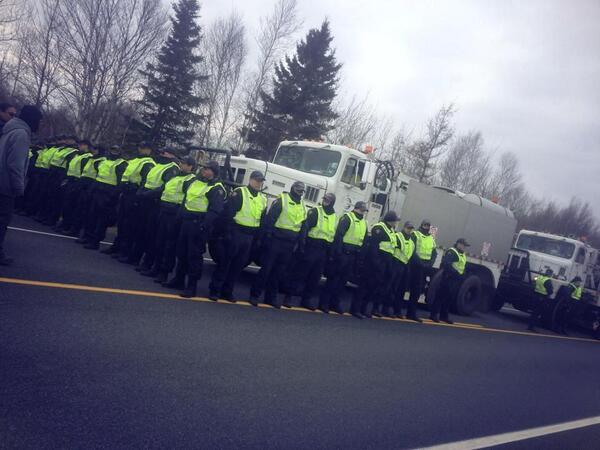
The history of #RCMP (formerly #NWMP) and #Elsipogtog

In my race, class, and colonialism class, the discussion of what is Canadian culture? always rears its ugly little head. Some people claim that we are a multicultural country *blech* I beg to differ.

What do you think of when you think of Canada? Maybe polar bears, igloos, “Indians,” or maybe the RCMP! Well, apparently, that is one of nation’s symbols. So it wouldn’t be wrong to think of the RCMP when you think of Canada but don’t you think it is kind of odd that we are a country who’s identity is also associated with police?!? I thought we were supposed to be all nice and peaceful… police, especially the RCMP are anything but *gasp* what we expect Canadians to be.

Look at Riza Santos, Miss Universe 2013 contestant! She displayed her culture proudly by wearing an RCMP uniform! At an international level.

Credit: Oh No They Didn't

Credit: Oh No They Didn’t

Note: RCMP officer’s don’t look anything like the above.

But wait, how did the RCMP come to be or is this post going to be all about bashing RCMP? No. It’s a brief glimpse into the history of the RCMP (formerly the NWMP).

The information page on the RCMP site does offer a little glimpse into the history of the RCMP (source). The RCMP states, ” Its immediate objectives: to stop liquor trafficking in the North-west; to gain the respect and confidence of the natives; to collect customs dues; and to perform all the duties of a police force.” And in Racialized Policing, Elizabeth Comack states something similar. Yet, she also highlights that they were also created to “protect the Aboriginal population of the Northwest from whiskey traders and other outlaws and ‘to ensure that all people of the Canadian North West — Indians and Metis, settlers and traders — might have the opportunity of living under a system of law impartially enforced and guaranteeing equal rights to all” (67). The NWMP started off with 50 men then grew to be about 300 (I guess is a lot to protect the poor Indians from the whiskey traders and other outlaws).

But really though, is that all the NWMP was created for? To protect the poor little Indians from dangerous criminals? To guaranteeing equal rights to all?

Nope!

As Comack also points out, that this particular history of the NWMP and later the RCMP ignores colonialism. One story that is often underreported within the history of Canada is the role the NWMP (and later the RCMP) played in carrying out the colonial project, to assimilate Indigenous peoples. The NWMP was involved in playing “an instrumental role in carrying out this colonial project or ‘civilizing mission'” (Comack 73). This civilizing mission also including signing of the treaties, the Indian Act, and the residential school system. The role of the NWMP, as highlighted by Comack, was to “ensure the submission of Indigenous peoples to colonial rule… and the primary reason for establishing it was to control the Indian and Metis population of the North West” (74) with the main concern being “to keep peace between Aboriginal people and settlers in order to encourage economic development” (74). Their role was also to keep Indigenous peoples on reserves and in an essence, criminalized them if they did so. When these statements are contrasted with the issue happening on the east coast right now (source), I see no difference in the role of the NWMP then and the role of the RCMP now.

Really though, maybe except for a colorful uniform, what is the difference?

rcmp1

RCMP “secretly monitoring” protestors in field in camo and armed with weapons

(@DelSchilling)

rcmp2

RCMP pepper spraying peaceful protestors

(@ToddLamirande)

rcmp3

RCMP protecting Fracking vehicles (corporate interests)

(@EricaVioletLee)

Do we really want our nation to be associated with a police that protects corporate interests? I guess that is all you can ask of a colonial country. Corporate interests over human rights.  The sad but honest truth.