Author: kwetoday

Indigenous student(s) + educational institutions/academia

As I begin drafting this post, I am sitting on the bus and heading home after a brutally tiring day. It wasn’t that this day had anything special going on. In fact, I was excited about today until I arrived into class.

From since I was a young child, I had many experiences within educational institutions that range from super-duper awesome to “holy fuck! Did that just really happen?” You know not the good kind of WTF!

Or maybe you don’t know but that’s besides the point.

When I think back to my initial experiences in education, there is always this one troubling memory that comes to my mind. I do not recall how old I was but I remember it was when I was quite young. I attended a catholic school whose student body was mostly comprised of Indigenous students. This school wasn’t within my Indigenous community, however. So, those from my community had to be bussed into town to attend a non-Indigenous school. This memory though was troubling because of what I witnessed.

On this day, we were walking past this one hallway (it might have been one of the portables) and we were lined up waiting. I remember looking down this little hallway and I noticed a teacher who was holding a student’s head between his legs. If you can picture a student sitting in a chair and the teacher standing behind him and forcing his head between his legs (to bend at his torso). The student was screaming. The teacher was yelling. The student didn’t stop screaming but another adult (or teacher) blocked my view from what was going on and soon enough, the line progressed forward. I don’t recall if I ever told anyone, like my parents, about this incident. Yet, when I think about it, I wonder what the little boy had done and what happened to those teachers/adults.

This experience provides the premise for the remainder of this post: experiences in educational institutions from an Indigenous student’s perspective. But let me tell you that I am not alone in my experiences. This isn’t an individual thing. It’s an institutional thing.

What I both experienced and witnessed throughout my educational years did not change much since that first memory. Throughout my elementary school years, I recall teachers throwing chalkboard brushes at students, calling students names, strapping students to their chairs/desks as a form of punishment, forcing students to stand in the corner at the front of the classroom or stand at the back of the classroom (sometimes with books in their hands while they stood there), and even slapping our desks with wooden meter sticks while our hands were on top of them–slapping these sticks so hard to the point of breaking them in half. Remember, this was a school whose student body was predominantly Indigenous. I don’t think I have to highlight what that statement suggests.

Okay, maybe for some people, I do.

Those experiences of mine are not much different than my older sisters’ experiences. In fact, my one sister overheard a teacher call her peer a “stupid Indian.” Yup. There you have it plainly and boldly in your face racism. Being a child in a school where you are meant to be subservient, most children didn’t say or do anything to stop this behaviour. However, my sister who overhead her teacher call her peer a stupid Indian did tell my mom what happened that day. From that experience, my sister ended up taking the teacher to human rights because of the way the teacher approached her after she told my mom about the experience (ended up humiliating her as well). The teacher? She was just moved to a different school and told to apologize.

This isn’t a one time thing either. Because I also remember the school principle at one point saying something equally offensive to our entire class which made reference to our Indigenity. I can’t recall what she said word for word but I remember I had to tell my mom and dad. What followed is telling of these experiences. Not only did the principle deny openly what she said but she also accused me of hearing things (you know, calling me crazy/unable to comprehend what she really meant by her racist remarks). She even caused my own father to grow angry with her to the point that he had to walk out on her condescending/patronizing behaviours. This principle now sits on a board for an Indigenous non-profit organization (or least sat on this board for a period of time).

By the time I made it to my final year in elementary school, these experiences didn’t stop. In fact, our teacher in the final year at my elementary school actually stated to the class, “Don’t think I don’t know about your reputation.” I asked her what this reputation was… she sent me to the office without answering the question. Honest question though right? I really wanted to know what our reputation was. But It didn’t stop there. In fact, throughout this final year, she ended up calling our entire class names such as stupid, dirty cow, dumb cow…. you get the gist. Not only did I start to believe that I was stupid (even if she wasn’t talking to me), but this was also the same year that I first tried to commit suicide. It wasn’t as bad as my attempts that followed but this was a turning point for me because I began to internalize these ideas about myself, not as an individual being but because I was Indigenous. Even though I graduated at the top three of my class, I soon believed that I had to be perfect in order to prove to the white teachers that I wasn’t dumb/dirty/stupid. You know, not just another dumb Indian, dirty Indian, or stupid Indian.

Then when I arrived at high school, I made a few close friends, some Indigenous and some non-Indigenous. I ended up going to the academic stream and usually didn’t coordinate my class schedule around what my friends were taking (I did what I did and what I thought would peak my curiosity). I was usually the only Indigenous student in my classes. It was hard. I was also bullied by a group of white girls, tripped by white boys, and racial slurs would be whispered as I was walking by to my seat at the back of the class (god forbid I sit at the front because then everyone could see that I was the only native in class). Sometimes these slurs were non-racial and perpetuated the whore stigma (because of my choice of clothing–dresses and skirts). Eventually I changed the way I dressed but this wasn’t until after my car accident, which was so bad that I fell back a year and ended up having to receive accommodations for my brain injury that I sustained in the accident. I don’t know what happened in that car accident except for that I was walking on the highway running through my reserve and I was hit while walking.

Now, fast forward to my move to London and to my experiences in university, I always question whether if it is all worth it. Not only during lectures (both online and offline) I have witnessed many other racist comments or behaviours from my peers, professors, and people I have worked with in a research setting. Whenever discussions are centered around Indigenous issues, there is rarely enough context given to the discussion. Many times these discussions result in someone saying something racist, ignorant and just downright stupid (both online and offline). Usually when something ignorant or stupid is said, it is usually racist. So putting those qualifiers in a list doesn’t mean the exist or present themselves individually. I have had to write to a professor to ask a student to stop making racist comments about Indigenous peoples, especially since these comments usually resulted in the rest of the class agreeing with her/him. I was never given any confirmation that a professor did speak with a student when such comments were made but professors usually just send a quick email to say, “Yup. I will talk to her/him.” Am I stifling discussion/free speech or whatever academic bullshit? No. It is actually hurtful and stressful especially since I am usually the only Indigenous student present AGAIN, and I usually have to leave class or debate on whether I will attend the next lecture. Thus, my educational experience usually suffers.

Another university experience included working on a research project and being the only Indigenous person on a team that was actually called “Indigenous Research Team.” Kind of contradictory right? Not only did this team have ZERO Indigenous representation on this team but the passive aggressiveness from one of the team members actually resulted in me going to human rights for advice. Did I want to file a complaint? No. I was scared, again. I also knew that I would be causing myself more stress had I actually filed a complaint. I ended up documenting the behaviour and comments towards me, which included reference to my Indigenity, or Indigenous peoples as a group, especially those comments not made within ear shot of a supervisor. When I finally approached one of the supervisors  about my experiences, this supervisor plainly stated that because both she and this person (who were making these toxic remarks about Indigenous peoples) were both minorities that in no way could my feelings/experiences have any truth in them. Some of these comments were so problematic that they made fun of Indigenous nations’ experiences–some of the same nations that they were attempting to recruit for research. When I finally had enough, I wrote a 4-page letter to the principle investigator. By this time, I wish I had followed through with the initial remarks made towards me and my Indigenity that was made at the beginning of summer instead of waiting until the end.

Then today, all these experiences came rushing back to me. I already wrote a detailed post about it on my Facebook and wrote several tweets about it. Briefly speaking, a professor asked me how my weekend was, I told her that it was great. She then switched the conversation to presentations. I said, “I was done but I did present at a graduate student research conference” and mentioned it was on Indigenous research. She replied, “Oh so nothing academic then.” I stopped the conversation there because I didn’t want to assume she was implying this work was non-academic. Come the end of the class, I had asked her to clarify what she meant by that comment. She said, “Oh I guess that was a poor choice of words.” I said, “Yes for being a professor, who has done research herself. Yeah.” She goes on to say that what she meant by not course work. I said, “Okay.” Then she goes onto say that she appreciates work being done outside the classroom and that she was sorry that she “offended me.” I said, “No. Don’t apologize for me being offended. You should be apologizing for your poor choice of words.” So she does, but this time I am in tears. I was in tears because of the triggering this comment did for all previous educational experiences, and the dismissal of my experiences. And that’s why I told her she shouldn’t be apologizing for offending me because offending me isn’t the problem… it was her choice of words which in all previous experiences were also the cause for such problems. And words and language have power.

As I stated earlier, this isn’t an individual thing. This isn’t me being super sensitive, easily offended. This is an institutional thing. This is a larger problem within society, especially Canadian society, where these experiences serve to maintain these structures and power (including both individual and institutional power). It is part of a larger problem that continues to cause problems for many Indigenous students (and Indigenous peoples/nations) within educational and similar dominant institutions. Remember that young girl from Saskatchewan who was told to wear her “Got Land? Thank an Indian!” sweater inside out because it was offensive/racist? No. Well you can read about that here. The reactions from non-Indigenous (namely white people) was so problematic/violent that the young girl had to deactivate her Facebook on the advice of the RCMP. Why didn’t the RCMP press charges against those who were posting such violent comments? Because this is part of a MUCH larger problem.

When white people say that I need to get over these experiences or comments, or that I should just forget about it, or that I should forgive people (in positions of power) for these comments, it infuriates me. Forgetting about these experiences, or moving on, or just getting over it IGNORES structures of power that reinforce and reproduce these experiences as being nothing more than well, something as not as significant. It says that I am misinterpreted something which basically questions my intelligence. Fuck that!

So if you are white and you are reading this, please don’t ask me what you can do to help me or don’t apologize for what happened to me or other Indigenous peoples/nations. We already had enough shitty apologies from the government that basically mean nothing.  You know what you can do to help Indigenous peoples? Take time to tell other white people to shut up or intervene in situations that are similar (aka racist). As an Indigenous person, I am always asked by white people, “How can I help?” You know what, if you want to help an Indigenous person or Indigenous movement or whatever, we need your help in  your own communities/institutions. That’s where we need your help. Now go and use your white saviour for some actually good–saving your own people and institutions.

Sustainability: Sustainable for who…

On the McDonough Partners site, their philosophy states, “As designers, we promote a positive vision of the future, based upon the belief that many of the environmental problems we face are, at root, design challenges (www.mcdonoughpartners.com) And then on his personal website, William McDonough says, “I see design as the first signal of human intention” (www.mcdonough.com). When it comes to architectural design and theory, there exist this need to unify beings, our places and our spaces through a re-conceptualization of the natural and social.

In Cradle to Cradle, William McDonough and Michael Braungart, writes that “inventive machines that use the mechanisms of nature instead of harsh chemicals, concrete, or steel are a step in the right direction, but they are still machines” (p. 598). Within this passage, they introduce the idea of industrial re-evolution which is looking at the developing of industrial systems in a new way, through creating partnerships with nature and instead of producing things that destroy natural spaces begin to utilize natural spaces where human beings become “tools of nature” (p. 598). Design today includes looking at the natural as an agentic being that can both influence and shape design in a more active way. It is no longer being conceived as a space to penetrate, manipulate, invade, and destroy. The industrial re-evolution also represents a shift from the obsession of history, reconnecting with history and toward a movement obsessed with sustainability.

Alberto Perez-Gomez describes the crisis that faces architecture “has its roots in a historical process touched off by the Galilean revolution” (p. 517). Turing the design on itself, McDonough sets the working framework for the 21st century designers. He sets the groundwork for 21st century design by taking consideration, as stated earlier, an obsession with sustainability. The core principles of McDonough’s framework, as stated on his design website, are derived from nature and include that everything is a resource for something else, use renewable energy, and celebrate diversity. Yet, the obsession with sustainability presents the conundrum inherent with this obsession of sustainability, what is sustainability?

In this particular piece itself, there is no clear definition of sustainability except that the reader must assume that by utilizing natural spaces and the energies that these spaces produce to create social spaces will be enough for these spaces to sustain themselves immemorial. Michael Braungart outlines that this obsession with sustainability has to do more with creating buildings and systems “that give more people more of what they want, need and love.” He further expands, “imagine buildings so delightful, so expressive of the world’s diverse interactions between nature and human culture, so comfortably affordable for so many, so able to inspire wonder in the living world, that the demand for them is driven by the pleasure from the bottom up (p. 600). This drive to create new and diverse buildings presents the issue with the social, the desire to create something with meaning and the drive to be individuals. But if design is obsessed with creating, where is the sustainability in creating, re-creating, or inventing and re-inventing to make something anew?

Martin Anderson from The Federal Bulldozer describes the issue with federal urban renewal programs. He states that the federal urban renewal program is sometimes privately referred to as the “Negro removal program” (p. 345). Then, Herbert J. Gans from the Urban Villages written in 1962 describes the paradox with slums with renewal programs. With these pieces in mind, urban renewal programs are just a euphemism for gentrification of spaces. With the consideration with this newfound obsession with sustainability, it begs the question, who will be benefiting the most from this obsession?

It can be argued that this re-conceptualization of the natural and social as both being interconnected and influencing each other simultaneously and synchronously only benefits the ones at the top or the ones who influence the capitalistic modes of production. The obsession with sustainability may take into consideration design as being the first step of human intention but the obsession with sustainability has very little to do with humans as agentic beings. The obsession with sustainability for design is obsessed with turning the natural space into a space to be penetrated, manipulated, invaded and destroyed. Capitalism, eh?

Duty to Consult: Haida Nation and Mikisew Cree First Nation (a case study)

A brief excerpt from the post is below. For full details, please scroll down.  

The difference between the two cases is that the Haida case dealt with unproven claims; meanwhile, the Mikisew case dealt with treaty rights. While the two are different, the concept of the spectrum with respect to the duty to consult remains the same: the scope and the content of the duty must be measured against the adverse effects of the proposed Crown’s actions. This duty to consult is triggered when the Crown has real or constructive knowledge of the potential existence of Aboriginal right or title and contemplates conduct that might adversely affect it. Thus, the Crown has a legal responsibility, a demonstration of care and consideration with respect to their actions and the outcome of their actions.

What is notable about these cases is that each had a prima facie case. In other words, each case had all evidence required to bring forth a legal case and the evidence supported each case undeniably. Yet, the government and other parties continued to ignore or dismiss the parties’ perspectives even before claims were filed in courts. For instance, as mentioned earlier, the Haida Nation, prior to the arrival of settlers, had harvested the lands in question and was actively seeking to prove title to the land at the time. There was also a potential existence of both Aboriginal right AND title as supported by their strong prima facie case. Chief Justice also stated that “where a strong prima facie case for the claim is established, the right, and potential infringement is of high significance to the Aboriginal peoples, and the risk of non-compensable damage is high” (para. 44). With the Haida case, there was no argument as to whether Aboriginal title and rights could be ignored by the Crown.

With the Mikisew case, the government approved the winter road (which would have been built on traditional grounds and would have strongly infringed on their right to hunt) and they further felt that they did not have a duty to consult with the Mikisew Cree First Nation. The Crown also did not consult, even as the threshold to trigger the duty to consult was a low one. The Crown’s action were, as described by Justice Binnie, unilateral because the Crown, “not only ignores the mutual promises of the treaty both written and oral, but also [their actions] is the antithesis of reconciliation and mutual respect” (para. 49). In both cases, the Crown had real and constructive knowledge of the potential existence of Aboriginal right or title and acted in a way that adversely affected Aboriginal right or title. Last but not least, Justice Binnie states in his case that the evidence present should have prompted a draft environmental assessment due to the seriousness of the impact on the Mikisew. The Crown did not even consider the draft environment assessment process.

Additionally, the federal court at the trial division level issued an interlocutory injunction. But, in the Haida case, Chief Justice outlines why an interlocutory injunction is an insufficient legal remedy. As outlined above, the reasons for why an interlocutory injunction is an insufficient legal remedy:

  • They may not capture the full obligation on the government;
  • They typically represent an all-or-nothing solution (either the project goes ahead or it halts);
  • While the duty includes balancing of Aboriginal interests with other interests, the balance of convenience test tips the scales in favour of protecting jobs and government revenues, with the result that Aboriginal interests tend to “lose” outright pending a final determination of the issue, instead of being balanced appropriately against conflicting concerns;
  • They are designed as a stop-gap remedy pending litigation of the underlying issue

Surprisingly, injunctions are being issued to this day in Aboriginal rights or title claims, and often in support of development—in opposition to the decision of these two cases. [details of the case below]


CASE STUDY: HAIDA NATION AND MIKISEW CREE FIRST NATION

            For purposes of this case study, I will first discuss Haida Nation v. British Columbia (Minister of Forests) (hereinafter referred to as Haida Nation). Following this discussion, I will then review Mikisew Cree First Nation v. Canada (hereinafter referred to as Mikisew). Within each of these discussions, I will cover the background and history of the cases, interveners, key facts, precedent cited, arguments, decisions, and their respective relevancy/importance.

Haida Nation v. British Columbia (Minister of Forests), [2004] 3 S.C.R. 511, 2004 SCC 73

This case is on appeal at the Supreme Court Level from the Court of Appeal for British Columbia. There are two appeals being heard simultaneously. The appellants in the first appeal are Minister of Forests and Attorney General of British Columbia on behalf of Her Majesty The Queen in Right of the Province of British Columbia (hereinafter referred to as AG et al.), and the appellant in the second appeal is the Weyerhaeuser Company Limited (hereinafter referred to as WCL). The respondents for both appeals are the Council of the Haida Nation and Guujaaw (the chief of Haida Nation at the time the case was heard).  The interveners for the case include twenty different parties with invested interests relating to business, various industries (including mining, timber, logging, or forestry) and several First Nations that are directly affected by these industries. Chief Justice McLachlin wrote the unanimous decision. Thus, Chief Justice McLachlin wrote the decision with no concurring or dissenting opinions.

Context/Background

At the center of the case includes the issues of Tree Farm Licences (TFL) and the fact that prior to the case, Haida Nation had been actively trying to prove title to the land since at the time of the case, title to the land belonged to the government (para. 6). The TFLs continued to be administered by the government to forestry companies, similar to WCL. Before this appeal, however, another large forestry firm acquired the TFLs in 1961 and they were allowed to harvest trees in an area designated as Block 6 (para. 4). Following this, the Minister replaced the TFLs in 1981, 1995, and 2000 and then approved a transfer of the TFL to WCL (para. 4). The Haida Nation prior to the arrival of settlers had harvested the land in question, and as mentioned earlier, they were actively seeking to prove title to the land (para. 2).

History of the Case

The previous decisions included the Justice Halfyard of the British Columbia Supreme Court to dismiss Haida’s petition. His reason for deciding was that the parties had a moral duty not a legal duty (para. 9). Thus, they did not have a legal liability to consult Haid Nation. The respondents to Haida Nation filed an appeal in the British Columbia Court of Appeal and the Court of Appeal reversed both decisions saying that both have a legal duty (para. 9). Following this decision, AG et al. and WCL appealed this decision to the Supreme Court of Canada (SCC).

Questions before the Court

  • What duty does the government owe?
  • Is the government required to consult and to accommodate their concerns (before proven title to the land)?
  • Do third parties have a duty to consult?

Decision

Appeal dismissed for AG et al. but allowed the second appeal from WCL.

Precedents Cited (Relevant to the Class)

There were more than twenty cases cited as precedent. As such, only those cases that have been previously discussed in class will be listed here. The cases that have been previously discussed in class include the following: Delgamuukw v. British Columbia, [1998] 3 S. C.R. 1010 which was the only case cited as applied and the cases that were referred to include R. v. Marshall, [1999] 3 S.C.R. 456; R v. Marshall [1999] 3 S.C.R. 553; R. v. Sparrow, [1990] 1 S.C.R. 1075; R. v. Sioui [1990] 1. S.C.R. 1025; R. v. Guerin [1984] 2 S.C.R. 335; St. Catherines Milling and Lumber Co. v. R., 13 S.C.R. 577; R. v. Van Der Peet, [1996] 2 S.C.R. 507.

Arguments

AG et al. argues that they have a “right and responsibility to manage the resource (forest) for the good of all British Columbians” (para. 8) and that the Haida have no legal right to be consulted or have their interests accommodated until they prove their claim (title to the land). Interestingly, this suggests that AG et al. argued that they prioritized all British Columbians’ interests over the interests of Haida Nation leaving Haida Nation at a serious disadvantage when it comes to asserting Aboriginal rights and/or title

Further, Chief Justice McLachlin states in her decision, pertaining to the consultation question, that it must be meaningful. She also highlights that good faith consultation can result in obligation to accommodate but Chief Justice also writes, “although what accommodation if any may be required cannot at this time be ascertained” (para. 10). Hence, this case does not determine steps for accommodation for the Haida people. Rather it provides a general framework for the duty to consult and accommodation before Aboriginal title or rights claims have been decided.

Originally the analysis of the duty to consult was focused on the Crown’s justification to infringe on existing Aboriginal or treaty rights. The significance of this case introduces the analysis of the duty to consult which included asserted but unproven Aboriginal rights.

Test Arising From the Case (relevancy/importance): Duty to Consult

The duty to consult, as outlined in the case, is grounded in the principle of the honour of the Crown (para. 16). This is a process of fair dealing and reconciliation that begins with the assertion of sovereignty and continues beyond formal claims resolution (para. 32). The foundation of the duty (both honour of the Crown and reconciliation) suggest the duty arises when the Crown has real or constructive knowledge of the potential existence of Aboriginal right or title and contemplates conduct that might adversely affect it (para. 35). In other words, the Crown cannot play ignorant to potential existence of Aboriginal right or title. In the case of Haida Nation, this potential existence of both Aboriginal right AND title was supported by a strong prima facie case. Chief Justice further provides a model for explaining the flexibility and generous application of the duty to consult in relation to a prima facie case, similar to Haida Nation. She provides a spectrum at paragraph 43 where at one end exists a weak claim for Aboriginal title, the Aboriginal right is limited, or the potential infringement minor. On the other end of the spectrum exists a claim “where a strong prima facie case for the claim is established, the right, and potential infringement is of high significance to the Aboriginal peoples, and the risk of non-compensable damage is high” (para. 44). The former requires a notice and a discussion surrounding the issues raised in the notice (para. 43). The latter requires meaningful consultation which may lead to accommodation (para. 46-47). While both cases are instances of consultation, the latter indicates a more seriousness in violation of Section 35 if the consultation is not fulfilled. Chief Justice explains further that in the middle of the spectrum will exist various instances that require different or flexible forms of consultation that are dependent on each case’s needs (para. 45). Thus, this spectrum addresses the scope of the duty proportionate to the strength of the case supporting existing right or title and seriousness of the potentially adverse effects upon rights or title claimed.

In the case of the Haida Nation, their case fulfilled all three factors of a strong claim for Aboriginal right AND title, and following, an infringement on these rights AND title would risk non-compensable damage. Referring to the spectrum, the case of the Haida Nation exists on the spectrum that was discussed to be most extreme: “where a strong prima facie case for the claim is established, the right, and potential infringement is of high significance to the Aboriginal peoples, and the risk of non-compensable damage is high” (para. 44). In her decision, Chief Justice writes, “there was a prima facie case in support of Aboriginal title, and a strong prima facie case for the Aboriginal right to harvest red cedar” (para. 71). Thus, Haida Nation satisfied the duty to consult prima facie, and there was no argument as to whether Aboriginal title and rights could be ignored by the Crown.

To answer the question, whether third parties have a duty to consult, Chief Justice found that there is no duty owed to third parties. As mentioned earlier, the foundation of the duty rests on both honour of the Crown and reconciliation. In her decision, Chief Justice highlights that this honour cannot be delegated to third parties as the legal duty to consult rests on the Crown (para. 53). She emphasizes that this does not mean that third parties are never liable (para. 56).

In addition to the above, Chief Justice also states that there is no duty to real agreement; rather, it is a commitment to a meaningful process of consultation in good faith (para. 42). Thus, the content of the duty varies (individually and flexibly).

Mikisew Cree First Nation v. Canada (Minister of Canadian Heritage), [2005] 3 SCR 388

This leads us to the second case, Mikisew Cree First Nation v. Canada. The appellant is Mikisew Cree First Nation, and the respondents are Sheila Copps, Minister of Canada Heritage, and Thebacha Road Society. The interveners are Attorney General of Saskatchewan and Attorney General of Alberta, Big Island Cree Nation, Lesser Slave Lake Nation Regional Council, Treaty 8 First Nations of Alberta, Treaty 8 Tribal Association, Blueberry River First Nations, and Assembly of First Nations. The issue relating to the interveners will be discussed later. This is on appeal from the federal court of appeal but still addressing the Crown’s duty to consult. Justice Binnie wrote the decision with no dissenting or concurring decisions. Thus, like Haida Nation, this is a unanimous decision.

Context/background

The history of the Mikisew Cree First Nation in relation to the Treaty 8 terroritory is the fact that the land that was set aside was not considered sufficient, until after a Treaty Land Entitlement in 1986 (para. 3). Following this, the federal government approved a winter road to run through Mikisew First Nation Reserve (para. 3). Before the government approved this winter road, they felt they did not have a duty to consult with the Mikisew Cree First Nation. The proposed road alignment would have been built on traditional grounds and would have severely infringed on their right to hunt (para. 3).

In addition to this, the court highlighted the fact that Mikisew Cree First Nation existed in a remote northern part of Alberta within Treaty 8 territory (para. 3). The decision also highlighted that basis of the Treaty 8 negotiation was for the “assurance in the continuity of traditional patterns of economic activity” (para. 47).

History of the case

On August 27, 2001, the federal court in the trial division issued an interlocutory injunction against construction of the winter road (para. 17 in Mikisew). However, in Haida Nation, Chief Justice outlines why an interlocutory injunction is an insufficient legal remedy. She outlines four reasons why in the Haida Nation decision and they are as follows: They may not capture the full obligation on the government; they typically represent an all-or-nothing solution (either the project goes ahead or it halts); while the duty includes balancing of Aboriginal interests with other interests, the balance of convenience test tips the scales in favour of protecting jobs and government revenues, with the result that Aboriginal interests tend to “lose” outright pending a final determination of the issue, instead of being balanced appropriately against conflicting concerns; they are designed as a stop-gap remedy pending litigation of the underlying issue (para. 14 in Haida Nation). In Haida Nation, Chief Justice further writes:

That Aboriginal claims litigation can be very complex and require years and even decades to resolve in the courts. An interlocutory injunction over such a long period of time might work unnecessary prejudice and may diminish incentives on the part of the successful party to compromise. While Aboriginal claims can be and are pursued through litigation, negotiation is a preferable way of reconciling state and Aboriginal interests.  For all these reasons, interlocutory injunctions may fail to adequately take account of Aboriginal interests prior to their final determination (Haida Nation, para 14).

However, this decision involving the injunction was appealed to the Federal court of appeal and they found that there was no infringement and restored the minister’s approval of the winter road in surrendered land. The argument for the assenting decision was that “the winter road was more properly seen as a ‘taking up’ pursuant to treaty rather than an infringement of it” (para. 22). But this decision included a dissenting opinion in favour of Mikisew. The reasons for deciding in the dissenting decision in the Federal Court of Appeal were followed, and Justice Binnie writes in agreement with Sharlow J. A., “that the winter road was itself a prima facie infringement of the treaty 8 rights and that the infringement had not been justified under the Sparrow test” (para. 23). If the dissenting opinion in the Federal Court of Appeal would have been followed, the appeal would have been dismissed.

Questions before the court

  • Whether Crown had duty to consult Mikisew
  • If so, whether Crown discharged its duty

 Decision

Appeal with costs is sought, and Justice Binnie allows the appeal, setting aside the decision of the Court of Appeal, and all costs against the respondent in the Supreme Court, and in the Federal Court of Appeal, costs are allowed “on a party and party basis” (para. 70). Further, Justice Binnie sets the costs as decided by the trial judge in the Trial Division to remain (para. 70).

Precedents cited (relevant to the class)

Again, there were more than twenty cases cited as precedent. As such, only those cases that have been previously discussed in class will be listed here. The cases that have been previously discussed in class include the following: R. v. Badger, [1996] 1 S.C.R. 771; Haida Nation v. British Columbia (Minister of Forests); R. v. Sparrow, [1990] 1 S.C.R. 1075; R. v. Sioui, [1990] 1 S.C.R. 1025; R. v. Marshall, [1999] 3 S.C.R. 456; R. v. Marshall, [2005] 2. S.C.R. 220, 2005 SCC 43; Delgamuukw v. British Columbia, [1997] 3  S.C.R. 1010.

Arguments

The case further established the framework for the duty to consult. At the time of the decision, the Haida Nation decision was just recently released before it. At the time of injunction was in place, the Haida Nation decision was being decided. Thus, the trial judge did not have the framework available to him. The Historical context was considered and as mentioned earlier, the content of this process is dictated by the duty of the Crown to act honourably. Each case is flexible but the flexibility is not in the conduct contemplated by the Crown; rather, it is in the variable content of the duty once triggered. For Mikisew, the threshold to trigger the duty to consult was a low one. Only a noticed had to be given with information disclosed. However, the Crown did not meet this low threshold. Thus, a prima facie case in violation of the duty to consult existed for Mikisew.

In the facts it was noted that the respondent did put out a notice for town-house type events and delegated the duty to the Minister through Parks Canada which the respondent attempted to argue was sufficient. The respondent argued “while [Mikisew hunters and trappers] own hunting territory would now be compromised, they are entitled to invade the traditional territories of other First Nations from their distant home turf” (para. 47). Thus, Justice Binnie, argues that the Crown’s action is unilateral because it “not only ignores the mutual promises of the treaty both written and oral, but also its antithesis of reconciliation and mutual respect” (para. 49). The foundation of the duty to consult, as stated in Haida and earlier, is based on honour and reconciliation and suggest duty arises when Crown has a real or constructive knowledge of the potential existence of Aboriginal right or title and contemplates conduct that might adversely affect it. The courts considered whether the process by which the “taking up” is planned to go ahead and whether this was compatible with “honour of the Crown.” Justice Binnie cites Delgamuuk and Haida Nation cases in his reasons for deciding, and this includes the following:

  • “Delgamuukw states that the minimum acceptable standard is consultation and that the consultation must be in good faith and with the intention of addressing the concerns of Aboriginal peoples whose lands are at issue” (cited in para. 61).

AND

  • “Haida Nation provides the determination of the content of the duty to consult and provides that this will be governed by context where context involves…specificity of the promises made…seriousness of the impact on the Aboriginal people of the Crown’s proposed course of action [with] the more serious the impact the more important the role for consultation will be…” (para. 63).

Justice Binnie highlights that seriousness of the impact also includes the loss of tradition, culture, economic as a result of loss of wildlife that was stated, would be an effect in the Draft Environmental Assessment (para. 44). Further to this, Justice Binnie decides that the duty lies at the lower end of the spectrum wherein a notice was required and to engage directly with them and not after the fact (para. 64). The engagement should have included, Justice Binnie writes, “the provision of information about the project addressing what the Crown knew to be Mikisew interests and what the Crown anticipated might be the potential adverse impact on those interests” (para. 64). Simply stated, the Crown had real and constructive knowledge of the interests at stake, but choose to be ignorant of the interests. Justice Binnie also emphasizes that the process is a reciprocal one and there is an onus on Mikisew to carry their end of the consultation process “to make their concerns known, to respond to the government’s attempt to meet their concerns and suggestions, and to try to reach some mutually satisfactory solution” (para. 65). However, the Crown failed to meet to this low standard. Justice Binnie writes, “that consultation never reached that stage. It never got off the ground” (para. 65). If these consultations had occurred, Justice Binnie highlights that the process may have allowed for a road alignment or construction that would have also satisfied Mikisew’s objections. If the road had been built in spite of these objections, Justice Binnie also emphasizes that the Crown would have “been in violation of its procedural obligations” (para. 57). Again, the Crown would have blatantly chosen to be ignorant of the issues.

Relevancy/importance: Duty to consult

This case provides the framework for the duty to consult when there is a low threshold and also for when there is an existing treaty.

Issue Pertaining to the Interveners

The AG of Alberta, as interveners, framed their argument differently at the time of trial than what was expected (para. 41). Mikisew argued that they were prejudiced at trial because of argument was framed differently than how it was framed at trial. However, Justice Binner, in relation to the interveners, decided that the Mikisew did not identify any prejudice for the new information and it should “not have taken Mikisew by surprise” because the issue for the AG is still the treaty infringement (para. 41). In other words, the interveners’ argument was still centered on the treaty infringement and Mikisew could have reasonably anticipated the AG argument.

Additional Discussion

The difference between the two cases is that the Haida case dealt with unproven claims; meanwhile, the Mikisew case dealt with treaty rights. While the two are different, the concept of the spectrum with respect to the duty to consult remains the same: the scope and the content of the duty must be measured against the adverse effects of the proposed Crown’s actions. This duty to consult is triggered when the Crown has real or constructive knowledge of the potential existence of Aboriginal right or title and contemplates conduct that might adversely affect it. Thus, the Crown has a legal responsibility, a demonstration of care and consideration with respect to their actions and the outcome of their actions.

What is notable about these cases is that each had a prima facie case. In other words, each case had all evidence required to bring forth a legal case and the evidence supported each case undeniably. Yet, the government and other parties continued to ignore or dismiss the parties’ perspectives even before claims were filed in courts. For instance, as mentioned earlier, the Haida Nation, prior to the arrival of settlers, had harvested the lands in question and was actively seeking to prove title to the land at the time. There was also a potential existence of both Aboriginal right AND title as supported by their strong prima facie case. Chief Justice also stated that “where a strong prima facie case for the claim is established, the right, and potential infringement is of high significance to the Aboriginal peoples, and the risk of non-compensable damage is high” (para. 44). With the Haida case, there was no argument as to whether Aboriginal title and rights could be ignored by the Crown.

With the Mikisew case, the government approved the winter road (which would have been built on traditional grounds and would have strongly infringed on their right to hunt) and they further felt that they did not have a duty to consult with the Mikisew Cree First Nation. The Crown also did not consult, even as the threshold to trigger the duty to consult was a low one. The Crown’s action were, as described by Justice Binnie, unilateral because the Crown, “not only ignores the mutual promises of the treaty both written and oral, but also [their actions] is the antithesis of reconciliation and mutual respect” (para. 49). In both cases, the Crown had real and constructive knowledge of the potential existence of Aboriginal right or title and acted in a way that adversely affected Aboriginal right or title. Last but not least, Justice Binnie states in his case that the evidence present should have prompted a draft environmental assessment due to the seriousness of the impact on the Mikisew. The Crown did not even consider the draft environment assessment process.

Additionally, the federal court at the trial division level issued an interlocutory injunction. But, in the Haida case, Chief Justice outlines why an interlocutory injunction is an insufficient legal remedy. As outlined above, the reasons for why an interlocutory injunction is an insufficient legal remedy:

  • They may not capture the full obligation on the government;
  • They typically represent an all-or-nothing solution (either the project goes ahead or it halts);
  • While the duty includes balancing of Aboriginal interests with other interests, the balance of convenience test tips the scales in favour of protecting jobs and government revenues, with the result that Aboriginal interests tend to “lose” outright pending a final determination of the issue, instead of being balanced appropriately against conflicting concerns;
  • They are designed as a stop-gap remedy pending litigation of the underlying issue

Surprisingly, injunctions are being issued to this day in Aboriginal rights or title claims, and often in support of development—counter to the decision of these two cases.

Links to each full decision:

#WS3330G Immigration and Refugee Protection Act: #Terrorism & #HumanTrafficking

So yesterday I did a presentation on Valeria Knowles’ book which is entitled “Stranger at Our Gates.” This book is a detailed historical analysis on immigration policy from 1504 until 1997, and within the past decade.

This isn’t the first time I have written about IRPA on this blog. I have touched on it briefly in previous posts on human trafficking and terrorism. In fact, part of the presentation included such interests of mine. In particular, my curiousity within this topics are on the discourses that frame how these topics are analyzed (or more correctly, not analyzed).

Within this presentation I spoke specifically on the motive requirement which I write in great detail in my paper entitled, “Anti-Terrorism Law and Ideology: An Analysis of the Motive Requirement.” In short, the motive requirement was described as being essential to terrorist activities, and in order to fulfill this requirement one must be seen as “acting in a manner calculated to promote social and political change through violent, undemocratic means…motivated by shared ideology” (Jenkins 2009:432). The problem with this motive requirement, as discussed in my paper and several other scholars, is that such activities become discriminatory in nature (not that the institutions that govern such activity are inhernetly non-discriminatory). In fact, scholars who have written on this topic argue that motive requirement within the definition of terrorist activity needs to be removed to prevent racial, social, political, or religious profiling of both innocent citizens and non-citizens of Canada (Webb 2005; Roach 2005; Carter 2009). We all know that being profiled is only a problem for racialized/indigenized and minority groups (non-citizenship status for example), and by racialized, I don’t mean white people. Remember Skylar Murphy who was still allowed to board a plane to Mexico with a pipe bomb in his bag?  Not only this, the motive requirement expands the defintion of what constitutes terrorist activity. This definition is so broad that Cindy Blackstock, who advocates for the rights of First Nations children both domestically and internationally, was listed as an enemy to the state of Canada under Canadian Security Intelligence Services.

In additon to the above, the way in which institutions and policies address the issue of human trafficking is problematic. Within Canada, human trafficking is defined in two distinct ways, one includes a definition under the IRPA and the other under the Criminal Code of Canada. The Criminal Code of Canada deals specifically with domestic human trafficking (in other words, the trafficking that allegedly affects Indigenous women and girls) and the IRPA deals with international human trafficking, or the movement of bodies across borders (in other words, the kind that allegedly affects immigrant/migrant women and girls). Further, institutions state the victim does not know it is a victim. Most recently, within a Canada-wide police initiative (a shit show of a strategy) to combat human trafficking, only one person was arrested and the police stated that the woman was 18 years old (meaning of legal age to consent) and that she did not cooperate with the police (Source). More precisely, she did not identify as a victim. So what happened to that woman? Was she arrested, charged, or taken to a holding cell? What will happen to other individuals who don’t subscribe to the victim identity? Therefore, it is up to the systems (aka policing/border patrol) to identify victims and perpatrators, and these two (without accident) are defined as originating from the same ethnic origin which could potentially criminalize personal or familial relationships.

These discourses on human trafficking are compelling, especially since white women (historically) were defined as “chosen” or “recruited” through immigration policies or initiatives in an effort to help build families (or build Canada aka protect whiteness). Meanwhile, the movement of Black, brown, and Indigenous bodies across borders and within borders were/are being defined as trafficked (historically and presently), which also restricts/restricted their movement greatly, and defining them in such a manner meaning it was/is a problem that needs to be dealt with swiftly (aka with aggressive policing initiatives–much like this one happening in 2014). Racism, as it existed/exists in immigration policies/inititatives always tend(ed) to focus on how to protect and maintain Canada’s whiteness. Additionally, present day anti-human trafficking campaigns only ever include white faces/bodies within their advertisements or materials. But in the same breath, the same organizations argue that there is a need to protect the most vulnerable, or women of color or Indigenous women.

This begs the question, what are we really trying to accomplish with these discourses and policies?

#WS3330G Stranger at Our Gates by Valerie Knowles

The purpose of the book, Strangers at Our Gates, which is authored by Valerie Knowles, “describes briefly the different kinds of immigrants who have settled in this country over the centuries and the immigration policies that have helped to define the character of immigration in various periods” (p. ix). Stating the obvious, and similar to Knowles, racism played a role in Canadian immigration policy.

Knowles’ historical analysis of Canadian immigration policy adopts the Doctrine of Discovery. The Doctrine of Discovery follows that England discovered North America and this doctrine is used to justify settler invasion. In other words, in Canadian history, those with the biggest guns win, literally and metaphorically. This point also emphasizes the concept of history as a social construction, which speaks directly to the question of power. Dr. Anton Allahar in Hidden From History states, “It is often the view of the most powerful that carries the day and that is remembered” (p. 245). The historical exploration of Canada’s immigration policies speaks to these differential power relations and more specifically, historical silences and the erasure of people and events in Canada’s history. While Knowles’ statement that racism was prevalent within these legislative discourses is correct, I posit that racism was also a method for social control. With my big, bright red and white Canadian thinking cap on, I see our immigration policies acting more like a security blanket for maintaining the Canadian Identity. This begs the question, what is the Canadian identity?

Today, immigration policies are centered on the Canadian philosophy of multiculturalism. Multiculturalism as a policy first began to enter Canadian legislative discourses in the late 1970s and the early 1980s, under the Trudeau and Mulroney eras respectively. It was officially adopted in 1985 under the Canadian Multiculturalism Act. Even though many Canadians seem to adhere to this multiculturalism identity with pride, I suggest that the idea that Canada is a multicultural country is misleading. Multiculturalism is much more of a “cloak” to disguise the racism prevalent in Canadian society. Multiculturalism says that as individuals, newcomers can celebrate their own distinct cultural values and ideals but only if Canadian values and ideals are bought into first, or more precisely, if you assimilate first.

So returning to the initial question on Canadian Identity, I present a closing question: How do you think racism within immigration legislative discourses play a role in maintaining Canadian identity? And, do you think that much has changed within immigration policy over the years especially with respect to racism? 

Interview with @Evolving for #WIPCE #ShawnWIPCE #indigenous

This is an interview between @kwetoday and @Evolving (Shawn) to help raise awareness and support Shawn’s campaign on indiegogo to help he attend the World Indigenous People’s Conference on Education (WIPCE). You can read that interview below and if you are able to, donate some good ole zhoonya ($$$)  to his campaign!

So first off congratulations on your acceptance to speak at the World Indigenous Peoples Conference on Education (WiPC:E)! Can you expand a bit on your topic and why choose to this particular topic? 

Thank you, Naomi. I was debating submitting a paper for the conference, but then I came up with the idea to present on the program I am currently enrolled in, the Master of Social Work – Aboriginal Field of Study. I met with my program co-ordinator, Kathy Absolon-King, and presented my idea to her. With her approval, I submitted my proposal to WiPC:E and was accepted by the conference committee. I choose to present on this topic because it is the first program of its kind in Canada. As a student, I feel the conference is a great opportunity to raise awareness among other academics of the tools this unique program has to offer to those enrolled and the community in which they serve. The goal of the program is to develop wholistic practitioners that will work in the field through the use of both Traditional Indigenous knowledge and Western approaches to social work practices. 


With respect to the Aboriginal Field of Study program, it is described as the first MSW program in Canada that is rooted in a “rooted in a wholistic Indigenous world view and contemporary social work practice” and that the goal of the program is to “to develop social work practitioners who demonstrate an understanding of and respect for the history, traditions and culture of the Indigenous peoples of Canada.” Why is this wholistic Indigenous world view and understanding and respect for the history, traditions, and culture of Indigenous peoples in Canada important to the MSW academic field and practice?

During my educational career, I have learned many Westernized theories and approaches to use when working with clients. I was always taught to treat the relationship as professional and “client/counselor”. I’ve been taught that we don’t let the client get to know us on the personal level and they should view us as the counselor and nothing else. The question I was always faced with during my undergrad was “How do I work with my people and keep them from knowing who I am as a person?” I found this to be a hard concept to grasp because it sounded cold and distant. In this program, I feel as if my slate has been wiped clean and I am being taught a new way to work with clients. We begin by first understanding ourselves. We learn how to “locate” ourselves, which is answering the question “Who am I at this very moment?” We need to first understand the impact that colonialism has had on our lives and the clients we work with. Once we understand our own colonialism, we than begin to understand how we could use this awareness to help others. We do so by the tools we are provided with in the classroom. Some of them being the teachings of the medicines, our environment, traditional songs, and participating in ceremonies on a daily basis. By learning these tools we are able to implement them when working with clients. This is necessary because there many people within the field of social work either do not understand traditional practices or were never taught. 


And the theme for this year’s conference is “E Mau Ana Ka Mo‘olelo: Our Narratives Endure” which is a call to invite speakers to share their stories so that Indigenous peoples “may solidify and continue our cultural legacies.” How does your personal story or your particular topic engage or expand on this theme?

Sharing our voices and our stories is necessary. They carry knowledge, wisdom, and history. Our stories remind us of who we are as a people and where we come from. They remind us to be proud and to carry on our traditions. For me, the title of the conference means that even we will all pass one day into the spirit world, even though our physical bodies may be gone our voices will still be carried on through the next generation. That is why its important that we engage with one another, talk, converse, laugh. We need to keep our stories alive and hosting conferences such as WiPC:E allows for this exchange of dialogue to take place. 


You have numerous speaking experiences, and a lot of these experiences touch on your personal history and identities, Indigenous, mature student, LGBT, etc. Why is important for you to speak about your personal histories and to talk about your experiences? What are some of the challenges in sharing your personal story? How do you overcome those challenges? Do you have any advice for those who have similar experiences in overcome their own challenges?

I have been sharing my personal story for the past 5 years at numerous workshops, classrooms, and conferences across Canada. I talk about what it was like growing up as First Nations and Two-Spirit and my addiction to drugs and alcohol. I enjoy sharing my personal story because it allows me to provide a message of hope to others who might be going through the same challenges in life. My talks also focus on the positive such the tools I used in my recovery from addiction and services that helped me earn my education. My words of advice that I give at all my speaking engagements is “Don’t be afraid to ask for help. Use those three little words ‘I need help’. I needed to admit that I couldn’t do it alone and I am glad that I came to that realization because it got me to where I am today. 


What do you hope to gain from this new experience speaking at WiPC:E? How important is it for Indigenous people to gather, regionally, nationally, and internationally? What are the next steps for you in this journey leading up to WiPC:E? 

Education is vital. This conference will provide that will allow for ideas to be exchanged while allowing people to network with other academics who share the same passion for education. It necessary that we keep encouraging the next generation to attend post-secondary and that is why this conference is needed. We need to know what is working (or not working) for these institutions that also educate within an indigenous framework.I am currently seeking financial support to attend this conference and it’s unfortunate that there is little support out there, especially as a graduate student. So far, I have found the funds to pay for my registration but still need help with airfare and accommodations. I had a good friend suggest creating an Indiegogo account and so far I have a handful of donations. I am very grateful for the amount that I have raise so far, but still have a long ways to go in regards to fundraising. 


And regarding 2013, what was the most memorable experience for you and why?

My favorite moment of 2013 was being able to spend 3 days with Sylvia McAdams, cofounder of Idle No More. She was in Waterloo to speak at a conference and during her visit I was asked to be her guide to events. It was an honour to spend time with her because I have been involved with the movement from the beginning and organized a few events in the London area. During her visit, she received kept receiving messages about Elsipogtog and was upset there wasn’t more she could do. She asked my friend Lisa, Heather, and myself if we could organize a rally. It just so happened that the three of us had experience in the past putting together these events. In 24 hours, we held a candle light vigil and round dance in downtown Waterloo with a turn out of over 200 people. Syliva spoke at the rally as well Bridgette DePape from Shit Harper Did. Those three days were unforgettable and I look forward to working with Sylvia again in the future. 


Thank you Naomi for your support over the years. Miigwetch!

Thank you/Miigwetch Shawn for sharing your story! 

2013 was the year that…

Well 2013 was the year that I didn’t write a “Happy New Year!” or “Yay! It’s 2013!” post. I barely remember New Years last year. I was in Toronto and had dinner at the Keg with my sisters but anything after that I don’t really recall and not for reasons you might think. The first few months of 2013 were all quite a blur actually. I was still grieving the lost of my best friend’s life from the previous August. It was tough. I almost failed my quantitative research methods. Well, not actually failed but almost did not maintain my place in the honors specialization in criminology program. I know I am hard on myself especially when it comes to my grades. But I did it! Phew!

Last year was also the year I won some awards/scholarships, and I continued to volunteer at Indigenous Services on campus. Volunteering and helping out Indigenous peers is actually one of my favourite things. From seeing friends complete another year, to seeing first years come by the center for the first time (or even fourth years come by to the center for the first time). From my first year at Western, the number of Indigenous students at the center has significantly increased and it makes me really happy just thinking about it. Indigenous Services has been integral to my success on campus. So when I see new Indigenous students come to the center for the first time, I know that they will also receive the same kind of help I received and be successful in all that they do! I ended up doing scholarship workshops for some of the students who wanted help or advice. One peer that I actually helped with her scholarship application emailed me to let me know she will be applying to med school and wanted to say thanks for the presentation I did on applying for scholarships. Very thoughtful and made me appreciate the time that I am able to help others.

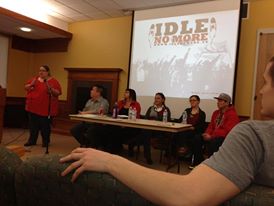
One of my papers was used in two course packs at two separate institutions. Pretty fuckin rad! I also ended up doing two paper presentations, one at Western and the other at Wilfred Laurier (Brantford Campus). I was also asked by an exceptional person to sit on an Idle No More panel along side some spectacular folks at the Kings University Campus.

idn

2013 was the year I met a lot of great people. I applied to the Alberta’s Future Leaders program. Randomly. I didn’t plan on applying to the program and I remember seeing the poster as I was working on an essay (or maybe I was studying… again, blur). I just remember seeing that the deadline was that day and I ended up putting together my resume and cover letter and sending it off. The coordinators emailed for an interview time to be done via phone and I ended up being interviewed in March sometime. Then come April, I heard back from them as I was doing the paper presentation at Western University. I had to scramble to get a criminal background check and my first aid and CRP while at the same time studying for my finals. The coordinators told me the training began on April 29. My last final exam was on the 29. So they were really accommodating and I ended up flying out at 7am on the 30. This was also one of the best experiences of 2013 with a lot of great people and experiences. So, I lived out west all summer and made some great friendships lasting beyond those summer months.

afl2

When I returned to Ontario, I was eager to get back to school. This year is my final year at Western. I ended up taking the LSATs, and applying to one of my top choices in schools. I received a lot of help with this and am thankful for being able to have that help. Many thanks/miigs JF!

For my Christmas break home, I am elated by the fact that I didn’t have any full year courses this past term. This means that I actually had my first real Christmas break–no essays to worry about that are due in January when I return or chapters to read (well I will have to read some articles before I start classes January 6). It just felt really good to just relax, play, dance, and sing with my nephew, and meet my newborn niece!

lain

So 2013 was the year that I grieved the loss of a friendship, made new friendships, made plenty of unforgettable memories, and learned from myself and others… 2013 was a great year! Thanks/miigs to all those I have met along the way and that were apart of 2013 with me!

CANADA’S ANTI-PROSTITUTION LAWS: A METHOD FOR SOCIAL CONTROL

CANADA’S ANTI-PROSTITUTION LAWS: A METHOD FOR SOCIAL CONTROL

INTRODUCTION

“It feels like the Canadian public doesn’t understand our realities, especially when it comes to police violence and abuse. They’ve been taught that police are there to ‘serve and protect us’ and keep the peace. But what folks don’t know is that the Royal Canadian Mounted Police was originally created to control and manage the ‘Indian Problem’, which included using force, violence and coercion against our peoples. This is the RCMP’s living legacy.” (Native Youth Sexual Health Network & Families of Sisters in Spirit, 2013).

The above quote from the joint press release with Native Youth Sexual Health Network and Families of Sisters in Spirit provides a premise for this essay: that Canada’s current anti-prostitution laws are a method for social control, and within a colonial context, a method of controlling Indigenous bodies to exploit and dominate Indigenous lands. [1] Basil Davidson, in Columbus: the bones and blood of racism (1992), argues that if it were not for slavery that the “maturity of capitalism would have been a different one, and very conceivably a less ruthless and destructive one” (25). Before the arrival of Columbus to the Americas, it is reported that approximately 112 million Indigenous peoples were living on this continent and close to 18 million living in what is presently called United States and Canada (Wesley-Esquimaux, 2009, p. 14). Following contact with settlers, it has also been noted that nearly 90 to 95% of the Indigenous population had been “wiped out by epidemic disease, warfare, and famine, with most people dying within 100 years of contact” (Wesley-Esquimaux, 2009, p. 14). These effects of disease, warfare, and famine are important in understanding the effects of colonialism on Indigenous peoples. However, these are not the only ways that Indigenous bodies and lands have been exploited and dominated. One important tool for the colonizers, in addition to controlling the movement of Indigenous bodies, is the controlling and dominating of Indigenous sexualities and genders through regulation and policing.

Historically, for Indigenous peoples, “both gender roles were viewed as equal and necessary for the health and survival of the community” (Boyer, 2009, p. 71). When settlers first arrived to what is now called Canada, Indigenous women “made integral decisions about family, property rights, and education” (Boyer, 2009, p. 71). Still, today, Indigenous women are in dire circumstances. In Contributions to Culture and Community through Canadian Law, Yvonne Boyer (2009) highlights that the change in social status for Indigenous women in Canada can be traced with the “progression of colonialism” (72). One such example of the effects of colonialism for this group is the exorbitant number of missing and murdered Indigenous women. Even though the current Conservative Government dismantled the Sisters in Spirit initiative in 2010, which worked to document the missing and murdered Indigenous women, Indigenous women continue to dominate these statistics in comparison to their non-Indigenous counterparts (Sayers, 2012; Oppal, 2012). For instance, Indigenous women make up 3.8% of the total population; yet, they make up 10% of the total number of documented missing and murdered cases from 2000 to 2008 (Oppal, 2012).[2] Indigenous women between the ages of 25-44 years are also five times more likely to die as a result of violence in comparison to non-Indigenous women in same age category (Native Women’s Association of Canada NWAC, n.d.). The Native Women’s Association of Canada (NWAC), a leading non-profit advocacy organization for Indigenous women, also states that while family violence is one area of violence that is heavily investigated and researched, steps must be taken to address violence perpetrated by strangers or acquaintances, especially among Indigenous women in the sex trade (NWAC, n.d.). Even though organizations that represent or advocate for Indigenous women’s safety and security at both national and international levels remained divided on the controversial subject of the decriminalization of the sex trade, this paper will argue that Canada’s current anti-prostitution laws are an extension of Canada’s colonial agenda to the present day. I will utilize Fanon’s arguments from The Wretched of the Earth that colonialism is violence to argue that Canada’s anti-prostitution laws constitute violence. Through a historical analysis of these laws I will show how they operate, including disproportionate enforcement, to create social control along the lines of race, gender and class to advance Canada’s colonial agenda. Additionally, I will utilize a Marxist perspective to address the question of whether racism and colonialism are connected.

RACISM AND COLONIALISM

To begin this essay, I will provide a working definition of colonialism that is relevant to Indigenous peoples’ experiences within a Canadian context. During this, I will also answer the question of whether racism and colonialism are connected. While one might argue that racism and colonialism are intrinsically interconnected, an analysis of both concepts indicates that racism can be seen instead as a consequence of colonialism. In When Black First Became Worth Less, Anton L. Allahar (1993) underlines that racial categorization of various groups were “applied in different ways [and] serve diverse ends and interests” and that these racial categorizations justified practices of slavery and colonialism (39). Central to this justification exists the Doctrine of Discovery, which is as “a dogmatic body of shared theories […] pertaining to the rightfulness and righteousness of settler belief systems and the supremacy of the institutions that are based upon those belief systems” (Miller, Rurur, Behrendt, & Lindberg, 2010, p. 94). Settlers saw Indigenous peoples as not fully human, but viewing Indigenous peoples in this light did not pertain to race. Instead, it is connected to a negation of their systems, a denial of the legitimacy of Indigenous systems, as viewed from the settlers’ perspectives. Linda T. Smith (1999) outlines that these negations happened by viewing Indigenous peoples as not fully human, and accordingly, they were viewed as not civilized enough to have systems, languages, and modes of thought (28). Thus, these negations were not initially based on race.

Race is a concept that has been used to justify actions or policies against certain groups as a consequence of colonialism. As such, a definition of race is necessary to understand the concept of racism within a colonial context. Allahar (1993) describes race and colour to “act as key social markers that provide individuals and groups with packaged meanings of themselves and others” (39). Sometimes these meanings have negative connotations and that when these meanings seek to “relegate people to subordinate positions in a system of hierarchical social rankings, racism is a result” (Allahar, 1993, p. 39). For the settlers, as stated above, Indigenous peoples were seen as not fully human and for some Indigenous peoples, they were not even seen as humans at all; they were otherized (Smith, 1999). The effects of otherizing Indigenous peoples based on the settlers’ view of Indigenous peoples indicates that they sought to displace Indigenous peoples socially, politically, and economically, in the quest for more resources, capital, or material things. In other words, settlers sought to exploit and dominate Indigenous peoples’ resources for imperialistic endeavours to acquire further capital and material need for production. Just as Davidson argued that if it were not for slavery the progression of capitalism would have been much different, less ruthless and destructive, and suggesting that the capitalism directed the colonization of Indigenous peoples. Both Allahar (1993) and Davidson (1992) argue that racism did not cause slavery to happen; rather, racism was a consequence of slavery. Certainly, the way slavery and these destructive effects of capitalism occurred, and how capitalism is connected to colonialism must be outlined to address whether racism is connected to colonialism.

Similar to racism and colonialism, Smith (1999) outlines that imperialism and colonialism is interconnected. Smith (1999) argues, however, that colonialism is “but one expression of imperialism” (21). When outlining European imperialism, Smith states that imperialism is used in four different ways including imperialism as economic expansion and imperialism as connected to discovery, conquest, exploitation and domination (Smith, 1999). For Indigenous peoples in Canada, this economic expansion is tied to this quest, the Fur Trade and other commodities of exchange value. Colonialism in the Canadian context is then tied to capitalism via European imperialism as a method for economic expansion. By the inherent exploitive structure and nature of capitalism, this created a differential in power relations between the Indigenous peoples and settlers. To analyze the complexities of these power relations, a brief exploration of Frantz Fanon’s arguments in both Wretched of the Earth and Black Skin, White Masks is desirable.

In Black Skins, White Masks, Fanon (2004) undertakes a psychological perspective to colonialism and inferiority/superiority. Then, in Wretched of the Earth (2008), he argues, the colonizer and the colonized are mutual constructions of one another, and that without the colonizer the colonized does not exist. Fanon’s analysis of colonialism fails to take into consideration these complicated power relations among settlers and Indigenous peoples. Before settlers arrived, Indigenous peoples lived a way of life that saw everything, from plants and animals, and everyone, from male to female, as equal and as beneficial to the social (Burrows, 2010). First, the alteration of existing cultures is missing from his analysis. Then, Fanon dichotomizes the differential in power relations within colonialism, which is characteristic of Western thought and academia, and Fanon allows the binaries prevalent within colonialism to become all-encompassing definitions through the dichotomization of the colonizer/colonized. Similar to Fanon, however, dialectical Marxist analysis is useful in understanding how the structure and nature of capitalism played in settlers/Indigenous peoples’ relations.

In addition to the above, Fanon premises his superiority/inferiority argument through the claim, that in the eyes of the white man, the Black man is the “missing link in evolution from ape to man” (Fanon, 2008, p. 1). This missing-link argument erases Indigenous peoples in the Americas. It is an erasure of their experiences, an erasure of their systems of being and an erasure of their very existence from his arguments. It asks where did Indigenous peoples come from, and if they did not originate from the Americas, then whom did Indigenous peoples discover and displace? One might posit that we all came from somewhere, namely Africa. But this further legitimizes the Doctrine of Discovery vis-à-vis imperialism, which justifies the domination and exploitation of Indigenous lands for economic profit and legitimizing colonialism and its effects. These arguments suggest that whoever has the biggest guns, both literally and figuratively, wins. Historically, through warfare and policing the Europeans appear by this argument to be the victor, and legitimize colonialism and all of its violence.

One can easily argue that racism and colonialism are connected. But colonialism did not occur because of racism, or vice versa. Rather, colonialism created the environment for racism to cultivate economically, politically and socially.  This growth of racism within a colonial context is demonstrated through the construction of the Indigenous problem, or more specifically, the “Indigenous Question” (Smith, 1999, p. 90). The construction of the Indigenous problem, as highlighted by Smith, is a reoccurring theme within imperial and colonial endeavours to control and dominate Indigenous peoples including their lands. Smith (1999) argues that the Indigenous problem “originates within the wider discourses of racism, sexism, and other forms of position the Other” (90) and that “its neatness and simplicity gives the term its power and durability” (90). Moreover, Allahar (1993) argues that racism evolved, and that race has become quite meaningless; however its effects were real. For Canada’s Indigenous peoples, these effects are still very real. As outlined by Davidson (1992), it was racism that justified the invasion and the dispossession of lands as colonialism progressed. The invasion and dispossession of Indigenous lands still occurs through the quest for more capital accessible through the natural resource extraction industry, which occurs largely on Indigenous lands in a paternalistic manner that infantilizes Indigenous peoples.

Nevertheless, the question whether racism and colonialism are connected must still be answered. Racism is both an essential and effective tool to help facilitate in Canada’s colonial agenda. Colonialism, as an expression of European imperialism, created the environment for racism to develop, economically, politically and socially, to effectively relegate Indigenous peoples to dominate and exploit their lands. As such, colonialism is connected to the imperialistic quest for more material productions and similarly to Allahar’s statement in When Did Black Become Worth Less (1993), racism acted more like a relation of production, which allowed colonialism to persist and sustain itself within the capitalistic modes of production. If it were not for racism, would the ruthless effects of capitalism have occurred? Given that capitalism can utilize others tools for exploitation and domination, maybe. But we cannot predict what might have happened through a historical analysis. We can only use a historical analysis to understand the effects of these institutions. Racism, as a relation of production, persisted because it helped facilitate and sustain colonialism.

Colonialism for Canada’s Indigenous peoples can be seen centrally as an expression of imperialism and to quote previous Indian Affairs Minister Duncan Campbell Scott, “to get rid of the Indian Problem” (Leslie, 1978, p. 41). This goal to get rid of the Indian Problem still continues to this day. As Lee Maracle (1996) highlights the aims of the colonizer is “to break up communities and families, and destroy a sense of nationhood” (93). Not only are there more Indigenous children in state care than there were during the residential school era, Indigenous peoples experience high rates of criminalization, including arrest, detention, and remand (National Collaborating Center for Aboriginal Health, 2010; Government of Canada, 2013). Specifically, and as highlighted earlier, Indigenous women continue to go missing and murdered at much higher rates than their non-Indigenous counterparts demonstrating that colonial violence affects both race and gender.  One might argue that there is something inherently wrong with Canada’s justice system but, a closer look at Canada’s colonial agenda indicates that it is designed to do exactly what it was meant to do: to further economic expansion and to get rid of the Indian Problem.

CANADA’S COLONIAL AGENDA

The skills and knowledge of Indigenous peoples upon settlers’ first arrival to the Americas were essential to the establishment of the colonies. For example, with respect to the fur trade, certain relations with Indigenous peoples were even encouraged by the Hudson’s Bay Company as being advantageous, socially, politically, and economically, especially those among white settlers and Indigenous women (Mawani, 2001). As such, the relations between those Indigenous fur traders providing for settlers the raw material of furs were essential to this imperialistic venture. Seeing the Indigenous person as a partner was an effective means to allow the colonial agenda to persist and sustain itself, insofar that these relations did not upset these modes of production Eventually, however, such skills and knowledge became irrelevant and obsolete as more Europeans arrived and disrupted the initial relations between settlers and Indigenous peoples. As the movement of more Europeans to Canada increased, the reliance on Indigenous Nations for survival was minimized. In other words, Indigenous peoples became excluded from the relations of production.

Although initially the relations with Indigenous Peoples were economically, politically, and socially favourable, once the scales of power began to tip in favour of European settlers, these relations proved to be more of a nuisance. Throughout the 19th century, various treaties were signed. An indication of that had become of these relations, treaties were signed and viewed as “less expensive and more acceptable than armed conflict” (Comack, 70). That these treaties were “less expensive and more acceptable than armed conflict” indicates the intention in signing them was to deal with what had become undesirable relations (Comack 70). These treaties followed a change in the relations of productions and can be seen as an economically motivated move for settlers. These treaties also delineated land use, and how it was to be used economically among Indigenous peoples. Once Indigenous peoples were segregated to reservations through the signing of treaties, the Indigenous problem was seen as fixed within settler policy discourses.

One of the other strategies for legitimizing this colonial agenda included the enactment of the Indian Act, not without coincidence enacted the same year as the confederation of Canada in 1867 (Comack, 2012). With the enactment of the Indian Act, Indian Affairs agents were created, legislated and legitimized. The tasks of the Indian Affairs agents were to regulate and police Indigenous peoples. The policing and regulation of Indigenous peoples is demonstrated most notably through the establishment of the residential schools, which were designed to forcibly remove Indigenous children from their homes with hopes of them assimilating into Canadian settler society. The following quote from then-Indian Affairs Minister Duncan Campbell Scott (Salem-Wiseman, 1996), highlights this assimilationist agenda:

It is the opinion of the writer that…that Government will in time reach the end of its responsibility as the Indians progress into civilization and finally disappear as a separate and distinct people, not by race extinction but by gradual assimilation with their fellow-citizens. (p. 120).

Again on the question whether race is connected to colonialism, the above quote demonstrates the goal was to have Indigenous populations gradually assimilate into Canadian society. This would appear to be an attempt to deny that Indigenous people were of a distinct separate group from race.  This assimilationist agenda remains an additional example colonial violence that Indigenous peoples experienced both currently and historically.

Shortly following the confederation of Canada and the enactment of the Indian Act, the North West Mounted Police (NWMP) was established in 1873 (Comack, 2012, p. 67). Today, the NWMP exists as the Royal Canadian Mounted Police (RCMP) (Comack, 2012, p. 66). The NWMP, according to Comack (2012), “played an instrumental role in carrying out this colonial project” (73). One of the many roles that the NWMP played was to enforce these government assimilation policies, which included assisting Indian Agents with the removal of Indigenous children from their homes and returning Indigenous children to the residential schools if they ran away (Comack, 2012). Furthermore, the creation of the NWMP is also inherently connected to the capitalistic modes of production. Comack (2012) stresses the plans of John A. MacDonald, the prime minister at the time of the creation of the NWMP, with his primary concern being to “keep the peace between Aboriginal people and settlers in order to encourage economic development” (74). As such, there were economic benefits to both keeping the peace between Indigenous peoples and settlers. These economic benefits can be connected to the settlers’ economic concerns in the signing of the treaties. In consequence, the role of the NWMP in the colonial agenda is that of policing and regulating the movement of Indigenous bodies on Indigenous lands.

As stated earlier, Maracle (1996) concisely states the aim of colonizer, “is to break up communities and families” (93). The forced removal of Indigenous children contributes to this aim of the colonizer through assimilationist attempts. The policing agency, the NWMP/RCMP, simultaneously furthers Canada’s colonial agenda through protecting economic interests. Comack (2012) notes that the NWMP is there to protect the economic pursuits of the settlers. Even though Fanon dichotomizes the relationship between the colonizer/colonized, the premise of his argument that colonialism is violence is quite useful in understanding the relation between the settlers and Indigenous peoples.

In Wretched of the Earth, Fanon argues that colonialism is violence (Fanon, 2004). For Fanon, colonial violence seeks to dehumanize the colonized. For settlers this dehumanization of the Indigenous peoples originated with imperialistic endeavors, seeing Indigenous peoples as the Other. The role the NWMP played in colonialism and the role the RCMP continues to play in assisting with the implementation of the colonial agenda are tied to the economic pursuit for more capital, by exploiting and dominating Indigenous lands. Fanon (2004) states, “For a colonized people, the most essential value, because it is the most meaningful, is first and foremost the land” (9) and controlling and dominating the lands of Indigenous peoples is essential to actualize the colonial agenda. In order to help facilitate the exploitation and domination of Indigenous lands, the colonizer needs to seek to control and dominate Indigenous bodies.

HISTORY OF CANADA’S ANTI-PROSTITUTION LAWS

An effective and essential way to exploit Indigenous lands is to control the movement of Indigenous bodies on the land. Controlling the movement of Indigenous bodies on Indigenous lands has been done through various means from the signing of the treaties to the segregation of Indigenous peoples by creating reservations, to the enactment of the Indian Act, and the creation of the NWMP and its living legacy in the RCMP. As stated in the introduction, before settlers arrived, gender roles within Indigenous systems were non-hierarchal in structure and Indigenous women were central to Indigenous systems of being and existence. Yet, today, Indigenous women are in dire circumstances and Boyer (2009) highlights that the change in social status for Indigenous women in Canada can follow the “progression of colonialism” (70).

This progression of colonialism began with the subordination of Indigenous women. Though relations between Indigenous women and the settlers were encouraged for economic, political, and social reasons, these relations were primarily sexual in nature (Mawani, 2001). The settlers saw the benefits of maintaining these relations with Indigenous women; however, the relations were exploitive in nature and structure since the intent behind these relations, which included the quest for more resources, was also exploitive. With the increase of Europeans moving to the Americas, there was also an increase in European women. The relations between the settlers and Indigenous peoples, mainly Indigenous women, began to change socially and politically. The relations between settlers and Indigenous women began to become more of a nuisance as the European women were set up as more desirable, upsetting the relations of productions between settlers and Indigenous women.

As more white women became readily available to start families of their own with settler men, Indigenous women’s position in society diminished further. Eventually, Indigenous women were painted as being overly promiscuous (Mawani, 2001). With these new relations that devalued Indigenous women even more, efforts to socially construct Indigenous women as beings that needed additional regulation and policing followed. The laws that policed and regulated women included vagrancy laws, which were adopted from Europe before colonization (Shaver, 2012). However, one of the most underreported legislative changes that occurred in the Indian Act relates to this increased regulation and policing of Indigenous women’s bodies through the enactment of Canada’s first anti-prostitution laws.

Lee Maracle, in I am Woman, describes legislation and laws as tools to suppress the resistance to domination by the colonized. Maracle (1996) writes, “laws are constructed by the occupying force to facilitate the suppression of any resistance from the dominated” (93). As a result of some of these laws, Indigenous women were eventually constructed as being more promiscuous which violated Western gender norms. The social construction of the Indigenous women as being promiscuous and violating Western gender norms was a result of settler attempts to subjugate Indigenous systems of being and specifically dehumanize Indigenous women. Shortly after the Indian Act was in place, sections were included to exclusively deal with regulating and policing of Indigenous women’s bodies through the social construction of the prostitute, as a form of social control. In 1879, sections were added to the Indian Act, specifically targeted keepers of “houses of prostitution” and houses explicitly included wigwams, or Indigenous peoples’ houses (Boyer, 2009). Again, these legislative changes can be tied to the aims of the colonizer, to break up families and communities authorizing the police and Indian Affairs agents access to the houses of Indigenous people on spurious grounds.

Following this, several other sections were included, but were later repealed and replaced in 1880 and 1884. Even though these sections were repeatedly repealed and replaced, these changes increased the force and effect of these laws on Indigenous women bodies. Boyer (2009) writes, “these sections of the Indian Act underwent several revisions, each adding more force to the legislation” (78). Because these laws originated under the Indian Act, it indicates no attempts to criminalize non-Indigenous men since the Indian Act policed Indigenous bodies and lands exclusively. As stated earlier, the definition of “houses of prostitution” expressly included wigwams, presuming that wigwams were disorderly by nature (Boyer, 2009). Moreover, the definition of a prostitute appeared to define and treat all Indigenous women as prostitutes (Mawani, 2001). As the colonizers began to socially control Indigenous women’s bodies through legislation, the aim of the colonizer becomes clear. By attacking the center of Indigenous systems of being and existence, Indigenous women, colonizers controlled the movement of bodies by limiting the Indigenous women’s role within settler society through the dehumanization of Indigenous women as both women and Indigenous people.

CONCLUSION

Presently, Canada’s anti-prostitution laws exist under the Criminal Code of Canada. Logically, one can see that the criminalization of the Indigenous peoples is part of Canada’s colonial agenda with the creation of the Indian Act in 1867 and then the Criminal Code of Canada in 1892. Indigenous families had a false choice as to whether their children would attend residential school or not. It was either the Indian Agents would forcibly remove their children, or they would be arrested and still, their children would be taken to these schools. With the construction of the Indigenous woman as the prostitute, Indigenous women were dehumanized both as women and Indigenous beings. Additionally, Indigenous women were further criminalized with removal of these sections from the Indian Act and then the creation Criminal Code of Canada. Today, street-based sex workers make up 5% of the total sex work population and Indigenous sex workers constitute 20% of street-based sex workers (POWER, 2012, p. 5; NWAC, n.d.). Additionally, street based sex workers also comprise 90-95% of the total anti-prostitution charges laid (O’Doherty, 2011). Furthermore, the Missing Women’s inquiry also raised concerned that serial killer Robert Pickton targeted Indigenous women given their status in present-day Canadian society, less than human (Oppal, 2012).  Lee Maracle (1996) highlights this dehumanization with the following quote,

“The denial of Native womanhood is the reduction of the whole people to a sub-human level. Animals beget animals. The dictates of patriarchy demand that beneath the Native male comes the Native female. The dictates of racism are that Native men are beneath white woman, and Native females are not fit to be referred to as women.” (p. 17-18)


This racism is both an essential and effective tool to help facilitate Canada’s colonial agenda. Colonialism, as an expression of European imperialism, created the environment for racism to develop, economically, politically and socially, to effectively relegate Indigenous peoples to dominate and exploit their lands. Racism, as a relation of production, allows colonialism to persist and sustain itself economically, politically, socially, and even ideologically. Within the modes of production, the superstructure reinforces the base via dominant ideologies and current legislation. Colonizers further their aim through control and domination of Indigenous lands and Indigenous bodies by attacking the center of Indigenous systems of being and existence, Indigenous women .One might argue that there is something inherently wrong with Canada’s justice system with the increasing criminalization of Indigenous peoples and the unsolved missing and murdered Indigenous women. But Canada’s colonial agenda indicates that it is designed to do exactly what it was meant to do: to further economic expansion and to get rid of the Indian Problem.

REFERENCES

Allahar, A. L. (1993). “When Black First Became Worth Less.” International Journal of Comparative Sociology, Vol.XXXIV.Nos.1-2.

Boyer, Y. (2009). “First Nations Women’s Contributions to Culture and Community through Canadian Law.” In G. G. Valaskakis, M. Dion Stout & E. Guimond (Eds.), Restoring the Balance: First Nations Women, Community, and Culture (69-96). Winnipeg, MB: University of Manitoba Press.

Burrows, J. (2010). Canada’s Indigenous Constitution. Toronto, ON: University of Toronto Press.

Comack, E. (2012). Racialized Policing: Aboriginal People’s Encounters with the Police. Black Point, NS: Fernwood Publishing.

Davidson, B. (1992). “Columbus: the bones and blood of racism.” Race and Class, (33)3: 17-25.

Fanon, F. (2004). Wretched of the Earth. (R. Philcox, Trans.). New York, NY : Grove Press. (Original work published in 1961).

Fanon, F. (2008). Black Skin, White Masks. (R. Philcox, Trans.). New York, NY : Grove Press. (Original work published in 1952).

Leslie, J. (1978). The Historical Development of the Indian Act, second edition). Ottawa, ON: Department of Indian Affairs and Northern Development.

Maracle, L. (1996). I am Woman (2nd ed.). Vancouver, BC: Press Gang Publishers.

Mawani, R. (2001). “The ‘Savage Indian’ and the ‘Foreign Plague’: Mapping Racial Categories and Legal Geographies of Race in British Columbia, 1871-1925.” (PhD thesis). Retrieved from <http://www.collectionscanada.ca/obj/s4/f2/dsk3/ftp04/NQ58938.pdf&gt;.

Miller, R. J., Ruru, J., Behrendt, L., & Lindberg, T. (2010). Discovering Indigenous Lands: The Doctrine of Discovery in the English Colonies. Oxford, UK: Oxford University Press.

National Collaboration Center for Aboriginal Health. (2010). Child & Youth Health: Aboriginal and non-Aboriginal Children in Protection Services. Retrieved from <http://nccah.netedit.info/docs/fact%20sheets/child%20and%20youth/NCCAH_fs_childhealth_EN.pdf&gt;.

Native Women’s Association of Canada (NWAC). (n.d.). Fact Sheet: Missing and Murdered Aboriginal Girls. Retrieved from <http://www.nwac.ca/files/download/NWAC_3D_Toolkit_e_0.pdf&gt;.

Native Youth Sexual Health Network & Families of Sisters in Spirit. (2013). NYSHN and Families of Sisters in Spirit release a joint statement an resources; “Police (In)Justice: Responding Together to Change the Story.” Retrieved from <http://www.nativeyouthsexualhealth.com/policeinjusticerespondingtogethertochangethestory.pdf&gt;.

O’Doherty, T. (2011). Criminalization and Off-Street Sex Work in Canada. Canadian Journal Of Criminology & Criminal Justice, 53(2), 217-245.

Oppal, W. (2012). Forsaken: The Report of the Missing Women Inquiry. Retrieved from <http://www.missingwomeninquiry.ca/wp-content/uploads/2010/10/Forsaken-ES-web-RGB.pdf&gt;.

POWER: Prostitutes of Ottawa/Gatineau Work, Educate, and Resist. (2012). The Toolkit: Ottawa Area Sex Workers Speak Out. Retrieved from <http://www.powerottawa.ca/POWER_Report_TheToolkit.pdf&gt;.

Sayers, N. (2012) 21st Memorial March for Missing or Murdered Aboriginal Women. Retrieved from <http://apc-cpa.liberal.ca/blog/misisng-or-murdered-women/&gt;.

Shaver, F. M. (2012). Prostitution – The Canadian Encyclopedia. Retrieved from <http://thecanadianencyclopedia.com/articles/prostitution&gt;.

Smith, L. T. (1999). Decolonizing Methodologies: Research and Indigenous Peoples. Dunedin, NZ: University of Otago Press.

The Government of Canada. (2013). Aboriginal Offenders – A Critical Situation. Retrieved from <http://www.oci-bec.gc.ca/cnt/rpt/oth-aut/oth-aut20121022info-eng.aspx&gt;.

Wesley-Esquimaux, C.C. (2009). “Trauma to Resilience: Notes on Decolonization.” In G. G. Valaskakis, M. Dion Stout & E. Guimond (Eds.), Restoring the Balance: First Nations Women, Community, and Culture (13-34). Winnipeg, MB: University of Manitoba Press.


[1] While I acknowledge that there are numerous Indigenous nations and identities within Canada, for purposes of this essay, I will be using the term Indigenous peoples to refer to this population as a whole since First Nations, Métis, and Inuit identities have experienced the effects of colonialism, albeit in a myriad of ways. Yet, where it is necessary and possible, I will differentiate between appropriate nations and identities.

[2] I emphasize the word “documented” because, as reported by Native Women’s Association of Canada (NWAC), there is controversy over the difference in definition between murder, negligence death, and suspicious death. The high number of classifications of suspicious deaths, which are reported by the police as natural or accidental, raises concerns among family and community members, who argue it is a form of police bias (NWAC, n.d.).