Author: kwetoday

#c36 Advice for sex workers: Don’t talk to strangers

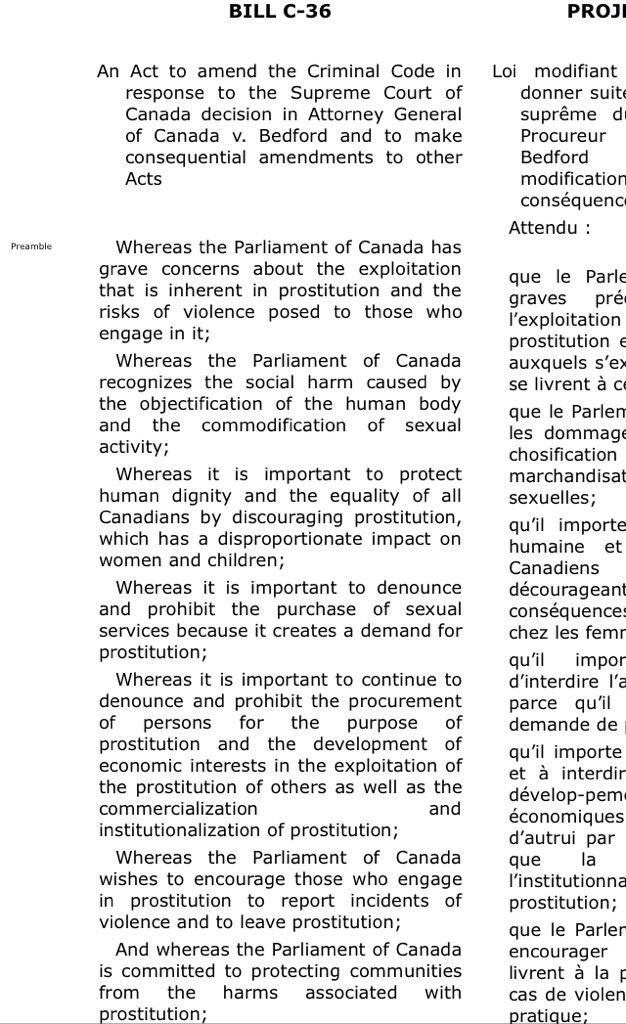
In a recent LFpress article entitled, “Escort assault stirs new law debate,” an officer is quoted as saying, “It’s very concerning because escorts, regardless of gender, go to places and meet with people who are not known to them. That in itself is a risk.”  What the officer is referring to is a recent incident involving assaults on escorts who went to a presumed client’s house.[1] When a sex worker goes to a client’s house or hotel room as opposed to hosting calls at her own location (an in-call), this is what is referred to as an out-call.

The problems with out-calls are highlighted by Himel J. in her decision. Himel J.’s decision reads, 

[338] In the report prepared for the House of Commons Subcommittee on Solicitation Laws, Dr. Maticka-Tyndale and her co-authors detailed some risks of conducting legal out-call work: [page428] it is difficult to assess the safety of a destination beforehand, the client may not be alone, exit routes may not be easily identifiable or accessible and prostitutes may be filmed without their knowledge. Some strategies to reduce these risks, such as hiring a driver or bodyguard, or meeting and communicating with a client in a public place beforehand, run afoul of the law.[2] 

The problem with out-calls are again highlighted by Chief Justice McLachlin in the Supreme Court Decision (re: Bedford). At para. 63, the decision reads:

[Himel J.] concluded that indoor work is far less dangerous than street prostitution — a finding that the evidence amply supports.  She also concluded that out-call work is not as safe as in-call work, particularly under the current regime where prostitutes are precluded by virtue of the living on the avails provision from hiring a driver or security guard.  Since the bawdy-house provision makes the safety-enhancing method of in-call prostitution illegal, the application judge concluded that the bawdy-house prohibition materially increased the risk prostitutes face under the present regime.  I agree.[3] 

The thing about the above LFpress quote is that it calls attention to two important issues within the C-36 discussion that are essentially being ignored. First, the LFpress quote highlights the problem with out-calls (they are unsafe as outlined both by Himel J. and McLachlin CJ.). Second, the LFpress quote admits that out-calls are unsafe. Yet, out of the two options to conduct sex work (in-calls versus out-calls) as emphasized above, it ignores the fact (as established in both court decisions previously cited) that out-calls are not as safe as in-calls.

But what if the assaults named in the above LFpress article occurred at an escort’s in-call location? What would a response from a policing agency look like then? Presumably, as opposed to condemning escorts for conducting out-calls, someone may criticize an escort’s decision to host at an in-call location. Instead of saying it is dangerous to go to houses of people that are unknown to escorts, the response may be to say it is risky to invite people unknown to an escort into their place. I must emphasize that replacing the fact that these assaults occurred during an out-call with a hypothetical in-call scenario are just that, a hypothetical. However, I must further emphasize that the message would very much remain the same and this message is that prostitution is inherently violent (as noted in Bill C-36’s preamble) because from this perspective, prostitution is unsafe regardless of location, in-call or out-call (which even goes to the extent of ignoring evidence by anti-prostitution campaigners’ very own gem of a researcher, Melissa Farley, that indoor workers experience less violence than outdoor workers Himel J. @ para. 353). 

The problem with the above LFpress quote and fundamentally, how the Bill will play out in the lives of sex workers reminds me of this very simple phrase we tell children all the time:

Don’t talk to strangers.

The above quote referenced in the LFpress article points to this simple piece of advice in a very indirect manner. The quote tells us that out-calls are bad because sex workers are going to strangers’ houses. So, in other words, sex workers: Don’t go to strangers’ houses. When applied to in-call locations, the advice to sex workers would look like something like this: Don’t allow strangers into your space. 

But what about the rest of the Bill? How would c-36 play out in the lives of sex workers?

Pivot outlines four sections of the Bill in their blog post entitled, “The new sex work legislation explained.” These four sections (as taken from Pivot’s blog) are below and what follows underneath each provision are advice for sex workers within the context of C-36.

Provision 213: “Stopping or impeding traffic and communicating to offer or provide sexual services for consideration” 

That is to say, don’t talk to strangers (even if they innocently ask you for directions). 

Provision 286: Prohibition against the purchase of sexual services: “Commodification of Sexual Activity”
s. 286.1(1): Obtaining Sexual Services for Consideration  
This single aspect of the law is similar to the Nordic model, in that it applies to purchasing or communicating in order to obtain sexual services.

Don’t let strange people offer you something in consideration for a sexual activity (I guess I should close my POF account and not let men buy me drinks or *gasp* go home with someone who I think is cute and is sexually enticing).

Provision 286.2: “Material Benefit from Sexual Services” 
The new provision continues to criminalize those who gain material benefits from sex work. This replaces the “living on the avails” provision that was struck down in Bedford.

So this means, you-the irresponsible sex worker-make certain you don’t give any strangers part of your income (To remind you of a few potential people unknown to you: taxi cab drivers, hotel employees, or the bar tender you tip as you sip your favourite glass of wine after a long day of work). Just don’t, mmkay?

Provision 286.4: Advertising Sexual Services 
The bill proposes to ban any advertising of sexual services

 Most importantly, don’t let strangers contact you and don’t let strangers talk to you.

The goal of C-36 is to “discourage prostitution” by attacking the “demand side” with the ultimate goal to abolish prostitution.[4] Fair enough, some people don’t like prostitution and some people hate prostitution, while others, like many anti-prostitution campaigners and the Conservative government, think it is inherently violent. 

By looking at these provisions more generally, however, the advice to sex workers, as taken from C-36 itself, would be, as stated above, don’t talk to strangers. But can we really embed the advice “don’t talk to strangers” in the lives of sex workers and legislation that ultimately affects their safety and well-being?

The SCC decision already stated that third party violence or the violence of johns does not negate the role of the state in making prostitutes vulnerable to violence.[5] C-36 restricts sex workers’ ability to conduct business in a very limited manner. The only non-criminal way to conduct sex work is by doing out-calls. Yet, as outlined above, the SCC already agreed that out-calls are the least safe option to conduct sex work. The SCC also said that, “Parliament has the power to regulate against nuisances, but not at the cost of the health, safety and lives of prostitutes. (para 136). C-36 also makes it more harmful for sex workers to conduct business by criminalizing other strategies that reduce risks in the lives of sex workers. By only allowing sex work to take place in a very limited scope (out-calls) and criminalizing other strategies that reduce risk, Parliament is regulating sex work at the cost of the health, safety and lives of sex workers. While c-36 assumes that prostitution is inherently violent, it also creates these harmful conditions, which then further legitimizes the message that prostitution is inherently violent.

In the end, C-36 says that sex work is bad because of the “strange people” sex workers let in their lives. So within the context of C-36, the advice to sex workers, in a very general sense, would be, don’t talk to strangers. Can we really tell sex workers, don’t talk to strangers? Why are we so consumed with infantilizing the lives of sex workers by giving them the same advice we give to children regarding the decisions, even if constrained, they make in their lives? Why are sex workers reduced to individuals inept at making their own decisions, even if constrained, in their own lives? 

As I stated elsewhere, if Bill C-36 were to become law tomorrow, sex workers will continue to work. People can think sex work as immoral and harmful. But if Bill C-36 were to become law tomorrow, it will then regulate against sex work at the cost of sex workers’ health, safety and lives, and that is unconscionable. 


[1] I say presumed because individuals who pose as clients to assault sex workers are not clients—they are just that, posers and these are the most dangerous individuals of all. Their intentions are harmful and violent.

[2] http://www.canlii.org/en/on/onsc/doc/2010/2010onsc4264/2010onsc4264.html

[3] http://scc-csc.lexum.com/scc-csc/scc-csc/en/item/13389/index.do

[4] See Preamble: http://www.parl.gc.ca/HousePublications/Publication.aspx?Language=E&Mode=1&DocId=6646338&File=4

[5] http://scc-csc.lexum.com/scc-csc/scc-csc/en/item/13389/index.do

$260,000 PLUS PER YEAR!

This post is inspired by this blog post written by a sex worker immediately following Operation Northern Spotlight, a policing initiative that was aimed at fighting human trafficking.

Yes, you read that title correct, $260,000 PLUS PER YEAR! Well, that is apparently how much the traffickers make in profits per year, per individual victim, and remember there are many (page 2, column A, para. 1). So that means that the traffickers are making MILLIONS! Per year, as per the “many” victims.

But where exactly did this figure, the profits of the human traffickers, originate from?!

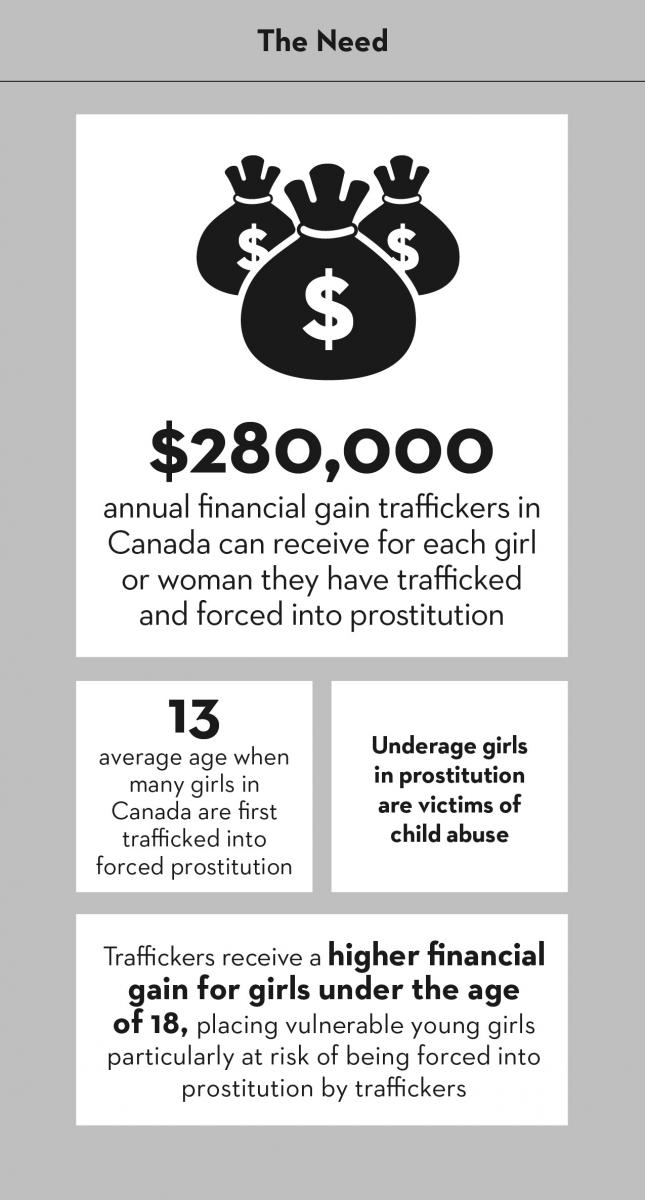
When I first started reviewing and critiquing human trafficking narratives, I was always interested in the sources of information. It is particularly compelling when government-related organizations release information and figures on human trafficking because rarely do you ever see a “works-cited” or a “references” page. The Canadian Women Foundation’s page on human trafficking, where I first found the source of this figure (the profits of the human traffickers) cites $280,000 per year in profits. Some sources cite this $280,000 per year and others, like Sweet Emily J highlight, cite the $260,000 per year in profits (and some, like PACT, cite $183,000).

Image Source: Canadian Women's Foundation

Image Source: Canadian Women’s Foundation


Post Bill-c36 and post JUST committee hearings, I am beginning to see this $280,000 figure being thrown around even more so.

Let’s have a closer look at the source of this information.. 

Remember, as Mackay pointed out, “victims of prostitution are many” (p. 3, column A, para. 1). But the victims of prostitution are not just those engaging in the selling sexual services, it also includes children exposed to prostitution (like you know, how prostitutes and prostitution are around children literally all the time), communities (be aware! your neighbour might be a prostitute) and society (*gasp* The. Entire. Society.) are also victims to prostitution. Who knew that one could be both a victim to society and an offender to society! Kind of like how the old laws: society needed to be protected from prostitutes and prostitutes needed to be protected from themselves. Neat how that happens, eh? Yeahno.

However, this isn’t a critique about the Bill itself. This post isn’t also a critique that prostitution is “intricately” connected to human trafficking, as Mackay asserted–though scholarly articles (like this one) highlight the problems with conflating human trafficking with prostitution, wherein prostitution is purely used as a legal term (a term more related to the social and economic aspect of prostitution would be “sex worker” as employed in the previous cited article). This post is a critique of this figure, the profits of the traffickers.

Specifically from MacKay’s testimony at the JUST meetings, he tells us the following:

  • Prostitution is an underground activity
  • Prostitution is inherently violent
  • Prostitution and human trafficking is “intricately” connected
  • Prostitution is associated with organized crime

Subsequently, from MacKay’s testimony, he also tells us:

  • The demand (the buying) side of prostitution fuels prostitution, human trafficking, organized crime, and also that there are really no specific statistics given the underground and elusive nature of prostitution (see page 11, column A, para 4 for a specific reference MacKay outlining that it is difficult to get statistics)

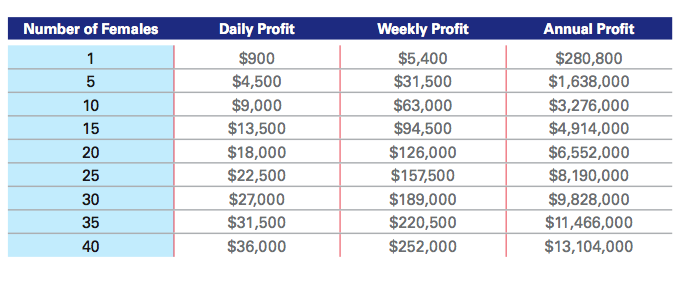
MacKay speaks from an authoritative position as a government official. A lot of what he says is rarely ever backed up with statistics, as he noted himself (again see page 11, column A, para 4). But there is one organization in Canada that has calculated (what seems out of thin air) one particular figure. This figure relates specifically to the profits of human trafficking. You can see the image below for these figures:

Image Source: CISC

Image Source: CISC

There is one thing about the source of this table. It doesn’t provide the source of its calculations–how did it come to the figures that are in the table above? *Poof* Profit of human traffickers out of thin air! Actually no, the CISC most likely obtained the figures from online ads of escorts and it appears that they reported the average range of what online escorts will charge per hour in major urban centers (as outlined below). Also, given that the RCMP reports HERE, an apparent valid source of information are online classified ads (like craigslist, backpage, and others).

Using online escort ads from classified ads as source of this information is really problematic because of its validity. In other words, this source of information comes into question because we must ask, does it really measure what they are trying to measure–profits of human traffickers. Even as Mackay asserted, traffickers are so elusive and underground that it is hard to collect statistics (and it is safe to say other figures) on this population group (again see page 11, column A, para 4). How can one figure obtained from invalid sources be touted as authoritative?

Not only this, as Sweet Emily J called attention to, there are major problems with the way these figures are calculated from a sex worker’s perspective who wants to maintain a steady stream of income. I mean, isn’t that the whole point of human trafficking–to controlling the profits made off the victim at a steady rate. So you would expect at minimum that a trafficker would require a steady steam of income and if the victim didn’t produce that required amount, from the sources listed above, violence would ensue, and hence, Mackay asserting the inherent violence.

Even if you break down these figures, it just doesn’t add up…from a trafficker’s perspective, whose goal is to control victims and you know, make that $280,800/year profit!

The above table tells us that one victims brings in $900/day and for 365 days a year and this same victim will net a profit of $280,800 (this is minus calculations for lodging, clothing and food–this is actually quite nice of CISC to include that in their calculations).

But if we actually take a look at these figures as raw figures, we see that one victim would bring in a total amount of $328,500 working 365 days a year. If the victim were advertising 300/hour, they would (at minimum) have to be staying in a $250/night hotel–no sex worker who charges $300/hour who works in an urban centre in any province stays in anything less. Otherwise news travels quick (via review sites/boards) that the rate paid doesn’t match the services offered. $300/hour is good chunk of change for any client and as Emily J says, “anti -prostitution folks like to think that ‘johns’ will just stick their cock in any hole, but this is a service industry, and clients demand good service for their hard-earned money.” I would like to be clear though, I am not here to knock on sex workers who charge less than $300/hour or sex workers who stay in hotels that charge less than $250/hour. I am critiquing the $280,800/year profit.

In order to risk losing out on profit (900/day), the trafficker would have to (logically) avoid having his victims working out of shady locations. Yet, as noted above, if news travels that the services advertised do not match the services actually offered and if word gets out that the victim’s services are not worth the amount being charged, then the trafficker will be forced to resort to booking hotels that allow the $900/day to be maintained. If the trafficker is forced to resort to lower-rated hotels, then the victim would be forced to see more clients per day to maintain the $900/day. However, to maintain a steady stream of income at the rate of $900/day, that would mean that the trafficker must book clients back to back or double book clients (to account for clients who do not show up or who cancel, because that happens too). If this is the case, at the lowest rate, it would be $100/client/hour (the lowest going rate based on online escort ads that an urban market may handle or else clients begin to question the quality of services, and who ultimately want to avoid “bad service” will begin to avoid subpar services). Sure, some sex workers charge less than $100/client. But for traffickers, that translates to a loss in profit. Continuing $100/client, the victim would then have to see 9 clients per day to maintain the $900/day. There are 24 hours in a day and if a victim is seeing 9 clients per day that means the victim could work for 12-14 hours to see the 9 clients (with minor breaks to freshen up, clean, eat, rest). This also means that the victim would have to be in a hotel 24 hours a day and also 365 days a year–hotel management would begin to ask questions. So the trafficker would have to continuously move their victims (but the definition of trafficking is so broad that some victims do not have to be moved to be considered victims which then becomes a contradiction based on the above).

Again, once news travels that it isn’t worth paying the $300/hour then the trafficker runs the risk of losing out on clients and thus, profit. As Emily J also highlighted,

So even if a client does see a trafficked girl (unknowingly or knowingly), it’s probably not going to be a good experience, and he is not likely to repeat with her, or recommend her to others. Despite what anti-trafficking and anti-prostitution activists think, most clients who purchase sexual services take many precautions, and actively avoid the nasty situations where trafficking may be likely to occur. They want a consensual interaction with a happy provider who enjoys what she is doing.” (Source)

News will travel fast that the “new girl” (because according to both personal anecdotes and government sources traffickers must keep their victims “new and fresh” or else they lose out on profits) isn’t worth the hourly rate advertised. It then becomes practically impossible to maintain the $280,800/year.


Also, as found within the sources above, that traffickers will book the hotels, book the appointments, take the calls, and also sometimes feed the victims drugs. If a trafficker was advertising the victim for $300/hour, at a 250/night hotel that would amount to $91,250/year in hotel costs. Now add in food, let’s assume, $50/day, which would be $18,250/year in food costs. These two figures together amount to a total of $109,500. Don’t forget there is also “information” that there exists a “National Trafficking Ring”:

Image Source: RCMP

Image Source: RCMP

So how do some of these victims get to and from point A to point B? Travel isn’t exactly cheap in Canada. Depending on where you are traveling to and from, for instance, it can be quite expensive especially if you are flying. It could be assumed that traffickers could also use their own transportation like their own vehicles. Yet, purchasing gas isn’t exactly cheap either. On average, to fill a tank of gas for a small car is approximately $60. If we were using this as a figure to calculate travel costs and if traffickers are moving their victims from city to city on this alleged national trafficking circuit, then I would use the $60/day/365 because you know, got to have to those victims moving! That amounts to $21,900.

But according to the RCMP, we also have reports of controlling victims through drugs and alcohol. So these figures do not even include the monies to purchase that. When cocaine busts usually happen, policing agencies usually report cocaine being sold at $10/point (meaning $100 for a gram). So if we were using the same figures as policing agencies, that would be $36,500 ($100/day/365) per victim.

To sum it up, we have the total costs to the trafficker:

  • 36,500 (drugs)
  • 21,900 (travel)
  • 91,250 (hotel)
  • 18,250 (food)
  • TOTAL: 167,900


The difference from the original $328,500 (the raw amount for one victim working 365 days a year at $900/day)? $160,600. This figure doesn’t even add up to the lowest amount that PACT reports as highlighted by Emily J. As noted above, this is amount is calculated on services being sold at $300/hour. Some services are sold a rate less than $300 (also discussed by Emily J). We need to adjust these figures to those amounts and if services being sold are less than 300/hour, then to achieve the $900/day per victim, the victim would have to see so a certain amount of clients per day. Yet, based on Emily J’s blog post, the population of men who can legally (meaning 18-64) pay for sexual services does not add up to the figure of the profit of traffickers, even in a major urban centre (Ottawa) that cites trafficking as a problem. Emily J also points out the fact that in order to achieve the $260,000/per victim/per year, a trafficked person would have to see 3.65 clients per day (which would be at the $300/hour rate). So, again, as I pointed out, to achieve the $900/victim/year, the victim would have to be forced to see more than three clients per day to achieve that rate! While some sex workers do see more than three clients per day, to maintain more than three clients per day for 365 days a year would be virtually impossible. Because if victims are moving around according to the RCMP on this alleged national trafficking ring and to avoid raising questions by hotel management, then you would have to account for travel and time spent booking into hotels. Then you would have to account for time to post ads, to take bookings and then for time to actually see clients.

Note: The above rate of the hotel comes from renting a “nice” hotel directly from the hotel site like a Delta in an urban centre. But if we were to adjust for discount hotel booking sites, the range would be $100-150 for a “nice” hotel in an urban centre. The rate then becomes 36,500 (total $215, 350) and 54,750 (total $197,100) respectively. As I outlined above, I chose to base my calculations off of “nice” hotels because in order to see the amount of clients, according to Emily J’s calculations, and to maintain the 900/day profit, every single day of the year, this is where the trafficker would have to hold his victims otherwise news will travel fast that the services offered do not match the services advertised or rate advertised and he would risk losing out on profit. This, however, does not correspond with the anecdotes from the NGOs that fight human trafficking. The story that comes out those discourses are that women are held in seedy hotels all hours of the day servicing clients around the clock. If that were the case, it then, as a described above, it becomes virtually impossible to maintain this profit 24.7 if you factor in the fact that hotel management will begin to question (and hotel management does) the amount of traffic to a hotel room, then victims will have to be continuously moved which traffickers will have to do to avoid raising any flags and if you factor in time spent traveling to and from various locations, to and from different hotels, and time spent booking into the hotel then placing ads, taking bookings, and time to actually see clients. 

However, like I previously mentioned, the trafficking definition seems to be broadening itself to include victims that are not transported to various cities. If we remove travel and hotel from the calculation, we arrive at a figure closer to the 280,800 (raw: 273,750). I removed hotel because some reports on human trafficking cite that trafficking victims are kept in condos or rooms in houses–so saying the traffickers owns the condo/house, then it reduces the costs in controlling the victim. But still, if we were to apply these to figures to Emily J’s analysis, it just does not add up! It is virtually impossible to maintain a profit of $280,800 per victim per year.

In closing, I do not refute that trafficking exists. Rather, I call into question the figures that produce these human trafficking discourses. Like Emily J says, “[trafficking] does not exist in the huge systematic ways that some people want you to believe, and perpetuating false numbers and lies only serves as sensationalism and does nothing to actually help the issue.”

And as I stated in my own testimony, conflating sex work with human trafficking does an injustice to the victims and sex workers.

Maya Angelou, Gather Together in My Name, and Prostitution

“So the young person thinks, ‘My goodness I must be the lowest thing in the world, because not only do I do that, but I want to do it.'” ~ Maya Angelou on why she wrote her book “Gather Together in My Name

The only time I have been ashamed of my experiences with respect to prostitution is when others told me how bad it was and how horrible it must have been. I was chastised and outcasted for the choices I have made.

What was horrible, though, was being told that I was a victim when I didn’t identify as a victim. What was horrible was when I couldn’t access services, supports, or rights (like any other person) because of stigmatization and criminalization. What was horrible was when I had to lie about who I was and my experiences just to be treated like a person.

Another powerful quote from Dr. Angelou, “So that I would admit where I had been, and they could see that and they could realize that You will encounter many defeats but you must not be defeated. It may even be necessary to encounter the defeats to know who you are and how you can rely on yourself and where you can pull yourself from.” I will always remember the day she made it to my university campus. I was so overwhelmed, I cried.

Update!

Hi all! 

I know it’s been a while since I actually wrote a post that updated you all on other things going on in my life. Just want to say that a lot of good things have happened since my last personal post. I will be officially (like official, official!) going to UOttawa in the Fall which I am super ecstatic about. My previous posts about my law school journey, including this one where I wrote about that I dreamt I was going to UOttawa… 

“I had 2 weird dreams. One I was going to U of Ottawa but there was a lot of obstacles. It is one of the schools I want to apply too.”

This was a note from my personal journal in 2012–two years later, I am going to UOttawa! I will admit that there has definitely been A HECK OF A LOT of obstacles (so many tears)! I am so fortunate for this experience (both the good and bad). This is one of the schools/places that I wanted to be! No matter what! 

But anywhooo, I am happy to be home and surrounded by family and love! It always feels good to return home. 

You can also check out a new tab I added to kwetoday.com which lists all my previous speaking engagements and if you are interested or know someone who is interested in having me speak/present, send this information to them! *wink wink* 

Love you all and don’t forget that you are all amazing! 

This is where I belong…

Week 6. It feels like Week 20. But really, it has only been week 6 and only two more weeks to go before the final exam: July 11 (and then I fly back to Ontario July 12). Boom, boom, boom! All at once!

As I sit writing this post, I am lying on my bed in my dorm room in an on-campus residence just a few metres away from the actually college. I sometimes forget to do this but I have to remind myself that I have come a long way since the first week. It doesn’t seem like a long time but we (my peers and I) have definitely all been working hard on becoming the best that we can be. To which I usually say, “the only person you should be better than is the person you were yesterday.” That is sometimes hard to forget. The world is built on being the best, only the best, and this never ending bad habit of comparing yourself to others—What did you get on the assignment? Did you pass? What is your mark? Do you understand what is going on? Hogwash! Down with the comparing yourself to others: seek on improving yourself and only yourself.

The other day, as I was sitting in the classroom and reading some cases before the day started, my peer walks in. I had my earphones in and I was listening to my music, as per usual. I notice some flailing arms on the corner of my eye and am slightly startled. I take an earphone out and burst out start laughing. My peer begins to laugh too and quickly says, “WE WON!” Then quickly runs off to tell everyone else, “WE WON!” It took me about two seconds to realize what was going on and to be back in the now, reality.

The Supreme Court of Canada (unanimously) recognized (a first ever in Canadian history) Aboriginal title belonging to the Tsilhgoq’in Nation.

It was at that moment–when my peer came rushing in (almost) screaming, “We Won!”–that I knew I belong in this program. I belong here. This is where I want to be. We spent our one class discussing the case–only briefly. That was also a really cool experience: to be able to be in a class filled with other Indigenous students, working hard to advance their legal education and having one of the top Indigenous legal scholars in Canada talk to us about the decision. How amazing is that! I wish many other Indigenous students could experience this–I will be forever grateful for these experiences.

Initially, I spent the first half and even after the first half (for a bit) struggling with this feeling, belonging. I constantly questioned, “Do I actually belong here?” or “Is this something I want to be doing for the next few years of my life?” I kept going back and forth on these questions—Yes. No. Maybe. I don’t even know. A questionable yes?! lol

In settling these feelings of uneasiness, I have reached out to people I admire and respect. Without a doubt, I am forever grateful for those people to remind me that I have to take care of me and to do things that make law school easier for me (like reconnecting with friends back home via skype while I am out here). I also met with someone who reminded me that the world will continue while we are here and that we should definitely remind ourselves to take a break, to come back to the now, the real world, reality. I have to gently remind myself of this too.

But the other day was so monumental–it was the day the SCC recognized Aboriginal title for the first time in Canadian history! It was also the day I knew that this is where I belong. I will remember this day for many reasons, and this will be one of them.

brain matter

Well, here I am…still in Saskatoon. Woot! I have had a lot of interesting experiences and some that required some major reflection. Also some experiences that required me to just forget about them (at the moment). This program that I am attending out west is really intense. You know when someone tells you something is going to be hard but you are all like, “Naaaaah!” No, this is really hard and intense and … I am certain there is a dirty joke in there somewhere but I can’t think about it at the moment. To describe this program in a few words is like a “make or break you.” But there are tons of supports in place to ensure you don’t break too! It is sometimes a little overwhelming (in a good way). Nevertheless, I am very grateful to be out here.

Last week (I think–it might have been this week–all the weeks just blend together), there was a former student that presented and he mentioned something that really resonated with me. I am constantly feeling like I have no idea what the fuck I am doing. I used to say that I had no idea what I was doing in undergrad but literally, I have no idea what I am doing. But anyway this presenter continued and mentioned that sometimes you will experience this. He then continued to say that what got him through those times was knowing his capability to problem solve. So obvious, right? Maybe.

This law school thing definitely requires a different style of thinking. I am used of thinking of the big picture and seeing how systems are connected and inform each other (systems like the criminal justice system). I am trying to think of ways to reframe that style of thinking to fit this new style of thinking. But I am so used of looking at the bigger picture that I sometimes miss the details (and sometimes that isn’t good). Whatever I learned in undergrad I just need to forget (or at least put on the side). Then I remember that when I first went into undergrad, whatever I learned in college, I needed to just forget. Then I remember feeling like, “Crap! I have no idea what the hell I am doing!” So, it’s like all those experiences over again but magnify them 200x. Yeah, that is what this is like–this law school thing.

Want to help fight #c36? #sexwork #cdnpoli

I have received a lot of messages from friends who were asking about what this Bill is all about? Here is a link explaining the Bill that is much easier to read than the Bill itself. This Bill is in response to the Bedford v Canada decision (which was an unanimous Supreme Court Decision). You can read about that decision here (and here is the actual SCC decision). Following this, many friends have also asked what they can do to help.

One way you can help is to write a letter to your MP. Here is a template to help you to write a letter to oppose #c36. You can find out who your MP is here. It is free (meaning no postage required) to send your MP a letter. A French-translation will be posted as it becomes available.

If you are looking for anymore sources and information on Bill C-36, comment below and I will do my best to reply.