Author: kwetoday

#Toronto @2ndHarvestTO

Happy Birthday to my nephew Lain! It is his third birthday and today I donated $25.00 in his name to Second Harvest. For every dollar donated, Second Harvest will turn it into TWO nutritious meals for “men, women, or children who would otherwise go hungry.” So that means 50 individuals will receive a nutritious meal to eat!

When I first came across this organization, I decided to volunteer with them (and also because that’s all I could really afford to do). The history of this organization is simple:

It all started in 1985 when two local women, Ina Andre and Joan Clayton, saw that good food was being thrown away while people were going hungry right here in Toronto. This contradiction didn’t sit well with them so they decided to do something about it. (Source)

Today, I choose to donate in my nephew’s name because I want him to know how lucky he is to have a mother who works very hard to provide him with a happy and healthy life. Many recipient agencies of Second Harvest’s efforts are in fact single mothers who are in a time of need or are fleeing domestic abuse. When I was 18 years old, I stayed in a women’s shelter after leaving an abusive relationship and needed a safe place to stay. Much like these women of recipient agencies of Second Harvest, I saw, first hand, how women, especially single mothers, strived to provide a happy and healthy life for their own children.

This gift in my nephew’s name is a gift to both his mom, my sister, for her hard work as a single mother, and to Lain to let him know how special he is to all of us!

Happy Birthday Lain!

What is my purpose in life?

Purpose. This word has been rearing it’s cute little face every few days or so now, and it has usually done so in the context of the question, “what is your purpose in life?” Yet, this questions only presents further questions like, what does purpose mean?

Dictionaries define it as “the reason for which something is created and done.”

So what is the reason for my life, me living, me waking up every morning. I am not a mother. I don’t ever want to be and that has been a decision I have made sometime after I turned 16. Years before that, however, I wanted no less than 3 children but no more than 5 children. Today, I am an aunty to my lovely nephew, and I am beginning to realize that mothering comes in the shape of various roles. One of those roles is being the aunty. While I do not plan on having any children (like never, ever), I do plan on being the best aunty that there can be and it really warmed my heart that my mom said she cried while wrapping a present I bought for my nephew’s birthday (that I missed being there in person) back in April before I left for out west! It also really moved me when my sister, my nephew’s mother (obviously), shared with me that my nephew received his birthday card that I sent two weeks ago and he put it up on his dresser in his new room. Moments like these are part of my purpose in life.

While I can’t define my own purpose in life definitely, I can say that I know I will not have regretted anything I have done or experienced in my life! From all the people I have met, to all the memories I have created…oh, the stories I could tell 😉

What is your purpose in life?

“Homeless in Their Homeland” by Alicia Sayers

An essay written by sister, Alicia Sayers, that outlines the history of my own family which includes no access to land/rights, displacement from the community, and residential schools. 

Homeless in Their Homeland

The line, “homeless in their homeland” in J. Edward Chamberlin’s, If This is Your Land, Where are Your Stories?: Finding Common Ground illustrates the reasons of my existence and I wonder if others feel the same way. My family is my home and they have lived this quote throughout their lives. Their experience as the first people on the land to losing this land and their language has been transcended into me. Upon exploring their past I have been able to understand my present and the conflicts I face on a daily basis while attempting to find common ground as a First Nations woman living in a Western society.

These people are my thrice-great grandparents, Samuel Kitchigekek and Cecile Chawanassigekwe to my grandparent, Lilian Kitchikekek (Kitchikeg) all hailing from my mother’s side. Each generation has significant importance to me as they have experienced themes currently defining my life.

Cecile, a Potowatomi from Wisconsin, migrated to Manitloulin Island and became a part of the South Bay band, where Samuel was from. The band travelled during each year to harvest and during a harvest in 1862, a new treaty for Manitoulin was instituted. Unfortunately, the band missed the signing and was not granted any of their land. My family’s lifestyle was changed, as they had no rights to their land. Having no rights meant they were homeless in their homeland.

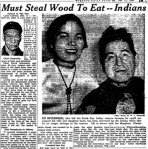
Less than 100 years later, the same story continued to affect my family. This is seen with my great grandfather, Edward Kitchigekek (1891-1964), who was removed from the South Bay band by the ‘Indian office’ because he left the reserve to make a living for his family. Edward was forced to leave because white settlers were moving onto the band’s land and he could not cut pulpwood, a source of income. He and five other families were being forced out of their own home.Picture 4
In a broader perspective, the historic and political changes during this time affected my family in the most important way – changing their home and their lives. Treaty signings were meant to designate land, but the 1862 Manitoulin Island Treaty was meant to take away land as it preceded the previous treaty of 1836, which designated all of Manitoulin Island as reserve land. Additionally, this same treaty left no land for the South Bay band.

Over 100 years after the 1862 treaty, the Department of Indian and Northern Affairs finally granted the band land. They were amalgamated with Wikwemikong, an unceded territory of Manitoulin Island. This historical moment of the forced herding of my people into smaller acres of land was reflected in my family’s lives. My people could now lead their lives but only in terms of where the government allowed them to do so. In earlier times, my people could not even live on their own land, they were forced to roam their homelands.

My great-great grandfather, Gabriel Kitchigekek (1856-1929) and grandmother, Lillian Kitchikeg (1932-1970) also brought me to this time and place for two different reasons. lillian Gabriel was a medicine man who had a cure for skin cancer during this time and it is remembered by the community that many people travelled to see him. Lillian attended residential school at St. Joseph’s Spanish Indian Residential School where Basil H. Johnston remembers her in his book, Indian School Days. Gabriel and Lillian are a mirror of the two most important things in my life: culture and education. I am not arguing residential school was a positive experience, but the themes in their lives, are still prevalent in mine.

The themes of land, language and education are who I am today. I believe these themes will continue to not only exist throughout my life, but in the lives of my children. At times I try to grab from education to take the place of being away from my land and not being able to speak the same language as my ancestors, but it’s only a fraction of who I am. As a result, at times I feel homeless, yet at least I know where my home is, it’s in the survival of my family and my people. It is with this knowledge of why I have arrived here that I can now understand where I am going. I am going home.

Chateh, Alberta

Well, another post on my adventures out west. A bit about where I am: The community is called Chateh and is located in Alberta. It is quite far north (like I previously mentioned more north than Garden River ON and for my southern ON friends, more north than Barrie ON). I love the north but I don’t like the mosquitos!

I had the opportunity to meet some wonderful people in the community, whether they are from the community or not. Recently, my partner and I had the opportunity to meet the Chief Ahnassay of the Dene Tha First Nation (DTFN) and had the opportunity to ask him a question that has been on my mind since being placed in Chateh.

Sometimes the community is referred to as Assumption. However, a lot of the community members from Chateh refer to the community to the same name, Chateh, and I wanted to know the difference in names. When we had met the Chief, this is one of the many questions we asked. He stated that the name Assumption comes from the Bible in the part where Mary’s body and soul is assumed into heaven (source). And the name Chateh comes from one of the traditional chief’s name, Chief Chateh. Chief Chateh was one of the traditional Chiefs along with Chief Zama, Talley, and Chonkolay (source). He also stated that they are moving away from this name, Assumption, and towards the name, Chateh. One of the most prominent steps toward this move is evident with the community name, Chateh, being present on maps and road signs! While one may not understand the significance of names/traditional names, one can appreciate that naming/labels are important to one’s identity. Recognizing the importance of naming one’s own self or own community as opposed to having names or labels imposed onto one’s self or community is important to Indigenous peoples and nations’ self-determination.

I feel really honored to be here in this community and to be surrounded by a group of amazing individuals…obviously! 😉 All of whom include my partner, the youth, and the community members.

A note from my personal journal

A note from my personal journal that I write in (try to) at least once a week. Dated July 3, 2012…


“I had 2 weird dreams. One I was going to U of Ottawa but there was a lot of obstacles. It is one of the schools I want to apply too.”


Today, I just registered to write my LSATs but I am still unsure about law school or masters (or as everyone keeps telling me, “why not both!”), and U of Ottawa is still one of the schools I still want to apply too!

And the second dream was just too weird 😉

Be in the moment…

A late night post saved for early morning…

About two weekends ago, it was Canada Day weekend. Last year, I can’t even remember what I was doing for Canada Day (and no, that is not due to consumed liquids). This year, as noted in previous posts, I am out west and quite north…like more north than Garden River, Ontario (and for all my southern Ontario friends, more north than Barrie, Ontario). I am loving every bit of this experience. However, one of the hardest things I am dealing with right now, and since being out here, is missing my family. I missed some milestones in my nephew’s life, missed some family members’ birthdays, and yes, I am missing my best girlfriends back home who are doing their fantastic activist/social justice work! The hardest is that I haven’t even seen my dad since last Christmas. Thankfully, my family understands and they are extremely supportive right now.

Back to Canada Day weekend, I spent Canada Day in Edmonton with some amazing young people who are continuously teaching me to valuable lessons on the daily and this weekend was one of those times to learn a valuable life lesson.

During this adventure, I recall sitting on the bus and taking a moment and thought about back home. My mind wandered over to the thoughts of my family and friends back home in Ontario, how much I missed them, and how I didn’t get to see them, and… I am sure you get the point. I was looking out the window down onto the passing cars. Then, for a brief moment, I looked up and saw the Edmonton skyline, and while looking over to my left, I noticed one of the youth jumping back and forth from one seat to the next. Next, I saw him taking pictures of the skyline from one seat to the next and gasping, “Wow! Look at those buildings!”

Having lived in Toronto, and some major cities, Edmonton, to me, isn’t that big (okay, maybe it is a little big compared to Sault Ste Marie and London). Yet, seeing this one youth being amazed and just loving the views we were seeing from the bus made me realize how important it is to live in the moment that we are in, to be present in all senses, and to be present in thoughts and feelings. And this young man glowed with excitement not just this one time we saw the skyline but each time we saw the skyline. Each time he said, “Will you look at that view!” and each time, I was even more thankful to be in that moment with this young person so amazed and excited by this skyline. In this moment and watching this young person, I was taught the small yet important lesson to be in the moment. 

Next time I am feeling like I am missing home, I will remember this young man and to be in the moment. Our moments in life our only temporary and we should learn to experience them as a whole. Be in the moment! 

The Immortal Life of Henrietta Lacks

“Black scientists and technicians, many of them women, used cells from a black woman to help save the lives of millions of Americans, most of them white. And they did so in the same campus — and at the very same time — that state officials were conducting the infamous Tuskegee syphilis studies.” —The Immortal Life of Henrietta Lacks

This quote begs the question: Why is it then I didn’t hear about Henrietta Lacks until later in my studies? I mean, the problems with the Tuskegee syphilis studies were drilled into our heads in first, second, and finally in third year of sociology-based courses. Was it because the Lacks’ case only directly involved one person, a poor black woman, and nobody else (except her family)? Why have I only heard it about recently and in my women’s studies class? That’s my issue with sociology as a whole area of study.

Healthy Eating in Da North! Part Deux

As promised, I am writing this post because I would like to share how I am adapting my preferences in eating up here in da north! Last post, I talked about how I found it hard to eat healthy in general. For obvious reasons, the grocery store is about an hour away and also the prices are uber expensive. Plenty of people in the community usually make trips to more “southern” parts of Alberta and try to combine their trips with other purposes which helps a lot with planning meals for their own families.


Being a single person, on my own, I only have to worry about my own mouth.


My first couple of grocery trips cost me approximately $100 as I had no idea what the hell I was doing. I finally made a list on my last $100 grocery trip since I needed to plan more. Some of the things I bought were seasoning and more frozen fruit (remember? I like my fruits albeit fresh, but this will do). I also began to buy my yogurt in bulk especially when it is on sale since it costs about $6 bucks when it is not on sale. I usually buy 3 of these and then freeze 2 of them. Also, don’t forget to check the expiry date on these items. If you notice that the front items are going to expire soon when they are on sale (that’s why they are on sale), reach back further and grab an items with an expiry date that isn’t so soon.


In my adventures up north, one thing I also noticed is the strange pricing behavior when it comes to special-dietary eats (or whatever you call them). What is really mind boggling about the grocery stores up here is the price of tofu and other special-dietary eats is that they tend to be cheaper or equal in pricing in comparison to Southern Ontario (back home). I am loving it and I am beginning to wonder if it is because tofu and other such items are not that “popular” out here.


Aside from the above, another tip: I stock up on canned goods like beans, chickpeas, and sauces (like marinara). I stay away from canned soups and canned pastas since these tend to have a lot of sodium and other bad things for you that make the food taste so yummy! One tip I learned about purchasing canned goods is that if you must buy these items, you can put one can in the fridge and there will be a top layer of grease/fat that you can usually scrap off before you pour it into the pot to cook it (seriously). I don’t know how much this helps since I rarely buy canned soups to begin with but wouldn’t hurt to try it if I had to resort to buying canned soup at some point.


Another thing I am tending to stock up on are chickpeas. With my chickpeas, I usually make a chickpea salad with carrots (veggies that last long), jalapenos, and banana peppers. This is what I like but you can add whatever you like. I think I may add chickpeas to a pot of boiled brown rice and corn one night. I am not sure how good that will taste but I am sure I can make it work 😉 I think I would also like to add beans to that mix which is inspired by this one dish I had at a gathering at my university offered by Indigenous services.


Another meal I would like to try that is also inspired by one of those gatherings is spaghetti squash. This seems like a rather healthy option since it doesn’t even use pasta (something that makes me feel really heavy after eating it which I don’t like). The squash lasts a long time too, and is super cheap compared to whole-wheat pasta. I haven’t made this before but I seen it being made it seemed pretty easy. I shall write another post on that adventure!


Anyways, just a short post for now.