Author: kwetoday

Canada and US: Guns

First things first: My heart goes out to anyone who has a lost a family member, a friend, a loved one, etc. attributed to gun violence.

I am writing this blog post after much deliberation and thought. Over the last few days I had much conversation in person and online somewhere with various individuals on handgun bans or about strict gun control. This type of conversation usually festers a lot of emotions inside me. Not because I have lost someone to gun violence *knocks on wood*. Not because I am a gun-totting Indian. Not because I despise law enforcement. Rather, it is the fact that individuals who are unfamiliar with crime stats/reports, gun violence stats/reports, regulations/legislation, or rights of others tend to be reactive to the issue. By being reactive to this issue, individuals tend to stick to questions that appeal to emotion rather than logic or facts.

The fact is that nobody will ever answer a question relating to gun use or gun violence that goes along the line of “Well, what is the sole purpose of a gun other than to kill people?” where this question had repeated itself on my twitter list. Of course, a gun can kill a person. A gun can kill anything. Well, actually it is the bullet and the gun powder in the bullet that kills. The gun just serves as a vessel. A gun can be used for sport and for hunting, whether it is for game (which I don’t support as a First Nations person) or for food. For example, take the recent story in The Toronto Star featuring Chris Baldwin and Sabrina Sergeant who were re-allowed to take part Ontario Summer Games after “city staff made a decision not to have the athlete am

bassadors representing sport shooting participate in the on stage welcoming ceremony.” Yes, that’s right. These two young, budding athletes in their chosen sport were treated like criminals for simply participating in a sport of their own choice. Then you have a particular group of people who were given treaty rights (and even have other groups fight for their non-treaty rights) to hunt for food in their particular territory. This right, whether it is non-treaty or treaty, has been fought for in court. Have you ever fought for your right in court? I doubt it. On top of this, Indigenous people in Canada are the most policed population group. Meaning, they are simply targeted by policing agencies for being who they are: Indigenous. The proof in this is the rates at which they are arrested and at which they populate prisons, whether it is provincial or federal

So when people told me that only law enforcement should be allowed to carry guns, all I could do was shake my head. I also shook my head when someone said that handguns should be banned and then eventually society will be socialized to accept this. Sure, in a perfect world. Yet, given the most recent incidents, we don’t live in a perfect world. If we did live in a perfect world, James Holmes’ alleged fantasy of playing Joker would just get him into a fight with Batman with a few “pows” and a few “bangs” here and there. Sadly, that didn’t happen. People lost their lives and families/friends lost their loved ones.

In contrast to this incident, we have, in Canada, an alleged issue of gun violence at a gang-banger level.  The views on this differ from various criminologists. Some say that it could have just been a fight over a girl. Others say this could not be a gang fight because gangs do not like to attract public or police attention. So what is the issue? In another GTA community targeted by marked and unmarked police officers for their supposed high crime rates, police are calling out the fact that they cannot arrest the single mothers who are opting for opportunities that are presented to them by fellow community members *ahem* drug dealers who are asking single mothers and children to act as look-outs for their business. The police are complaining that they cannot patrol the drug dealers. The police are complaining they cannot criminalize single mothers for trying to make best use of the opportunities presented to them. Yet, the violent crime rate seems to be falling. Yet, Mayor Ford was $10 million dollars to add more police. Yet, the programs that Amiga Taylor had hoped to see put in place 5 years ago to help deal with gun and youth violence are no where to be found.

Amiga Taylor lost her brother, who was shot dead at BBQ near Sheppard Ave.. She would like to see things like more community policing, more social programs, and the room for trusting relationships to build between police officers and community residents. These are all valid items that SHOULD be looked at. The idea that more police creates safer communities and that only police should be allowed to carry guns does not work in favour of community policing or social programs or opportunities. It further stigmatizes communities such as those recently affected by the GTA shootings. It doesn’t do the residents of those communities any justice in creating equality and in creating opportunities. It limits the room for equality, freedom, opportunities granted to other Canadians not living in such stigmatized communities. There should be room for opportunities to meet police officers not just in retroactive situations. Wente’s most recent article on the Danzig shooting demonstrates this. Wente highlights that the residents of the Danzig community are “not really helping the police.” This could be very well true because one of the residents has already had her face plastered all over the media and has been arrested in front of her children. Then in Wente’s same article, a city-councillor blames the system, and the fact that is it broken. The fact is that the system isn’t broken–it is made to do exactly what it is meant to do, and that is perpetuate the cycle of poverty. When programs are cut and job opportunities moved else where, there is no place else to go but stay put. Social welfare is not made to make people get rich and it isn’t very helpful for those who do try to find work and try to get out of the system.

So what’s the answer? I cannot even compare two separate country’s incidents because both countries view the right to carry arms very differently. In the United States, it is entrenched in their constitution “a right to bear arms” and in Canada, there is nothing in relation to the right to bear arms. The way the two countries also interpret the law according to the constitution is different. The US uses the intention of the “founding fathers.” Meaning the US courts will refer to what they think or how the founding fathers would have interpreted the law to date. In Canada, there is the living tree doctrine which states that the constitution is organic and will change with the times. And again, the way the two countries have their criminal justice systems set up is very different. In the US, there is a different criminal code for each state and different sanctions. In Canada, there is one criminal code and for some crimes, mandatory sentences (which I don’t agree with). The answer to each incident cannot be the same. The answer to the Colorado incident raises many questions but to ban guns would mean to infringe on the rights of all American citizens. Even the rights of those who legally carry and store their guns. The answer to the incidents in the GTA also raises many questions but to ban guns and only to allow police to hold and carry guns will further stigmatize the communities and the residents of those communities, and limit the rights of those who fought for them in the court system.

To me, the answer lies in the youth. We must look to the youth for answers. They will be the ones that will be most affected by the changes. If there is no social programs or opportunities for them in the future to help them turn away from the opportunity that crime provides, then what have we accomplished by simply adding more speciality cops and more surveillance to alleged high crime areas? If there is one thing I can suggest it is what I say in this last paragraph: Support the youth and don’t just support programs. The youth will be the ones who use the programs and they have to be the ones to help design the programs. The youth will be the ones who rise above the violence and make conscience decisions to not contribute to violence. If you do not give them the space to feel safe and comfortable to make those decisions, then what have we accomplished? Nothing.

For sources used in this blog, please refer to the links below:

AFN AGA

“Wow!” is the only word I have to say in response to my past experiences in the last little while!

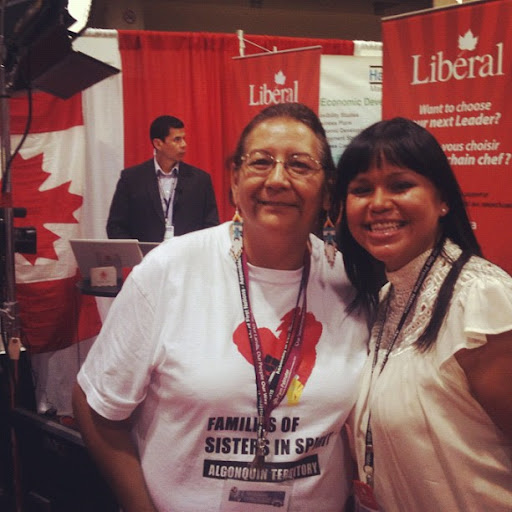
I had the opportunity to attend the Assembly of First Nations Annual General Assembly. This was my first time attending this event and I had a lot of fun! I was able to attend because it happened this time in Toronto (which is close to where I am currently living). I also had the chance to participate in my first Liberal.ca/live webcast! It was a lot of fun!

I had the opportunity to interview Sheila Isaac of the Indigenous Women in Community Leadership program of the Coady Institution and one of her graduates of the program; Bridget Tolley (pictured with me below), one of the co-founders of Families of Sisters in Spirit (who is amazing by the way); Tammy Martin, the executive assistant to the VP of education at Indspire, formerly known as National Aboriginal Achievement Foundation; and Jeannette Corbiere-Lavell, the president of the Native Women’s Association of Canada. It was really awesome to be able to interview all these strong, inspirational women while also being at an event that also had several strong, inspirational women running for the position of National Chief! There was such a positive vibe at these event!

I also had the opportunity to meet many amazing people, and had a few people come up to me to introduce themselves to me since they knew me from twitter (Don’t you just love twitter for that!). Some of the amazing people that were also there were Dr. Carolyn Bennett, our Liberal Aboriginal Critic, Dr. Kristy Duncan, our Liberal Environmental Critic, the fellow from EHL Homes who helped deliver homes to Attawapiskat, Cindy Blackstock, First Nations Child and Youth Advocate, and many many more! There were so many people who stopped by to find out more information, and to share their stories!

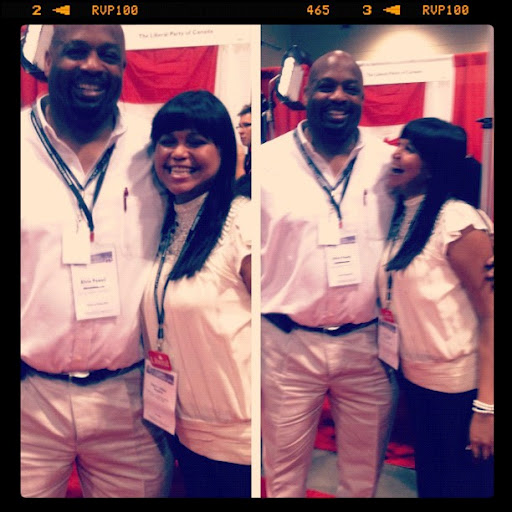
One particular story or interview that I enjoyed hearing was Alvin Powell’s interview. I was sitting in the back behind the curtain when he was on live. However, I could hear him telling his story and what he is up to now. I decided to approach him after hearing what he had to say on drug use. We talked a bit about our past and it was really nice to meet someone who shared similar experiences. I had to take a picture with him because he was sooooo tall, and he also used to play for the Miami Dolphins and Seattle Seahawks! For the record, I am about 5’9.

What the most exciting thing was being able to share a little bit about the APC to other Indigenous women who were interested in participating with the commission. That was really awesome especially since I am the VP-women’s rep. To be able to share my experiences and to get them excited about wanting to learn more about the LPC and the APC was super rewarding!

In the end, I had a really good time and I hope that I can make it again for future AGAs. The people that made the webcast and the booth happen: I just want to say thanks for everything and all the help/teamwork that everyone put forth! I have met a definite group of nice, young, ambitious Indigenous peeps that make me proud to be both Indigenous and a Liberal!

For more information on the APC, click HERE.

Being a woman

In society today this is how it goes for most women (still.. today):

  1. If you are single, there is something wrong with you.
  2. If you are childless, there is something wrong with you
  3. If you are single and childless, there is definitely something wrong with you (and you are making it worse by not getting married).
  4. If you are not married, there is something wrong with you.
  5. If you are married and childless, there is definitely something wrong with you too.

You know what is wrong today? Society. I am happy, single, and childless…not single, unhappy, and helpless.

The Help

Here is a draft post that I never published at the time. I am going through my draft posts and deleting the ones I don’t want or editing the ones I would like to publish on http://www.kwetoday.com … one day. Here is this particular post’s ‘one day.’

I am watching The Help today. I always like to rent movies whenever I’m feeling blue especially movies about real life. None of those fluffy, lovey-dovey movies. This movie reminds me of lady I met while on the greyhound coming back from Toronto. She asked me for help with trying to get to an address by bus. I was able to help her and get her to the correct bus stop. I told her she had to make a transfer too. During the rest of the bus ride, she shared a bit of her story.

She said she was working for a family, taking care of an older lady, and she continued to say “the father and son are doctors here in London.” I asked her how come she was taking the bus…the city bus to her destination. She said because that’s what they can reimburse me for. I asked her what did they reimburse her? She said, “Half the bus ticket.” That’s a whole $1.38. All I could do was shake my head. A family with two doctors couldn’t afford to pay for a cab fare her destination. It was also snowing out that night. Wet snow. We almost didn’t make it out of Toronto and back in London in time. So it was dark out.

The lady said she wanted to go back to school. She also said her family would pay for her to go back to school.

I always wonder if that really happened.

Something interesting….

Here is something interesting that I read today in the London Free Press: the article titled “Canada pledges aid for Afghan women.”

This is interesting to me because since Harper won the last election there has been many drastic changes within Canada. Among those drastic changes were some that directly affected Aboriginal organizations across Canada, and many, if not all, Aboriginal communities across Canada.

Here is a list of blog posts taken directly from Dr. Carolyn Bennett, who is the Aboriginal Affairs critic, amongst many other awesome things.

*If there is going to be any one article of the above just listed, I suggest you check out the last one mentioned.

While referencing the original article listed above, there was a question about whether or not the international governments should help Afghan women and girls? Sure why not!

The only thing that I am upset about with Canada helping women and girls is that they will not help the Aboriginal groups back home, especially Aboriginal women and girls! Why is the government investing in millions when they just cut millions that negatively affect the most disadvantage group in Canada!

Among those budget cuts, there was no mention of funding for post-secondary education for Aboriginal peoples, or no mention of funding for housing for Aboriginal peoples/communities, no mention of new investments in health. What is most alarming is that there has been no help or mention of assistance to finding the over 600 missing and murdered Aboriginal women in Canada or helping their families!

All I have to say is WHAT.THE.FUCK Harper!

Help home first!

Exciting News!

Today was a really good day! Okay, I lied…it was a really, really, REALLY good day actually 🙂

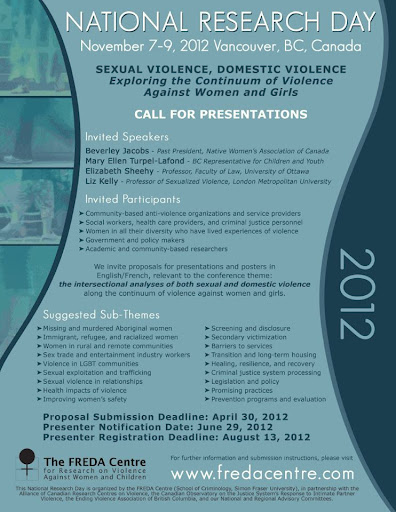
I got 2 really good news today: I won a scholarship and I also got accepted to present at a conference I applied for, I believe, back in April. The funny thing is that I applied for fun and was unsure that I would be accepted. Some of the amazing speakers include the following:

  • Beverley Jacobs, Past President, Native Women’s Association of Canada
  • Mary Ellen Turpel-Lafond, BC Representative for Children and Youth
  • Elizabeth Sheehy, Professor of Law, University of Ottawa
  • Liz Kelly, Professor of Sexualized Violence, London Metropolitan University
I remember I applied on the due date for submissions and was not sure if my topic would fit–I just submitted it anyway. I will announce my topic later. Just a little hint: the call for submissions asked for presenters to speak to the theme of intersectional analysis of both domestic and sexual violence along the continuum of violence for women and girls. There are many more sub-themes suggested. Check out the poster (below) for that list.

Anyways, now I have a new project to be working on 🙂 I am definitely looking forward to this and definitely lots to be grateful for! 

Update!

Well it’s been a while since my last blog post and a lot has been going on in my life. Some great things and not so great things.

Not so great things? I haven’t been able to go to the gym as much as I would like to. I need to change that. I can feel it in my body and mental state that it is affecting me. I feel depressed when I don’t eat healthy or exercise as much. So I just need to change that and commit to it. I started to make a “goal-setting” book. In it, I have cut outs from magazines of healthy recipes and tips for eating healthy. I just started it so hopefully it will be something that reminds me. The thing that really gets in my way is that I don’t have a set schedule anymore (like while I am in school or doing a regular job).

This leads me into the great things! I had the opportunity to sit down with someone I look up to and admire (including the work that her organization does). That person is Jessica Danforth! She is pretty amazing and does a lot of amazing work with Indigenous youth and women. Her organization is the Native Youth Sexual Health Organization and I did a little bit of transcribing for one of her projects with Metis Women/Youth. I don’t know much about Metis culture/practices but I did learn a lot about sexual health and environmental/land justice. So it definitely was something that I enjoyed doing for them.

Then during last month, I had the opportunity to put on a 2 day workshop on fighting stigma in the post-secondary classroom on campus! This project was funded by the Native Youth Sexual Health Network and Girls Action Foundation (big thanks to both organizations). This project was really fun and something that I enjoyed doing. I had an event planning business in high school that won 2 awards (one regional and one national). My experience in planning events really helped with this project. During the first day, the power went out in the main building! I thought “Oh, no! Of all things that had to happen, this just occurred!” I panicked a bit but the participants and speakers were both really awesome–they helped move the workshop outside and we had a little picnic under the sun. One of the speakers, Amanda Aikens, sang and drummed for the participants which was really beautiful. Then by the afternoon, when are our room was ready, we all moved inside for more food, and games with another awesome speaker–Cortney Aikens! She spoke on LGTB2QQIAA issues. What was really cool about this workshop is that I geared it toward undergraduate students on campus but a graduate student and several non-students also attended! There were lots of stories shared and great discussions that happened.  The second and last day went by with a breeze and less impromptu events! The speaker, Andrew Judge, was really awesome! He had shared some great stories and pictures with us. It was really an honor to have all 3 speakers there and the awesomeness of the participants.

In addition to all of this, I am going to an interview for the board-member position at Dale Brain Injury Association tomorrow! I am able to receive this opportunity because of a pretty-rad organization here in London ON called “Emerging Leaders.” This organization held an event back (I think) in April where the Emerging Leader members could meet other board members from other organizations here in London. I was super excited that Dale Brain Injury Association was there because I am a brain injury survivor myself. Today, I still volunteer with the Ontario Brain Injury Association (I have been volunteering on and off with this organization a year after my accident–which is almost 10 years now)!

I have also been able to attend some events in Toronto for the Aboriginal Peoples Commission and will be looking forward to the coming month with them! I will also be attending my first Assembly of First Nations Annual General Assembly! I am super excited for all the things that have happened or has been happening in my life since school is now over. Come to think of it all, I don’t think I would have been able to do all this awesome stuff if I didn’t lose my job 😉

I am hoping to be blogging more especially about recent news articles and the upcoming events!

Definition and Legislation: Human Trafficking

A piece I wrote for an organization on human trafficking. In particular, I focused on the definition of human trafficking and human trafficking legislation. Sources are available below!

A recent issue identified by the RCMP and Canadian Federal Government is the increase in human trafficking. In relation to this issue, the discourse that surrounds human trafficking definitions and its legislation is troubling for sex workers in northern Ontario, including Aboriginal sex workers. One of the key issues among various reports is the definition of human trafficking itself (Sikka 2009: 4; RCMP 2010: 8). The RCMP uses a two-part definition stemming from two different pieces of legislation, the Immigration and Refugee Protection Act (IRPA), and the Criminal Code of Canada (CCC) (RCMP 2010: 6). The major difference between these pieces of legislation is how they attempt to identify human trafficking victims themselves. On one hand, the IRPA attempts to identify human trafficking victims at an international level, meaning the crossing of an international border (RCMP 2010: 8). On the other hand, the CCC identifies human trafficking victims as being “uniquely Canadian” and unique to “vulnerable, economically challenged and socially dislocated sectors of the Canadian population” (RCMP 2010: 8). The use of the CCC definition is an attempt to target those populations in socially dislocated regions. These specific regions are characterized as regions with excessive resource development, specifically northern First Nations (Campbell 2008: 66). In addition to the CCC definition targeting specific regions and specific populations within Canada, a human trafficking victim does not have to be consensual or non-consenual in the elements that surround human trafficking; thereby, removing agency from the victim (RCMP 2010: 43). In “Human Trafficking in Canada,” the RCMP has identified that human trafficking victims and human trafficking perpetrators may share the same ethnic background (RCMP 2010: 1). Therefore, the CCC definition potentially criminalizes relationships between a sex worker and their family members. For example, family members of similar ethnic background of sex workers and who also share the same residence or who are also receiving material benefit (food/clothing/shelter) from the sex worker’s income might be subjected to charges under section 279.01 (1) and 279.02 of the CCC. The RCMP has also identified that sex workers may not identify themselves as victims of human trafficking (RCMP 2010: 38). It is the criminal justice system and its definition that defines who is the victim (or the perpetrator). Even if a sex worker does not agree with the label of being a victim or being trafficked, he/she may be forced to see herself as a victim in order to access adequate health services. Definitions of domestic human trafficking limit the sex worker’s freedom of choice, and potentially criminalize personal/familial relationships of the sex worker. This type of oppressive legislations removes agency from sex workers by applying the label of human trafficking victim even before all elements of alleged human trafficking are met, and targets sex workers in the north, specifically Aboriginal sex workers.

Sources:
RCMP: http://publications.gc.ca/collections/collection_2011/grc-rcmp/PS64-78-2010-eng.pdf
Sikka: http://iog.ca/sites/iog/files/2009_trafficking_of_aboriginal_women.pdf

Campbell, Kathryn M. 2008. “What Was It They Lost? The Impact of Resource Development on Family Violence in a Northern Aboriginal Community.” Journal of Ethnicity in Criminal Justice 5(1): 57-80.

Rafferty and the media.

Some people may be wondering why do some criminal lawyers represent such horrible people who commit heinous crimes? However, I do agree with what Rafferty’s lawyer had stated the article in the globe and mail today entitled ““After defending a child killer, Rafferty’s lawyer opens up.”

In the article, Mr. D. Derstine opens up about what it means to represent someone like Rafferty. In summary, it is about protecting individual rights–rights that are guaranteed by the Charter of Rights and Freedoms which many Canadians today forget about because they think or assume they will never need to defend those rights and freedoms–and the criminal justice system.

It was refreshing to read about how and why the evidence on Rafferty’s laptop was excluded from the trial: it had been obtained improperly by the police (without a proper search warrant). One of the rights guaranteed under the Charter is a right to be secure against unreasonable search or seizure. This has not been mentioned in any other articles written by the media. What has been mentioned is what the contents of the laptop were. That’s it.

Specifically, section 8 of the legal rights section of this states,

“Everyone has the right to be secure against unreasonable search or seizure”


Simple enough, right? Not really. There have been many cases that have defined what it means for a search or seizure to be unreasonable. In layman terms, however, it may mean that police do not have the right to search or seize your property without first having probable cause or a search warrant. And you know what, the police probably did have good reason to search Rafferty’s laptop but they don’t have a right to go and do it without following the rules (rules that should be followed by police–not rules that should be only followed sometimes and sometimes not).

Police should and must be held to a higher standard within Canada. Special exceptions should not be made for certain people and certain crimes.

Am I agreeing with what Rafferty did? Not in anyway shape or form. However, I am agreeing with what his lawyer said. If we did not these types of lawyers fighting for individual rights and protecting the validity of the criminal justice system, then we might as well be living in a police state.

Oh wait, we already are 😉 Thanks Harper!

For full text on individual legal rights within the Charter of Rights and Freedom, click HERE. Know your rights people–whether you think you will never need them or not… it is always good to know what is available to you as a Canadian and what is available to other Canadians.

Note: This is a commentary blog not a legal advice blog. Please do not follow this blog post as legal advice in any way shape or form.


Lifting Our Voices **event**

Here it is!

I had the opportunity to gain some funding to start a community action to empower Indigenous women. Thanks to Native Youth Sexual Health Network and Girls Action Foundation! I almost didn’t apply because I didn’t think I would be able to do it but I applied anyways. What have I got to lose? Nothing!

You can view the poster by clicking on the image below:

A bit of background as to why I thought of this:

I attended an earlier workshop who addressed stigma with another group. A lot of what I learned in this workshop could definitely be transfered to other areas in life or other topics up for discussion, like Indigenous issues. I included LGBTQ2 because before settlers arrived, Indigenous nations valued 2-spirit people and held them with high regard. However, today, they still face stigma!

In my first year of university, I was a bit overwhelmed on a few significant occasions. So much so, that I had to leave the classroom. Some of the things I would hear from students were:

We need to stop giving the chiefs handouts and start giving them handups I have no idea what this means but the discussion that followed it was not all that warming.

“Aboriginal people face high poverty rates because they do not have the same mental capacities as other races” This was in an online classroom and I had no idea what to think.

“It’s funny how people with unrelated degrees can get jobs in unrelated fields” This was said in my presence after being hired on a health research team as an Aboriginal cultural consultant and I did not have a health-related degree.

The above are just a few examples and I know I am not alone as a student. I thought to create this safespace/empowering workshop environment so that other students can meet, share their stories, learn skill sets/gain experience, and discover that we can all support each other in our educational pursuits!

If you are interested in attended, please do not hesitate to contact me! Any questions/comments/concerns, please email me (nls@kwetoday.com), comment below, or follow instructions on poster!

Looking forward to this opportunity!