Author: kwetoday

Expo 2012

Eeeeek! I can’t believe I read this article in the Globe and Mail. The article is titled “Canada can’t afford to attend Expo 2012 in South Korea, Heritage Minister says”

I read this last week and I was immediately thinking WTF! Really, WTF. Okay, I get it though. The expos are not top priority but why wouldn’t Canada be a top spot for visitors at the expo? I mean we have a lot more to share with the rest of world other than Cirque De Soleil show up? Is Cirque De Soleil even part of Canada heritage? I am not totally sure.

What is this 2012 Expo all about or how does it differ from other international events: regular every day people can attend the expo. As the ExpoMuseum site reads,

world’s fairs are unique in that the everyday person can experience them firsthand, not just athletes or politicians.

Previous expos were held in 1967 in Montreal and then again in 1986 in Vancouver. The first one being held in London 1851 at the Crystal Palace. I wonder if anyone could attend back then? Or were they just first-class citizen events only? Times have changed since the first one and a lot has changed in Canada since the first one back in 1967. I mean Aboriginals only won the right to vote 7 years earlier.

I got to thinking even more and thought that there is a lot of great items to showcase and feature at an international event. I couldn’t believe that the rest of the world isn’t interested because of their “shallow understanding.” The article reads,

“The shallow understanding of Canada, of Canadians and what is unique about Canada hinders top-of-mind interest in visiting the Canadian pavilion,” the report said.

I think the only shallow thing here is declining the invitation and perhaps the only people who have a shallow understanding of Canada are those that choose to decline it. Thanks, Canada you show your understanding and class so well. Maybe we can make another “Heritage Commercial” that shows Canadians declining an invitation to this event.

You can read another related article here titled “Liberals Blast Tories For Skipping Expo 2012 in South Korea.”

So you’ve hired an Indian. Now what? Part 1

So you have hired an Indian now what?

Well, I have written about my experiences living and working in a non-Aboriginal setting. What is a non-Aboriginal setting? I think describing this sort of setting has to do more with an organization’s overall goals and reason for operating on a daily basis. When I looked at various Aboriginal organizations or organizations with specific departments dedicated to Aboriginal relations “About” or background information sections I found some common themes:

– Working towards self-determination for Aboriginal people

– Increase awareness and understanding of Aboriginal issues

– Mutual respect/equal partnerships with Aboriginal communities and the organization

An organization or department that operates outside these common themes, to me, is a non-Aboriginal organization/setting.

When I was reading these various organizations/departments background information sections, I found that they all had goals. You know, sort of like a mission and vision statement. I thought that was a really good thing to have because I have worked for organizations who had no clear plan. They just hired an Aboriginal and hoped for the best or for even something magical to happen. For some people there seems to be this idea that all Aboriginals know everything about everything – everything being Aboriginal culture and traditions. We don’t. In fact, not all Aboriginal people’s traditions and beliefs are the same. Yeah, you read that right: we are not all the same. I think that is what is wrong with some organizations who do try to help Aboriginal people: they think we are all the same. An organization may even have good intentions in approaching Aboriginal issues but completely miss the target if they fail to understand this basic concept. What one community or group of Aboriginal need/want, may be completely different from what another community or group of Aboriginal need/want. That actually goes for any community…not just Aboriginal communities. Or an organization may recognize that we are not all the same but what they find in working with certain communities they think can be easily applied to the rest of the communities. It doesn’t work that way either.

So, you are an organization, either operating around those themes mentioned above to aid Aboriginal people/communities or not, but you have hired an Aboriginal…now what? Don’t expect anything magical to happen. That happens only in Hollywood where sometimes real Indians are not even used. Check out a documentary called Reel Injun to see what that statement is all about. Oh, try to remember we are not all the same. That means we have different beliefs, values, traditions, and even a different understanding or awareness of Aboriginal issues. Not every Aboriginal knows everything about everything. And please, if you hire an Aboriginal person, you don’t need to tell them you hired them because of their background/ancestry. They probably have a good understanding. Tell them you hired them because of their knowledge and experience. Keep it classy. Besides, you might make someone else a bit upset in the office. Not everyone can be Indian.

As I write this post, I think that what I really want to say and share is not going to be easily put in one post. So, here is the first of many to come.

Digi-vacay/mini-vacay

So I took a break from the online world and also from the real word. It was much needed.

A lot happened over the much needed short-lived break. Things like…

  • Apparently John Ibbitson was at the AMO conference in London ON. I mean the site said he was supposed to be there but I don’t know if he was. I don’t know what I would have done if I saw him out and about in London. Perhaps asked him about his piece in the Globe on the AFN education panel. You can read my post HERE in response to his opinion piece.
  • Jack Layton passed away. RIP Jack Layton. And I didn’t stay in Toronto to catch the funeral. Funerals aren’t my thing but was glad to read the updates on my twitter feed and the positive comments about the service.
  • I dyed my hair red. It didn’t work.
  • I rode in a porsche, top down (the porsche’s top down…not mine) and it was the most fun!
  • I read plenty of books and you can read about those HERE.
  • Currently started reading a new book a prof let me borrow. Note to self: take good EXCELLENT care of it.
  • Even though I wasn’t writing and posting on the daily on Kwe Today, I did still write on paper which is relaxing for me. Clears my mind.
  • Started running more. My new goal is to be running 20 Km by my birthday. Not 20 km in a day but on a weekly basis. I started out with running only 1.5-1.7 km a day now I am up to 2.5-3 km 🙂 Running. My 1st love.

    More posts to come before school starts! 2 weeks away! Oh-em-gee….

Digi-vacay

Well, I decided to take a digital-vacation. Yes that even means blogging. You can check out my other posts from previous days if you wish 🙂 but even though I won’t be posting here on the daily… I will still be writing and yes, doing lots of reading.

I thought I needed a break from reading but what I really needed was a break from everything–twitter, facebook, etc. etc. It’s been good to me but I need a time to just focus on running, reading, and relaxing. True relaxing. At least for the next few days 🙂

And this quote sums it up nicely…

“I never said, ‘I want to be alone.’ I only said, ‘I want to be left alone.’ There is all the difference.” – Greta Garbo

Hope

A poem I received from a past sexual assault counsellor. I found it today.

Hope
Sometimes life seems to fall apart
A little at a time,
And we want to fold up our dreams
And put them away,

Then from somewhere inside,
There comes a song of courage,
And we know we can never give up.

Hope is that song we sing
To ourselves,
Although it may be difficult to hear,
It is always there for us,
Deep within our hearts.

Jack Layton

Today while at work, I overheard my boss say something and I wasn’t sure if he was talking to me or on the phone. When he first said it, I wasn’t sure what he said but I asked him to repeat himself. Then I realized what he was saying, Jack Layton passed away this morning!

I was shocked. Kind of sad. Layton passed away because of cancer. I wouldn’t say he “lost his battle” or “his journey ended” because I rather not think that anybody loses a battle to cancer. To lose a “battle” to something, just seems like you were defeated as a person. I would much rather think that someone fought as hard as they could and their journey is beginning onto another stage. That is what I believe.

This post isn’t about what I believe in though. I read Jack Layton’s letter just now and I really appreciated how he thought of other people who have loved ones with cancer or who have cancer themselves. He also reached out to members of parliamentary caucus, young Canadians, all Canadians…there are other groups he reached out to through his letter but I suggest you read the letter to find out. You can read his letter HERE.

Seeing a leader to take the time to have final words of encouragement for the rest of Canada was really something remarkable to see and read. The last paragraph within his letter really moved me and I include those same words here:

My friends, love is better than anger. Hope is better than fear. Optimism is better than despair. So let us be loving, hopeful and optimistic. And we’ll change the world.

Loving. Hopeful. Optimistic. My prayers go out to his family and friends.

Elders

Something I found that I thought was cool or at least neat were the “Suzuki Elders”.

I thought this was neat because in the Aboriginal culture our elders are crucial to our younger generation’s knowledge about our own culture, history, and traditions.

With the Suzuki Elders, the website notes that:

Elders have always played a critical role in society as the repository of collective experience, knowledge and history of a community.

The difference I find between the Suzuki Elders and the Aboriginal Elders is the way they are involved, scientifically and through research, with the Suzuki foundation. When it comes to Aboriginal Elders (I am not sure if these Suzuki Elders are “Aboriginal Elders” per se), but they are in different in a sense that Aboriginal Elders mostly are limited in their availability. Suzuki Elders are available at the click-of-the-mouse. Not that either group is more superior than the other, it just happens to be the way the two operate and the fact that they do things differently based on their experiences, knowledge, and way of life.

I just thought this was neat (the discovery of the Suzuki Elders) and thought I would share their blog with the rest of my readers as I appreciated a lot of the topics that happened to be archived in the Elders’ blog. Some of the topics include Happiness Comes at a Price where the post talks about the overuse of natural resources such as oil, gas, etc. and the price we are paying with this overuse.

As I said earlier, just thought I’d share something with the rest of my readers. Check it out because Elders (Aboriginal Elders and Suzuki Elders) rock!

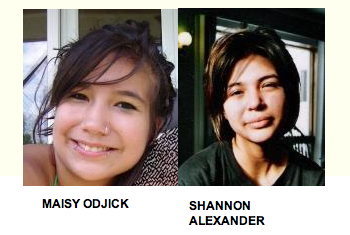
Maisy and Shannon

Photo borrowed from http://www.findmaisyandshannon.com

Today I started reading a book by Warren Goulding called “Just Another Indian.” I cried twice already. It talks about a subject that really gets to me every time I read or hear about: missing/murdered Aboriginal women.

Then, in another post on my FB feed and also repeatedly in my twitter feed, I see this link titled Police Study Link Between Sex Offender, Missing Girls.

I share the feelings with Laurie Odjick because I remember seeing these girls on television during the news casting. For a brief second. I remember thinking something similar to Ms. Odjick, If these girls were not Native, would the police investigative have been more exhaustive or media exposure increased? I remember seeing Maisy and Shannon’s pictures and remembered their faces and seeing this brief reporting on the news channel. I remember because I was scared. I remember thinking about my own safety. At the same time, I had just moved to London, Ontario on my own. No family. No friends. I really didn’t even have a place to call home. I didn’t know much about the missing of Maisy and Shannon or how or where they were first reported to have been missing because not much was reported. So, I had thought they had gone missing in Ontario. Apparently, they were just spotted in Ontario. I wish their pictures were shown in more places and for longer periods. I saw their pictures only twice since seeing their pictures on the news that day. Once on the television that day and another on the back of a transport.

You can read a letter that Laurie Odjick writes and you can just feel the frustrations pouring out through her words. You can read that letter HERE.

The book that I am reading right now talks about the lack of media exposure of the serial killer, John Martin Crawford, who raped and killed Native women. These women were reported missing to the police, police didn’t do much, and even when Crawford was on trial for admitting to killing the women he had killed, there was still very little media exposure. It makes me sad that this is still happening today in a completely different region in Canada almost 10 years ago? You would think that organizations and agencies would learn from the Crawford case.

It is a disgrace, like the article highlights, that young Aboriginal women are allowed to go missing at the present, alarming rates. Amnesty International even has their own campaign to help address this issue at an international level. You can check out the campaign called Stolen Sisters. I talk about this campaign in my post titled Globalization: The Further Oppression of Aboriginal Women. Even though the work that this organization is doing is great, it is still quite new and the latest reports that were generated in support of their campaign even mentioned that much of the previous and initial campaign’s initial report’s recommendations still need to be implemented.

So what can be done to help this particular? There is already a website set up to help raise awareness. You can check the website that was set up by the families of Maisy and Shannon, HERE. Donations have been sent and received and you can help donate to help find the Maisy and Shannon. The link to donate is HERE. Maisy and Shannon’s families have set this all up themselves. The family has done this all on their own time. Frustrated with the policing agencies. Frustrated with lack of accountability. Frustrated with lack of responsibility. The same feelings and similar situations that I read about in this book written by Warren Goulding.

It literally breaks my heart to read about this over and over again: young Aboriginal women going missing and almost nothing done by policing agencies/organizations–families are left to deal with the situation. Canada, it’s time to step up to the plate. First Nations people: you are failing them over and over again. I feel so helpless and I am not even related nor have I ever met Maisy or Shannon’s families or friends. I can only imagine what this woman and her family/friends are feeling or have felt.

Prays for the families/friends of Maisy and Shannon & to Maisy and Shannon ❤

As taken from the article in The Gazette: Anyone with information should call Quebec provincial police at 819-310-4141 or the Kitigan Zibi Police Department 819-449-6000. There is a $15,000 reward, offered by friends and family, for information that leads to their safe return.

John Ibbitson and Indians

Okay, so I was bit annoyed with a recent opinion piece that I read earlier today in the Globe and Mail. It was written by John Ibbitson, and apparently after I tweeted the link to the peice along with “many things wrong with this article,” I wasn’t the only one bothered by it. The opinion piece is titled “Dropout Chiefs Imperil a Generation of Kids.”

I write this post in hopes to explain exactly why I did not like this opinion piece. By the end of it, some might agree or some might say, “Well, everyone is entitled to their opinion and this is John’s opinion.” I hope that the latter will not occur because for some people the only knowledge that they have on First Nations people is from the major media outlets, and if media outlets are allowed to publish opinions like these, choice of words, choice of sentence structure and all, then it is downright absurd to say that we live in a country with media free of ignorance, stereotyping, or discrimination.

Let’s begin.

The first thing I do not like about the article is the title: Dropout Chiefs. This piece is written because of the fact that 230 First Nations chiefs are backing out of supporting the AFN’s most recent education panel. By using the term “dropout,” the piece is already giving the Chiefs a bad name.

Then, Ibbitson begins his article by calling out the Indian leaders as the culprits of “wrecking the best chance…to improve the miserable state of on-reserve schools.” I don’t think there could be any more negativity squeezed out onto the faces of those First Nations that choose to back out. The problem is not that First Nations leaders don’t want to improve the state of some of the schools on reserve. The problem is that they already know the problems of their schools; the only ones who do not know the extent is Ottawa. The panel is just another chance to “discuss” issues rather than take action on the issues. And yes, it is political but it’s not First Nations leaders trying to steal AFN National Chief’s spotlight. What is political about this all is that it’s Ottawa just putting on a fancy dress for a day, going out dancing, and then calling it quits–all just to say they did it because this piece still doesn’t say what the panel is meant to accomplish. In an earlier post titled Those Dayum Indians!, I write about the AFN education panel and mention it there first and state that “the article fails to mention what the panel was meant to accomplish.” I mean if you can’t write about what a panel is meant to accomplish and only talk about what is wrong with the other team, then what good is the panel anyways!

Ibbitson continues to talk about the “broken [First Nations] education system” as if to say that the non-First Nations education is what works. Well, it doesn’t and it hasn’t been working for years. Correction, decades. That is right, I said it: The non-First Nations education is NOT what works for First Nations students. Just look at the residential school system. It is these First Nations Leaders’ decisions not to support the panel because it is only discussing a band-aid solution for separate Nations within a larger Nation. Remember Ottawa and their party dress? All just to say they did it.

It may be a wrong thing to say as well, but the way I see this whole situation is just Ottawa forcing First Nations to collectively commit to something that individually they do not want to, and who gets called the Bad Indian in the end? The “Dropout Indian Chiefs.”

Continuing, Ibbitson talks about what is done with the federal government’s grants that are sent to reserves. He states, “with chiefs using the money as they see fit.” Well, I mean, he already cast the negative light onto chiefs by calling them dropouts and wrecking their “best chance to improve the miserable state.” So, one reading this who does not have any knowledge or background on First Nations may think that the chiefs will not use the money what it was sent to be used for: First Nations education. That is not the case. The money is sometimes used to invest into other educational initiatives. I cannot comment on those initiatives in this piece because those initiatives vary from First Nation to First Nation, and that is what key to understanding why those 230 First Nations leaders backed out–their needs for the nations differ and vary across the board.

Then in an fortunate-unfortunate situation, Ibbitson finally mentions the legacy of residential schools after calling the Chiefs “dropouts” and the First Nations education system “broken” in comparison to what? Non-First Nations aka White aka Canadian Education system?!? Not once is it mentioned in this piece that First Nations students need their culture, language, etc to be taught in the classroom to contribute to their success and help eliminate drop-out rates.

In this fortunate-unfortunate situation, Ibbitson talks about the force attempts of assimilation among a generation First Nations people, and he describes that system “dismantled and discredited.” What is especially wrong with this is that he has described the First Nations education system as “broken” earlier. Does this mean that the broken First Nations education system is equal to the dismantled and discredited residential school system? Ouch, Ibbitson.

Further, he describes this residential school era having left First Nations leaders having “suspicion” against education or “anything associated with the federal government.” Does this mean that First Nations leaders are against education entirely and any contact with the federal government at all? No. Ask any First Nations leader and they will say that the only way to improve the state of Aboriginals within Canada is through education. They will also say that it is not that they do not want to work with the federal government, rather they just want to be consulted with–Thought of as an equal in leadership in Canada. What First Nations leaders are against are any further attempts for Ottawa to take First Nations children out of their culture and way of life.

The generation of children are not being lost because First Nations leaders chose to back out. In fact, it is because those First Nations leaders that backed out that another generation of First Nations children will not be lost to further federal government decisions or legislation. These decisions to back out is about self-determination and having control over their own path to education, and I commend Chief Atleo for stating that “each region and each nation is welcome to craft its own solution [and that] no one, least of all the AFN, wants to see native leaders lose control of First Nations education.”

So I ask again, what was meant to be accomplished by holding the panel. It would be nice to have that talked about in these articles and opinion pieces rather than the “Dropout Chiefs.”

Why I am happy those FN backed out of the AFN education panel

So, I read this article on Indian Country Today titled Canada’s Aboriginal Education Panel in Place earlier today.

I was doing a bit of reading and trying to find out more about this proposed education panel. I wanted to find out 2 things:

  1. Who was supposed to be on it
  2. What was it meant to do How was this going to influence changes to Aboriginal education essentially

After reading this article, I found out that well, the panel was chosen in conjunction between the 2: AFN and Canadian Government. Good work. Then in the same article, National Chief Atleo is quoted saying,

“Our shared goal in this work is to dialogue with First Nations and other key players to advance a plan to implement sustainable solutions that put the success of First Nation children front and center,”

Okay really great. Unfortunately in that article, it only mentioned 3 people listed on the panel. Of those 3 people, not a single one was a youth. I know that the AFN has a youth council. Why wasn’t a youth rep included in that panel? I mean given that the issue is Aboriginal drop out rates or disenfranchisement, and central to those issues are youth. Wouldn’t a voice for the youth or at least some youth involvement be considered a key player in all of this? Because at Atleo says “plan to implement sustainable solutions that put the success of First Nations children front and center.” Who better than to include than a youth rep if not a few? Or maybe, the youth council would have been in attendance. Who knows?

That is all I have to say about this Aboriginal education panel.