Author: kwetoday

PM Harper = Honorary Chief Harper?!

Today, I read a few tweets on my twitter feed claiming that PM Harper was named an “Honorary Chief of the First Nations Blood Tribe in Alberta”. I didn’t believe it until I actually saw PM Harper tweet it himself Wait! Why am I even following PM Harper?! (Well I am not so sure about him actually tweeting it HIMSELF or some intern or student hired for the time being, but you get my point).

Cray-cray-craziness!

Then I noticed that he was given this title because of his 2008 residential school apology.

The article reads:

The honorary Chieftainship was requested by Blood Tribe Chief Charles Weasel Head in response to the heartfelt apology in 2008 by the Prime Minister to former students of Indian Residential Schools.

So what does this exactly mean then? Being given the opportunity to be named an “Honorary Chief.” The article further states:


Honorary Chiefs are expected to help promote the cultural pride of the Blackfoot and Kainai and all First Nations. They are expected to maintain the headdress with the highest respect and be an available resource to First Nations.

I don’t even know what this all means. Hmmm, do you think other nations should follow suit?

To read the 2008 residential school apology given by PM Harper himself click HERE.

To view the Truth and Reconciliation Commission of Canada website click HERE.
CANDO? Can you?

The website reads:

Do you know an individual between the ages of 18-35 making a difference in your community? If so, this is your opportunity to share their achievements by simply nominating him or her for the 7th National Youth Panel. Please find all eligibility requirements and nomination details available for download below. Contact the CANDO office at cando@edo.ca or by calling 1-800-463-9300 if you have require any further information.

I had the opportunity of being on this panel when it first started. A few years later my little sister sat on the same panel. If you know a young Aboriginal, I suggest you nominate them! This is a great opportunity for anyone.

Good luck to all nominations!

To visit the CANDO website CLICK HERE. (The nomination form is on the same website).

Games we used to play

This post is inspired by a girl I met at school and her blog. Her name is Alysha Li (Ironically, same name as my little sister) and her blog can be seen HERE.

She sent me a message on Facebook telling me about her most recent adventures and that she had started a blog. She is running summer camps for kids on reserves in Northern Ontario with Frontier College. The only thing I have to say is … Cool, and that I wish I could have that opportunity!

I read her blog and it was an interesting read. She wrote a post on the cost of certain items on the reserve. That post on her blog is titled “Day 9 Preparation.” Some of these item in her list included:

Medium block of cheese – $15
2L milk – $9
4 pieces of chicken breasts – $16
Bag of grapes – $10
1 Apple – $1
3 bell peppers – $8
Bottle of shampoo – $12

I thought to myself, “Where’s the klik or the spam?” Yeah, if you are First Nations and you grew up on a reserve you might know what I am talking about. If you don’t know, you are lucky. Trust me, Natives knew about spam before email was ever invented. Joking 😉 It’s not the same kind of spam!

Anyways, there is another post titled “Day 10: Canada Day.” In this post she describes how people are willing to do good things for anyone regardless of who they are and that reminded me of how much I miss home. If you ever want a true sense of community, go to any First Nations community. Yes, some First Nations are more divided than others and some more close-knit than others, but in the end when something needs to be done to help one another–it gets done.

In this same post, she talks about how the one task they were assigned to do. Then when time came to actually complete the activity, she knew the importance of her minute task of blowing up balloons.

Alysha writes

“It was really magical to see how just a few hours of blowing up balloons can bring so much happiness to the whole community.”

It reminded me of my sisters and the games we used to play. Literally, we would make toys out of anything and make entire games from just brown paper bags. I believe we even have pictures of us playing this said-game with brown paper bags–trust me, best game ever and I would still play it today.

Some of the games we used to play didn’t even require us to gather anything or make anything–just pick a color and wait for that color of car to drive.

These memories made miss home and reading what this one person had to write about while working on these summer camps for kids on reserves just made me realize that much more how lucky I am to have had the childhood I did and the memories I am able to remember–especially the ones with my family.

Rape

There is something strange about this word. Rape. I never used it before. Not even after the first time. Yes, that is right. It happened more than once.

I have a hard time saying the word. Even when I just talk about it. Even when I write about it right now, I have a hard time saying it. Can’t you count how many times I used the word “it” instead of the word “rape.”

It makes me feel uncomfortable talking about it. In any setting. A personal setting. In a classroom setting like it was brought up for discussion a few times this past school year. I worry what people might think of me when I say “I was raped.” Things like, will they think I am a slut? Will they think I am easy? Will they think I am dirty? Things that I shouldn’t even have to think about.

But you know what, when a female gets raped today some have gone so far as to blame the female. They say things like “She asked for it because she dressed like a slut” or “She was easy anyways. She is probably lying” even “She is dirty, slutty AND easy, what do you expect?” You would think that I might be the one scared to be raped again, but I am not. Fortunately, I have built up a good support network today. A positive, loving support network.

Unfortunately, I am more scared of what people might say about me or how people might think of me as a person–not just a female, but a person. And that is what should be on anyone’s mind when it comes to survivors of rape: Why are we still blaming the victim?

Bad Sugar: Water Rights and Diabetes in Arizona

Here is a short clip of the film “Bad Sugar” that I had the opportunity to watch tonight. The University of Western Ontario Indigenous Health and Well-Being Initiative was able to bring in the filmmaker who is also an Ojibwe/Metis. His name is James Fortier.

This documentary is unique in a sense that it talks about the “social determinants of health.” Things like poverty, low income, unemployment, education and how it may contribute to “bad health.”

It also uses the word “Genocide” where apparently I learned tonight that in the USA this term is not allowed to describe the historic relationships between the Indigenous people and white new-comers. Just another fine example of how history is told through the eyes of the non-Natives/white people.

I could not find a full clip of this film but I urge anyone who is able to have to opportunity to see it, to go and see it.

Diabetes is not just an issue here in Canada for Indigenous peoples, but all over North America aka “Turtle Island.”

Check out the documentary’s website HERE.

Check out the filmmaker’s website HERE.

Dear Drugs

Dear Drugs,

I hate you. Yes, that’s right. I. Hate. You. Some people say that “hate” is a word much too strong to use, but if there was a word with much more stronger meaning for how I feel for you…I would use it.

You have stolen the souls of some of my friends. Heck, even some the souls of my friends’ friends. I will even admit, you were once my friend. There were at times you made me feel no pain. No tears. No memories. No anger. No hate.

Now that I have grown, I am not afraid anymore. Not even one little bit. Especially not even worried that I might lost a few friends based on my opinion about you and especially not even worried to tell the world that I hate you.

Note: This post is written after seeing the numerous tweets and facebook updates that my friends have posted/shared regarding loss of their friends. Prayers to those who lost anyone to drugs/alcohol and prayers to those who need help to get past using these substances. Below is a video I love and thought it went well with the post because really… The drugs don’t work.

Who do you stand for?

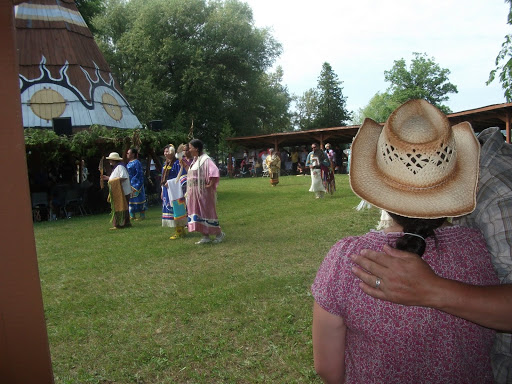
Today, I was able to attend a traditional powwow right after the youth gathering here on Manitoulin Island. I used to come to this powwow with my family all the time as a child. Moving away, I will admit I have not been able to practice my culture every single day, but I do when I can. In this picture here, this is the women’s traditional exhibition dance. The MC announced that we must stand. I knew this.

However, there are some non-native spectators that do not know this. Some non-native spectators stand and some don’t. If I try to tell one or two that they have to stand, sometimes they do without any questions and sometimes the look around and notice one or two others not standing. So they don’t.

You can see in this picture. The Traditional adult women dancers. The couple ahead of me is standing. Standing right behind them I thought, “I am proud of my culture because here everyone is standing. Honouring the women.” Then I thought about this even more. In Canadian culture, everyone else some people stand for one or two people who have done nothing for Canada except introduce a few laws or by the mere fact that they were born into the right family. **Ahem, PM Harper & Royal Family**

By the end of the song, I was proud to be standing for the women who were out there dancing.

But then it made me wonder outside of my culture, who everyone else was standing for and why?

Things I learned at the True Roots Youth Gathering…

  • Aboriginal people are the strongest of the strongest. We have survived genocide, cultural genocide, attempted assimilation… Guess what? We are still here. Alive and strong.


  • Aboriginal youth care. More than you think. The ones who do care make serious efforts to change what is happening to their nation, but they know they face many challenges. They just need to know that they are not alone in this fight. You/Youth belong!
  • Aboriginal Youth want to learn their culture and their language. And those who don’t want to or don’t seem to care are the ones who need it the most. Those youth are willing to help make changes today and now to help future youth.


  • Some Aboriginal youth don’t have the support in the family home to help bring positive change to their communities/nation. But they still need support.
  • An Aboriginal youth said, “History books tell lies” in one workshop. But together, they all want that to change.


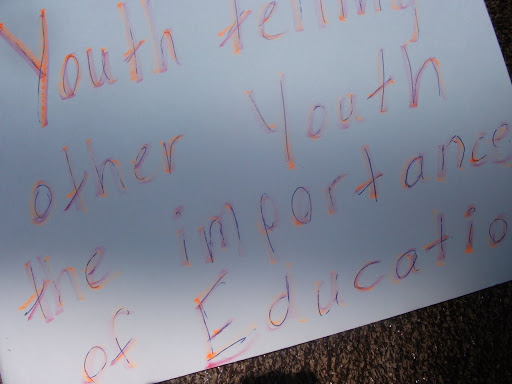
The above are just a few images of the words that the youth had written at the gathering I attended this week. Later, I will try to post more or at least them all. I decided to share these few words and things I learned at the conference because it is important to know that Aboriginal youth care.

They care today. They cared yesterday. And they will continue to care.

Who ever said Aboriginal youth didn’t care or that Aboriginal youth are apathetic, didn’t open their eyes, ears, or hearts.